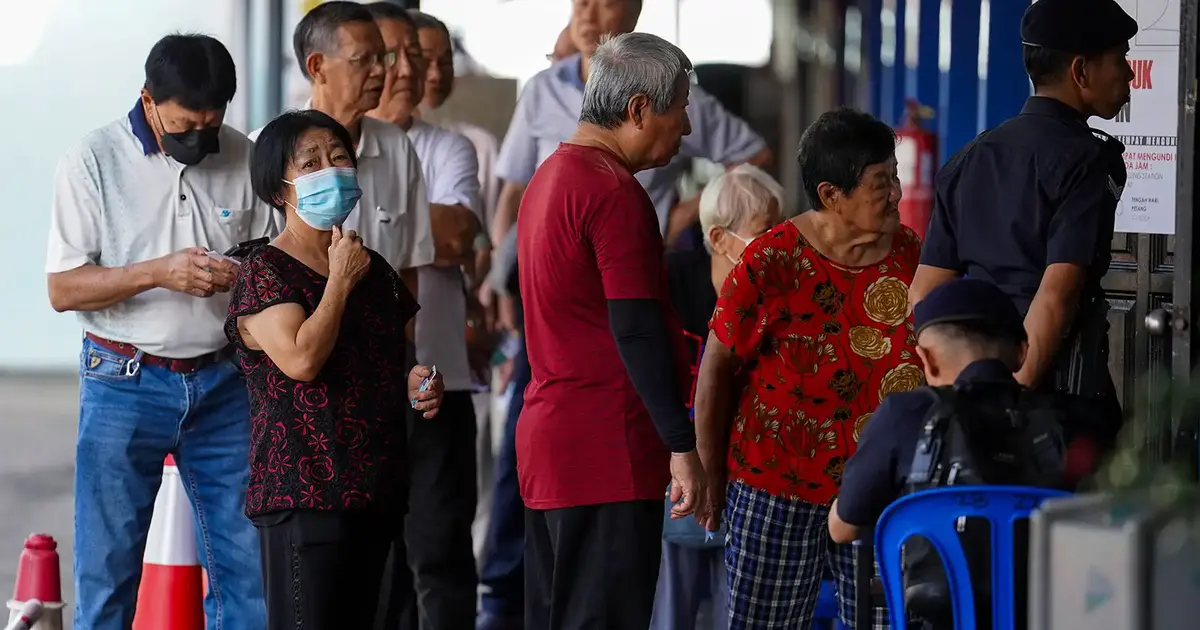
Pakatan Harapan's disappointing performance in the Johor state election cannot be attributed to Chinese voters wholesale abandoning the coalition in favour of Barisan Nasional, according to former Bangi MP Ong Teng Cheong. Rather, the coalition's losses reflect a more complex electoral dynamic centred on depressed participation rates among Chinese voters in the state. Ong's analysis, based on ground-level observations and electoral data, suggests that voter disengagement posed a greater threat to PH's competitiveness than active defection to BN.
The timing of this assessment proves significant for Malaysian opposition politics. The Johor election represented a critical barometer for Pakatan Harapan's standing in a state where it had never held power but where it sought to demonstrate renewed momentum. The state's substantial Chinese population—distributed across urban and semi-urban constituencies—has traditionally served as a bellwether for broader ethnic voting patterns affecting federal electoral prospects. Understanding the precise mechanics of PH's setback therefore carries implications extending well beyond Johor's borders.
Ong's contention directly challenges narratives suggesting that Malaysian Chinese voters have fundamentally repositioned themselves within the political landscape. Such assertions, frequently deployed in post-election analysis, can oversimplify the distinction between passive non-participation and active vote-switching. The former Bangi MP's reading suggests that turnout represents the more compelling explanatory variable. This distinction matters considerably because addressing apathy requires different strategic responses than winning back supporters genuinely committed to competing coalitions.
Lower voter participation among Chinese communities in Johor likely reflects multiple causative factors worthy of deeper examination. Disillusionment with political offerings, concerns about specific policy areas, or simple electoral fatigue may have combined to dampen enthusiasm for participating. The Covid-19 pandemic's lingering effects on public confidence in institutions, alongside Malaysia's protracted political instability during the period preceding the Johor election, may have contributed to abstention among voters typically more sensitive to governance quality issues.
The distinction Ong drew between turnout decline and direct vote transfers holds particular relevance for Malaysia's political future. If Chinese voters are predominantly choosing non-participation over BN endorsement, this creates different tactical problems for Pakatan Harapan than if they were actively shifting allegiance. A turnout crisis can potentially be reversed through renewed engagement and credible messaging, whereas recovering voters who have genuinely committed to alternative coalitions presents a far steeper challenge. The opposition coalition's strategic calculus must therefore account for this more nuanced understanding of its electoral foundation.
Geographically, Johor's position as Malaysia's southernmost peninsula state adds another layer of complexity. The state occupies a unique space in Malaysian politics, historically competitive but never comfortably within either PH or BN's firm grasp at state level. Chinese voters in Johor, particularly in constituencies such as Kota Tinggi, Pekan Nenas, and Bakri, frequently occupy the decisive middle ground in three-cornered contests or closely contested two-way battles. When such voters disengage, the arithmetic shifts decisively against whichever coalition struggles to mobilise its core support base.
Ong's analysis also implicitly addresses questions about Chinese voter sentiment toward specific PH component parties. The Democratic Action Party, historically the coalition's strongest performer among Malaysian Chinese, may have faced particular challenges mobilising its constituency without clarity regarding its national political direction and role within opposition structures. The former Bangi MP's emphasis on turnout rather than defection suggests that the gap reflected organisational capacity and voter motivation rather than fundamental ideology realignment.
The opposition coalition's performance in predominantly Chinese constituencies across Johor in the recent election warrant scrutiny alongside the national popular vote. Examining whether PH retained competitive standing in these areas despite lower turnout, or whether it lost ground even among participating voters, would clarify whether the coalition faced purely mechanical participation problems or deeper persuasion challenges. Ong's interpretation suggests the former scenario predominated, though individual constituency results likely demonstrate variation.
For Malaysian politics more broadly, this assessment carries implications for federal-level strategy and opposition coalition cohesion. Chinese voter participation rates have historically influenced overall election outcomes, particularly in states where ethnic demographics create tight margins between winning and losing coalitions. Should PH successfully re-energise participation among Chinese voters without requiring policy concessions that alienate other communities, the coalition could substantially improve its electoral standing.
Ong's observations also reflect broader conversations within opposition circles regarding coalition messaging and ground organisation. Building turnout requires sustained community engagement, effective communication of political platforms, and demonstrable connection between electoral participation and improved governance. The former Bangi MP's implicit argument suggests Pakatan Harapan must invest more substantially in these foundational activities before pursuing sophisticated arguments about policy differentiation.
Looking forward, the Johor result, properly understood through Ong's interpretive lens, presents the opposition coalition with both warning and opportunity. The warning stems from demonstrated capacity to lose competitiveness among crucial voter constituencies through organisational failure. The opportunity lies in the theoretical reversibility of such dynamics—turnout can be rebuilt, engagement re-established, and participation normalised through sustained effort and credible political delivery.

