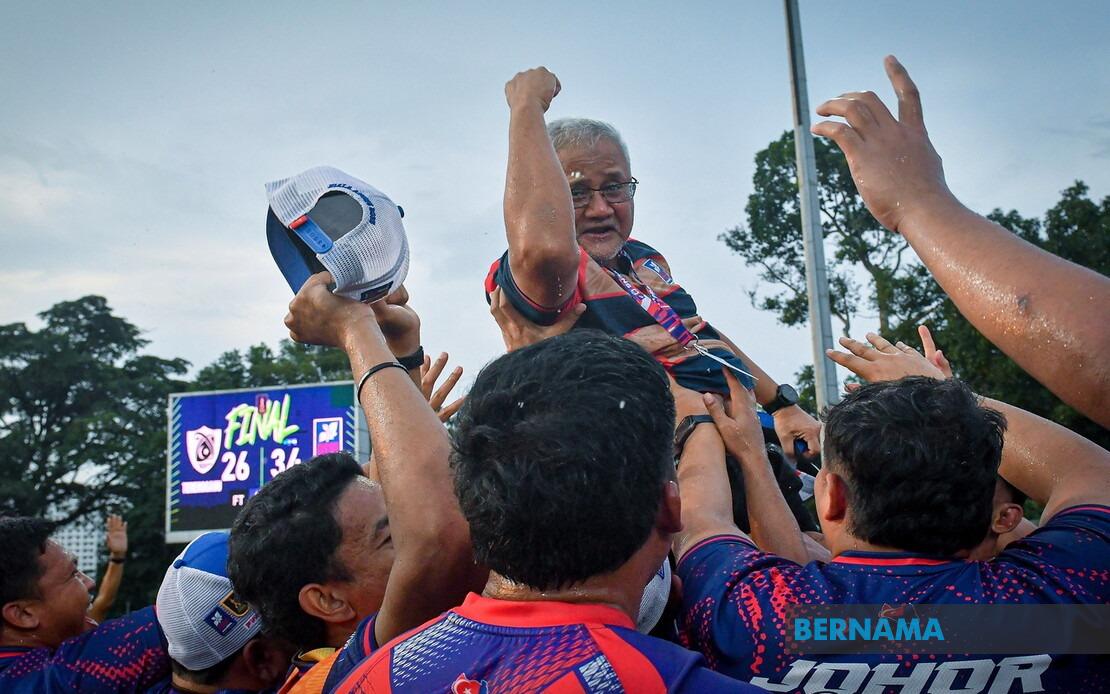
The Johor rugby squad achieved a significant milestone on Saturday at the Universiti Teknologi MARA Stadium in Shah Alam, capturing the Agong's Cup title with a hard-fought 34-26 victory over Terengganu in the championship match of the 42nd edition. The triumph represents a watershed moment for the state's rugby programme, which had been waiting since 2017 to reclaim the prestigious trophy that forms a central part of Malaysian domestic rugby competition.
The final delivered the kind of dramatic narrative that defines major sporting contests. Terengganu emerged as a formidable challenger, establishing commanding momentum early in the contest and entering the interval with a narrow 19-17 advantage. The advantage suggested the match would remain tightly contested throughout, with either team capable of securing victory. However, Johor's coaching staff and playing group demonstrated the composure and resilience required at elite levels of sport, regrouping during the break and implementing tactical adjustments that fundamentally shifted the contest's trajectory.
The second half proved transformative for Johor's campaign. Building from their halftime position, the team mounted a sustained offensive push that overwhelmed Terengganu's resistance. The successful comeback showcased not merely superior fitness or technical ability, but also the psychological strength necessary to overturn a deficit against quality opposition. By maintaining discipline and converting opportunities created through structured play, Johor accumulated points at a rate that proved insurmountable for their opponents, ultimately prevailing by an eight-point margin.
This championship represents Johor's third Agong's Cup title in the tournament's recent history. The state previously claimed the honour in 2013, establishing themselves as a programme capable of competing at the highest levels of Malaysian rugby. However, the intervening years between 2013 and the current triumph indicated that sustained excellence requires continuous investment in player development, coaching expertise, and organisational infrastructure. The nine-year gap since their last victory in 2017 demonstrates the competitive nature of domestic rugby, where consistency across multiple seasons remains elusive even for well-resourced programmes.
The parallel narrative of Saturday's tournament unfolded in the third-place playoff, where Kelantan produced an equally compelling performance against Royal Malaysia Police. The encounter between these two conventional powerhouses proved remarkably tight, with Kelantan eventually prevailing 43-41 in a match that showcased the exceptional standard of rugby being played across Malaysian states. This contest highlighted the depth of talent available within the domestic competition, with multiple teams capable of performing at championship-calibre levels.
The financial structure of the tournament reflects the investment placed in recognising excellence across all participating teams. Johor received RM20,000 in prize money for their championship success, while Terengganu collected RM15,000 as runners-up. Kelantan's third-place finish earned RM10,000, and PDRM secured RM5,000 for their fourth-place effort. These sums, whilst modest by international sporting standards, represent meaningful recognition of achievement within Malaysia's domestic rugby ecosystem and provide state unions with resources to support their ongoing development programmes.
Individual excellence was acknowledged through the player-of-tournament award, with Johor's Aqasha Daniel Irwan receiving recognition for his outstanding contributions throughout the competition. The accolade carried RM1,000 in prize money and a commemorative plaque, highlighting how prestigious tournaments extend recognition beyond team achievement to celebrate individual performances that materially influence outcomes. Irwan's selection suggested he demonstrated consistent excellence across multiple matches, providing standout contributions that significantly enhanced Johor's path to the championship.
The Agong's Cup occupies a distinctive position within Malaysian rugby's competitive hierarchy. As a tournament bearing the name and patronage of Malaysia's paramount ruler, it carries considerable symbolic weight beyond its sporting dimensions. Victory in this competition represents more than conventional tournament success; it carries cultural significance as an achievement endorsed at the highest levels of the nation's institutional framework. This context amplifies the achievement for Johor and provides additional lustre to their triumph.
For Malaysian rugby administration and state unions, the tournament's successful staging at UiTM Stadium demonstrated the viability of hosting major domestic competitions within the country's educational sporting infrastructure. The venue accommodated the various matches and provided adequate facilities for teams, officials, and spectators, suggesting that university campuses remain suitable environments for competitions of this calibre. This approach offers practical and financial advantages that support the sustainability of domestic rugby competition.
The implications of Johor's success extend beyond immediate championship glory. The victory signals to other state rugby programmes that sustained investment and strategic planning can yield tangible results, whilst also providing momentum that typically influences player recruitment, sponsor engagement, and community interest. For Johor rugby, the championship represents validation of their development pathway and establishes them as contenders for future editions of the Agong's Cup and other significant domestic competitions throughout Southeast Asia's rugby region.

