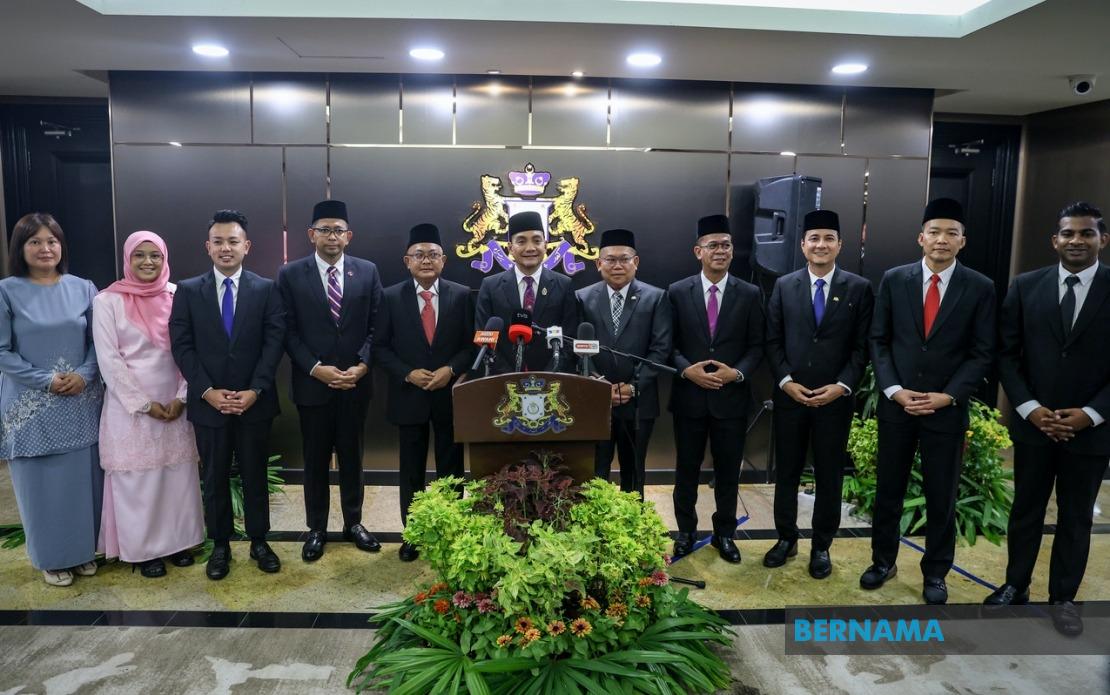
The Johor government has moved to bolster its education administration through the appointment of V. Rugendran as deputy chairman of the State Education and Information Committee, a structural decision intended to enhance coordination across multiple education-related agencies and initiatives. The appointment came as part of a broader administrative restructuring announced by Johor Menteri Besar Datuk Onn Hafiz Ghazi, who unveiled 10 deputy chairman positions across various state government committees to reinforce the administration's capability to tackle public concerns and expedite implementation of development programmes.
Dr Muhammad Naqib Md Ghazali, the committee chairman, characterised the appointment as a necessary step to distribute responsibilities more efficiently within his sprawling portfolio. Speaking at the Johor Education and Information Committee Chairman's Aspiration Ceremony held at the Johor Talent Development Council office in Kota Iskandar, he explained that introducing a deputy would facilitate delegation of tasks and enable the committee to operate as a cohesive unit rather than relying on a single point of decision-making. The measure reflects contemporary best practices in state administration, where division of labour within senior committees can accelerate response times to educational challenges and community needs.
The significance of this appointment extends beyond mere administrative convenience. With education serving as what Dr Muhammad Naqib describes as the core pillar of his portfolio, the added capacity from a deputy chairman will allow the committee to pursue multiple strategic objectives simultaneously. The committee oversees several major initiatives including the Sekolah Rintis Bangsa Johor programme and the expansion of the Johor Talent Development Council, both of which demand sustained attention and careful implementation. By distributing these responsibilities, the committee can now maintain momentum across different fronts without compromising quality or accountability.
For Malaysian education watchers, this development carries broader implications about how state governments are adapting their administrative structures to meet mounting expectations around service delivery. The Johor model of introducing deputy chairmen across multiple committees suggests a recognition that the volume and complexity of modern governance—particularly in sectors like education that touch millions of lives—requires more distributed leadership. Rather than concentrating decision-making authority, the state is experimenting with shared responsibility frameworks that encourage faster problem-solving and more frequent public engagement.
Dr Muhammad Naqib's emphasis on the committee's ability to engage with and listen to more people through this arrangement highlights an often-overlooked benefit of administrative restructuring. When leadership teams are better organised internally, they can allocate time for genuine public consultation rather than becoming bogged down in internal coordination meetings. This is particularly important in education, where stakeholder feedback from teachers, parents, students, and community leaders drives the effectiveness of policy implementation. The deputy chairman structure potentially creates space for this kind of outreach.
The timing of these appointments also deserves attention given the broader political and administrative context in Johor. Menteri Besar Onn Hafiz's initiative to strengthen committee structures across the state government suggests a deliberate effort to demonstrate governance improvements and responsiveness. For Johor citizens and observers, this signals an administration intent on proving that recent political transitions have not diminished governmental effectiveness. Instead, the new leadership is actively restructuring to enhance it, at least on paper and in initial announcements.
The emphasis placed by state leadership on inclusive service delivery—serving people regardless of race or religion, as Onn Hafiz reminded appointees—reflects sensitivity to Malaysia's diverse society and the particular importance of that principle in a state like Johor, which has significant Indian and other minority communities. Dr Muhammad Naqib's reiteration of this principle suggests that education policy under his watch will need to account for varied demographic needs across Johor's districts. A deputy chairman with experience in diverse communities could prove valuable in ensuring that education initiatives reach beyond majority populations.
The mention of developing a resilient generation of Bangsa Johor points toward a particular educational philosophy gaining traction in the state. Rather than focusing narrowly on academic metrics, there is a stated intention to build students capable of confronting future challenges. This requires sustained, strategic thinking about curriculum, teacher development, and institutional capacity—the kind of comprehensive work that benefits from internal administrative support structures like a deputy chairman role. It is not merely ceremonial but potentially substantive in enabling this broader vision.
For the Johor education sector itself, the appointment of someone like V. Rugendran to the deputy role carries practical significance. The committee will now have two senior leaders available for stakeholder meetings, policy discussions, and crisis management. In a state where education serves multiple roles—academic achievement, social integration, economic preparation—having doubled leadership capacity could make measurable differences in how quickly issues are diagnosed and addressed. Teachers facing resource constraints, schools seeking policy clarification, or communities with educational grievances may find more responsive pathways to redress.
The broader context of administrative reform in Johor also reflects Southeast Asian trends toward more professionalised state governance. Other Malaysian states and regional governments have experimented with similar deputy structures, recognising that complexity in modern education requires more than individual leadership. This positions Johor as part of a wider conversation about effective governance architecture in the region.
However, the real test of this structural change will come in implementation. The appointment alone does not guarantee improved outcomes; much depends on how V. Rugendran and Dr Muhammad Naqib Md Ghazali define their respective roles, how they divide responsibilities, and whether they genuinely empower each other or create parallel hierarchies. The coming months will reveal whether this represents genuine reform or primarily a symbolic gesture aimed at demonstrating administrative dynamism.

