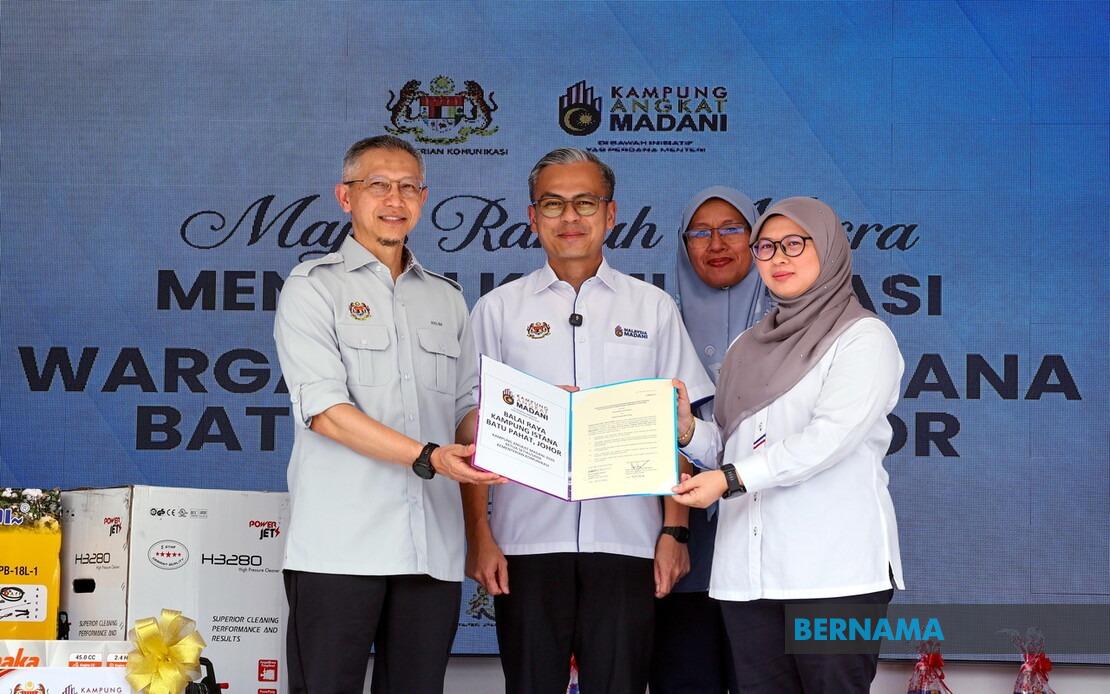
The 16th Johor State Election represents a straightforward choice about governance and progress rather than a vehicle for settling scores or endorsing individual agendas, according to Communications Minister Datuk Fahmi Fadzil. Speaking during a campaign walkabout in Batu Pahat on July 4, Fahmi pushed back against framing that ties a potential Barisan Nasional victory to public sentiment toward a former prime minister, characterising such linkages as misguided attempts to distract voters from substantive policy considerations.
Fahmi's remarks came in response to comments by Datuk Nazifuddin Mohd Najib, who suggested that a BN win would constitute public backing for his father, Datuk Seri Najib Razak, to receive a presidential pardon. The Communications Minister expressed concern that such narratives could cloud voter judgment and undermine the legitimate purpose of elections—to select competent stewards of public resources and architects of future prosperity. Rather than debating whether the electorate endorses particular individuals or their legal predicaments, Fahmi argued that discussion should centre on which coalition or leader can genuinely deliver improvements to Johor residents' quality of life.
The minister's campaign message reflects broader anxieties within Pakatan Harapan about the durability of electoral support, particularly among urban and non-Malay constituencies. When questioned about assertions that non-Malay voters no longer constitute a reliable voting bloc for the Democratic Action Party, Fahmi conceded that no political organisation should assume public favour is unconditional or permanent. This acknowledgment underscores a fundamental vulnerability facing any ruling coalition: the electorate's willingness to withdraw support if parties fail to address their priorities or if external developments alter perceptions of competence and trustworthiness.
Fahmi emphasised that voter allegiance must be continuously cultivated through demonstrated performance and responsive governance rather than taken as an inheritance. He suggested that when voters encounter rhetoric that triggers apprehension—such as claims framing an election as a proxy for validating controversial figures—many citizens recognise the implications and reassess their political calculations. This reframing positions electoral choice as consequential not merely for individual constituencies but for the nation's trajectory, potentially mobilising voters who might otherwise view Johor's election as a regional matter of limited personal relevance.
A significant dimension of Pakatan Harapan's campaign narrative concerns defections and cross-party endorsements, which the coalition interprets as evidence of eroding confidence in traditional power structures. Fahmi highlighted the public backing extended to PH candidates by figures with prior affiliations to opposition parties, particularly noting former Rengit assemblyman Datuk Dr Mohd Puad Zarkashi's decision to support a PH candidate despite long-standing associations with UMNO and Barisan Nasional. Such developments suggest that the political landscape in Johor is more fluid and unpredictable than historical patterns might suggest.
The shift represented by Puad Zarkashi's endorsement carries symbolic weight beyond his individual status. For decades, Johor functioned as UMNO's most dependable stronghold, where the party's dominance seemed institutionalised and virtually unassailable. Should Pakatan Harapan succeed in converting such figures or fragmenting UMNO's traditional support base, the implications extend beyond this single election. The minister framed these developments as evidence that even putatively solid political blocs can fracture when voters detect insufficient attention to their concerns or become disillusioned with existing leaderships.
Cross-party solidarity among opposition figures appears particularly pronounced in contests like the Rengit state seat and Sri Medan, where Bersatu members reportedly mobilised behind PH candidates. These alignments reflect tactical calculations by smaller parties and independent politicians who may perceive greater utility in supporting a resurgent Pakatan Harapan than maintaining marginal positions within or alongside BN. Such coalitional dynamics can amplify PH's organisational reach while creating perceptions of momentum that influence subsequent voter behaviour.
Fahmi attributed some of this emerging support to confidence in Prime Minister Anwar Ibrahim's leadership, particularly his administration's economic stewardship. The minister connected voter preferences to tangible outcomes, arguing that confidence in the federal government's handling of economic recovery and development translates into electoral advantage for the ruling coalition at state level. This logic assumes voters evaluate elections through a lens of economic performance and forward-looking competence rather than through retrospective or personal considerations. Whether this calculus dominates voter decision-making remains uncertain, particularly if inflation, unemployment, or perceptions of unequal development persist.
The 16th Johor State Election encompasses 56 contested seats across 172 candidate nominations, reflecting the state's significance within Malaysia's federal structure. Scheduled polling on July 11 follows early voting on July 7, providing both campaigns limited time to consolidate messaging and mobilise supporters. The compressed campaign period may advantage established coalitions with stronger organisational infrastructure while disadvantaging fragmented or poorly resourced challengers.
Fahmi's framework—positioning the election as fundamentally about governance rather than individual vindication—represents a deliberate rhetorical strategy aimed at elevating the contest beyond personality-driven narratives. By insisting that voters should evaluate coalition platforms and leadership vision, Pakatan Harapan seeks to direct attention toward policy commitments and administrative records. Whether this framing resonates depends partly on whether voters share the coalition's assessment that substantive governance questions should dominate their decision-making, or whether competing concerns about representation, identity, and judicial processes exercise greater influence on electoral behaviour.

