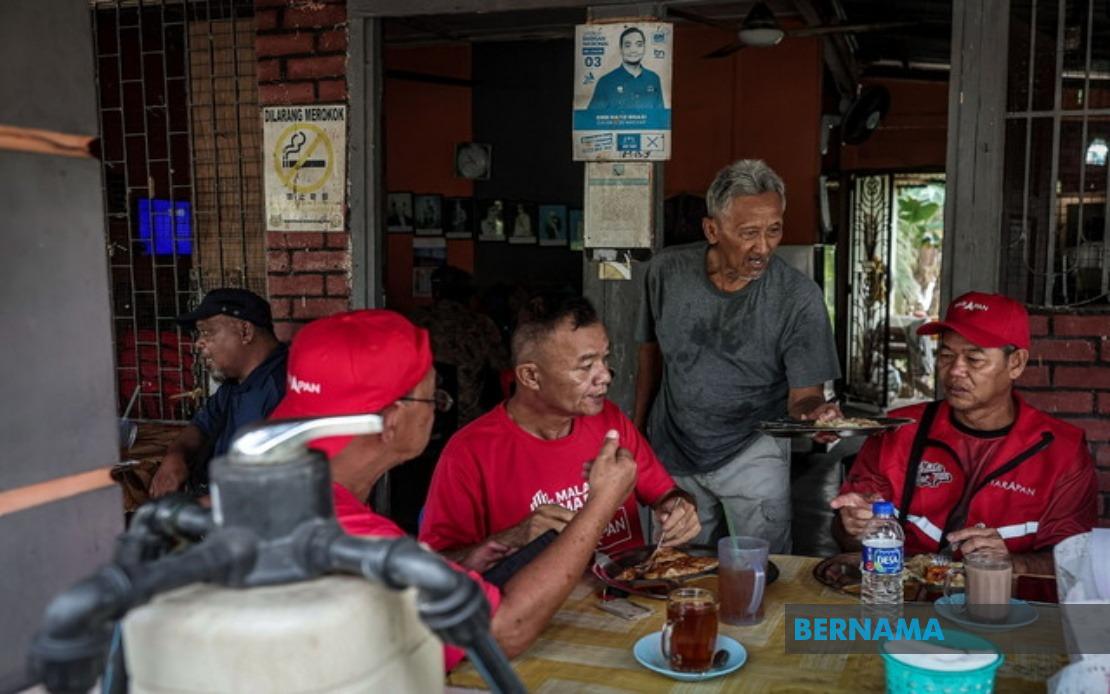
The Johor State Election, scheduled for July 11, is generating unexpected economic benefits for humble food traders and small business operators throughout constituencies like Layang-Layang and Simpang Renggam. What has traditionally been viewed as purely a political exercise has inadvertently created a seasonal economic spike that is proving transformative for informal sector workers who operate on thin margins. The influx of campaign workers, candidate entourages, and politically engaged visitors has fundamentally altered consumption patterns in these communities, creating a temporary but meaningful boost to household incomes for traders who have often struggled with unpredictable daily revenues.
In the Felda Layang-Layang settlement, 70-year-old Noorma Zafmeeden operates a modest warung alongside her 76-year-old husband Bahari Madiran, a couple who have called the area home since 1987. Their establishment, which typically serves roti canai and nasi lemak during morning hours before pivoting to fried dishes in the evening, has witnessed a striking transformation in fortunes. Where ordinary trading days would yield less than RM400 in morning sales alone, the election campaign period has fundamentally altered this trajectory. The couple's experience reflects a broader pattern affecting dozens of similar operations across the state, where seasonal political activity translates into genuine livelihood improvements for operators working in Malaysia's largely informal food service economy.
The dynamics at work reveal deeper patterns about how electoral processes intersect with economic activity in Malaysia's smaller towns and rural settlements. Campaign machinery requires sustenance—workers need meals, candidates conduct walkabouts near food establishments, and the general elevation of political consciousness draws people outdoors to witness campaign activities. This creates cascading demand at the very grassroots level where informal traders operate. For Noorma and Bahari, the election season represents something more nuanced than merely increased transaction volume. They describe their warung as a space where community cohesion materialises through food, where customers from different racial and religious backgrounds gather in what they perceive as harmonious co-existence. The political season amplifies this social function even as it improves financial returns.
The experience of Ahmad Ridzuan Awang, a 45-year-old nasi campur operator in Simpang Renggam, provides quantifiable evidence of the commercial transformation occurring across Johor's trading landscape. His operation typically relies on gradual sell-through of prepared dishes throughout the day, with inventory clearing by evening on successful trading days. The election campaign has compressed this timeline dramatically, with bulk orders from various political parties and campaign teams exhausting his daily stock by early afternoon—a situation unthinkable during non-election periods. This acceleration of sales cycles has profound implications for cash flow, inventory management, and the psychological satisfaction that comes with complete daily stock rotation. For small operators operating without formal credit lines or financial buffers, this represents genuine economic relief during a compressed but intense period.
The broader economic spillover effects extend beyond individual food traders into the surrounding commercial ecosystem. Suppliers of raw materials, packaging providers, and related service providers in these localities benefit from the elevated demand signals radiating from food establishments experiencing election-driven surges. Ahmad Ridzuan explicitly acknowledges this phenomenon, describing what he terms "political tourists"—campaign participants and engaged citizens who visit constituencies during election periods—as catalysts for commercial revitalisation that extends beyond food service into adjacent business sectors. This multiplier effect, though temporary, demonstrates how concentrated political activity can momentarily restructure local economic patterns, creating opportunities for previously struggling businesses to improve their financial positions.
Understanding the Johor election context provides essential framing for these economic developments. The 16th Johor state election involves 172 candidates contesting 56 assembly seats, representing competitive races across numerous constituencies. With polling scheduled for July 11 and early voting commencing July 7, the campaign window creates a defined period during which political activity concentrates intensely within specific geographic areas. This concentration differs markedly from the diffused economic activity of ordinary periods, making the election season a genuinely distinctive phenomenon for local traders. The temporal specificity—knowing the election falls on a particular date—allows traders and suppliers to mentally prepare for this predictable surge, though the magnitude and duration remain somewhat uncertain.
For Malaysia's informal economy, which encompasses hundreds of thousands of small traders, hawkers, and street-food operators, such periodic boosts address a persistent vulnerability. Most informal traders operate without stable customer bases, facing daily uncertainty about whether they will generate sufficient revenue to meet basic household expenses. Election campaigns, despite their political nature, function as rare occasions when external demand forces temporarily overwhelm the supply constraints that typically characterize informal food service. This creates psychological and financial breathing room—opportunities to save, replenish depleted inventory, and provide family members with tangible evidence that business can improve beyond their normal operating conditions.
The traders' accounts also illuminate the social dimensions of these economic interactions. Bahari Madiran's characterisation of his warung as a gathering place reflecting unity and harmony speaks to how food establishments in Malaysian communities often serve functions extending beyond commercial transaction. They become social infrastructure where different communities intersect. During election campaigns, when political mobilisation brings diverse groups into constituencies, these spaces become particularly important as neutral grounds where people from different backgrounds interact through the universal language of shared meals. This social functionality, which commercial frameworks often overlook, represents genuine value creation that election campaigns inadvertently highlight.
From a policy perspective, the temporary economic benefits experienced by Johor's small traders during election periods merit consideration within broader frameworks addressing informal sector support and income stabilisation. While election campaigns cannot serve as permanent solutions to informal trader vulnerability, they do demonstrate that concentrated demand can materially improve livelihoods. Government procurement policies, event-driven commercial activities, and tourism initiatives could potentially be designed to generate similar demand patterns during non-election periods, creating more consistent economic opportunities for traders currently dependent on unpredictable daily revenues. The Johor traders' experiences suggest that addressing informal sector vulnerabilities requires understanding how external circumstances can transform trading conditions.
The election campaign phenomenon also raises questions about the relationship between political participation and economic wellbeing in Malaysian constituencies. When democratic exercises simultaneously generate commercial opportunities, they acquire additional legitimacy and relevance beyond formal political functions. Citizens see that election periods can improve community economic activity, not merely determine political representation. This convergence of democratic participation with tangible economic benefit potentially strengthens public engagement with electoral processes, as voters observe direct connections between campaign activity and their neighbours' livelihoods. Whether policymakers intentionally leverage this relationship or recognise its potential remains an open question with implications for how Malaysia approaches both electoral processes and informal economy support.
As the Johor state election approaches, the experiences of traders like Noorma, Bahari, and Ahmad Ridzuan demonstrate that electoral processes generate consequences extending far beyond ballot boxes and parliamentary seats. They reveal how concentrated political activity restructures local economic patterns, creating temporary but meaningful improvements for workers operating at society's economic margins. These traders, whose voices seldom feature in political analyses focused on campaign strategy or voter behaviour, represent millions of Malaysians whose livelihoods remain precarious and demand-dependent. Their accounts suggest that understanding elections requires appreciating not only their political significance but also their economic ramifications for communities often overlooked in discussions of democratic processes.

