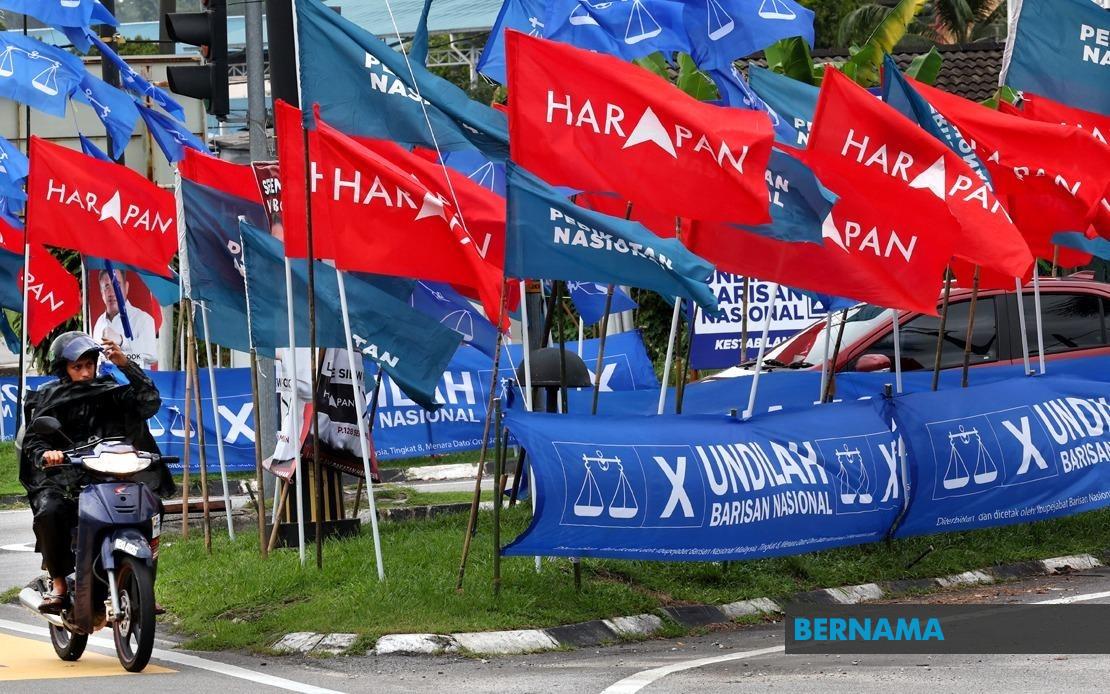
The 16th Johor state election has entered its decisive final phase, with candidates from across the political spectrum accelerating their ground operations as they race against the clock. Less than two days remain before the official campaign period expires at midnight tomorrow, with polling day set for Saturday. The atmosphere across the state reflects mounting urgency, as all three major coalitions and independent parties attempt to convert undecided voters and consolidate their respective bases through an exhaustive schedule of public gatherings, community visits, and direct voter engagement.
Pakatan Harapan has deployed its heavyweight leadership to swing critical marginal seats, with Prime Minister Anwar Ibrahim scheduled to address three major rallies tonight, signalling the coalition's determination to improve upon its 2018 performance in this stronghold state. The focus on strategically important constituencies such as Puteri Wangsa demonstrates PH's recognition that the result hinges on controlling a handful of battleground areas where voter sentiment remains volatile. Maszlee Malik, contesting Puteri Wangsa on the PH ticket, has actively mobilised supporters through social media, explicitly urging his constituency to attend the coalition's "Grand Finale Harapan Johor Selatan" event, leveraging contemporary communication tactics to drum up attendance at the eleventh hour.
The momentum maintained by PH candidates despite the gruelling pace of campaigning indicates disciplined party organisation and sustained morale within its ranks. Dr A. Ruban, PH's Paloh candidate, exemplified this commitment by returning to the campaign trail mere hours after completing medical treatment, publicly reaffirming his determination to contest every remaining hour before the deadline. Such displays of persistence serve a dual purpose: they project confidence to party workers and sympathetic voters whilst signalling that PH views each constituency as genuinely winnable. Meanwhile, Johor PKR's leadership has coordinated multi-candidate campaign activities, with Zaliha Mustafa participating in a motorcycle convoy involving 120 riders supporting the Kemelah candidacy, demonstrating how local party structures are mobilising volunteers across constituencies.
Barisan Nasional's approach reflects its status as the incumbent state administration with significant organisational resources to deploy in the final stretch. Ahmad Zahid Hamidi, BN's coalition chairman, has undertaken targeted constituency visits to the Endau and Kempas areas, his presence intended to reinvigorate party machinery and communicate central leadership backing to ground-level operatives. Onn Hafiz Ghazi, the Menteri Besar and BN's Machap candidate, has saturated his own constituency with campaign appearances whilst leveraging digital platforms to broadcast his appeal directly to Johorean voters. The "Ziarah Kasih" programme executed by Larkin's Mohd Hairi Mad Shah represents BN's attempt to personalise its development narrative through face-to-face interactions, attempting to convert governance claims into concrete voter commitments.
Perikatan Nasional's positioning as a third force competing for power has been reinforced through its own spectacular final campaign events. The staging of a major rally in Endau featuring both Ahmad Samsuri Mokhtar and PAS president Abdul Hadi Awang underscores PN's ambition to present itself as a genuine alternative capable of challenging both establishment coalitions. For candidates like Mazlan Bujang in Kahang, the PN ticket provides an opportunity to contest in a different political configuration than previous elections, potentially reshaping voter alignments in certain constituencies where dissatisfaction with the two dominant coalitions provides fertile ground.
Smaller political entities are equally engaged in final campaign activities despite their lesser resource bases. Parti Bersama Malaysia has deployed innovative mobile campaign infrastructure through its "Bersama Tour Truck," whilst candidates like Norsinah Abu in Larkin utilise small-group community dialogues to build personal connections with voters in neighbourhoods where large rallies may prove less effective. These granular campaign tactics reveal recognition that modern electoral contests involve multiple overlapping strategies, from mass mobilisation events to intimate community engagement, each serving distinct voter segments and psychological triggers.
The scale of the contest underscores Johor's significance within Malaysia's broader political landscape. With 172 candidates competing across 56 state seats, the election encompasses diverse socioeconomic constituencies ranging from urban Johor Bahru to rural Felda settlements, plantation areas, and industrial zones. This geographic and demographic diversity means no single campaign narrative or coalition strategy applies uniformly across all constituencies, forcing parties to tailor messaging to local conditions whilst maintaining overarching thematic coherence. The intensive final-stage campaigning reflects parties' understanding that marginal differences in voter turnout and persuasion can produce dramatically different seat distributions under Malaysia's first-past-the-post system.
The prominent deployment of national leaders signals how state elections increasingly function as barometers of national political sentiment and tests of coalition cohesion. Anwar Ibrahim's personal commitment to appear at multiple Johor events demonstrates PH's view that strong state-level performance is essential to maintaining coalition momentum and securing credibility with voters ahead of future national contests. Similarly, BN's utilisation of Ahmad Zahid Hamidi reflects the coalition's need to consolidate its remaining strongholds against encroachment from both PH and PN, particularly in constituencies where its historical dominance has begun eroding.
The intensity of ground-level engagement across all coalitions and candidates reflects the competitive dynamic that has characterised Malaysian electoral politics since 2018. Unlike periods when electoral outcomes appeared predetermined, contemporary state contests feature genuine competitive uncertainty, compelling parties to invest heavily in voter persuasion and mobilisation activities. The final 48 hours represent the culmination of this extended effort, with candidates and party operatives recognising that last-minute impressions can influence swing voters and marginal electorates.
For Malaysian observers, this closing stage reveals the current state of political competition in one of the country's largest and most economically important states. Johor's outcome will provide signals about voter sentiment regarding the Anwar administration's governance record, public satisfaction with BN's stewardship in the state, and whether PN can sustain electoral traction in a significant market. The results will reverberate beyond Johor, influencing calculations about future national political alignments and the viability of various coalition configurations.

