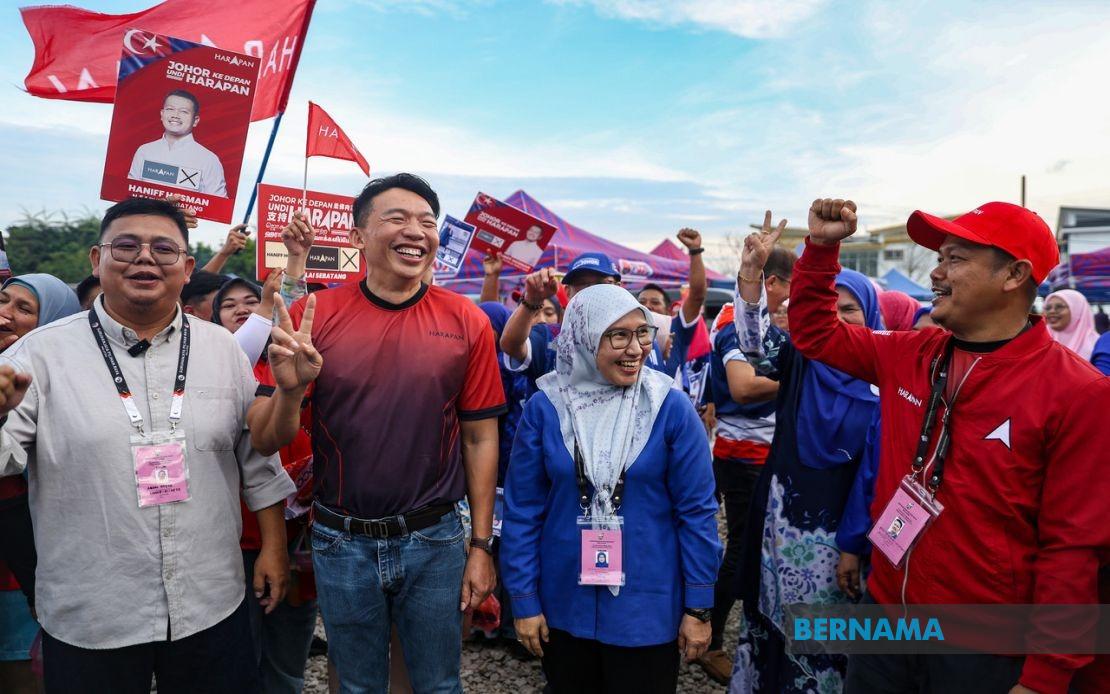
The Johor state election campaign took on an unexpectedly cordial tone when rival candidates from opposing political coalitions encountered one another while canvassing voters at the Taman Megah night market in Pontian on June 29. The unplanned meeting between representatives of Pakatan Harapan and Barisan Nasional drew the attention of shoppers and traders, who paused to observe the moment as the two groups approached from different directions carrying their respective campaign colours. Rather than escalating into tension, the encounter evolved into a courteous exchange that observers said reflected the maturity of Malaysia's democratic system.
The Pakatan Harapan contingent comprised Haniff @ Ghazali Hosman, the coalition's candidate for Pulai Sebatang, alongside his party colleagues Abd Razak Ismail of Benut and Cheah Chee Hong of Kukup. They were conducting a joint campaign walkabout when they came face-to-face with Hasrunizah Hassan, Barisan Nasional's candidate for the same Pulai Sebatang constituency. The meeting appeared initially awkward as the opposing teams, identifiable by their distinct flag colours, converged at a junction within the busy evening market setting.
What could have become a contentious moment quickly transformed into a display of political civility that surprised and impressed onlookers. The candidates exchanged greetings and engaged in brief conversation, demonstrating an underlying respect that transcended their partisan differences. Shoppers and night market patrons stopped momentarily to witness the interaction before the candidates resumed their separate campaign activities, continuing to engage with voters and traders throughout the venue.
When approached by media representatives following the encounter, Haniff characterised the meeting as a natural expression of healthy democratic competition. He emphasised that the Johor campaign environment had remained notably peaceful and orderly, free from the disruptions or confrontations that sometimes accompany election periods in other regions. His comments underscored a broader theme emerging from the state's polling period: that political rivalry could coexist with personal civility and mutual respect among candidates competing for the same seats.
Cheah, representing the Kukup constituency under the Pakatan Harapan banner, expressed satisfaction at campaigning alongside his coalition partners and took the opportunity to appeal directly to voters in the three constituencies represented by his group. He urged constituents in Pulai Sebatang, Benut and Kukup to maintain their support for Pakatan Harapan, framing the coalition's campaign message as a continuation of previous electoral mandates in these areas.
From the Barisan Nasional perspective, Hasrunizah offered a similar assessment of the encounter's significance. She characterised such meetings between candidates from different parties as an expected and normal occurrence during election campaigns, viewing them as indicators of democratic maturity rather than problems requiring management. Her response reflected a confidence in the stability of Johor's political environment and an apparent comfort with the contest's intensity, suggesting that passion for respective party agendas need not translate into personal antagonism or public disorder.
Hasrunizah further noted that despite the campaign period intensifying as election day approached, Johor maintained a controlled and incident-free environment. This observation carried particular relevance given occasional reports of political tensions in other Malaysian states during electoral contests. The Barisan Nasional candidate framed such peaceful encounters as opportunities to strengthen her coalition's campaign momentum, suggesting that the interaction would energise efforts to mobilise support for Barisan Nasional and the state coalition banner Maju Johor.
The exchange between these candidates illustrates a significant aspect of Malaysian electoral culture that often receives less attention than conflict-focused reporting: the ability of political opponents to maintain professional courtesy and acknowledge their common stake in democratic processes. In Johor's competitive landscape, where multiple constituencies remain genuinely contested between major coalitions, such demonstrations of civility may carry weight with voters evaluating candidates on character and temperament alongside policy positions. The night market setting, where economic activity continued unimpeded around the political engagement, symbolised the normalcy of the campaign environment.
The Johor state election scheduled for July 11 represented a significant electoral moment for the state, with early voting provisions for those unable to participate on the main polling day on July 7. The three constituencies represented by the candidates who met in Pontian have been identified as competitive spaces where neither coalition can assume victory, making these particular races among the most closely watched in the state-wide contest. The peaceful campaign conduct observed at Taman Megah suggested that voters would make their choices in an environment free from intimidation or major disruption, a foundation for legitimate electoral outcomes that both coalitions claimed to value.

