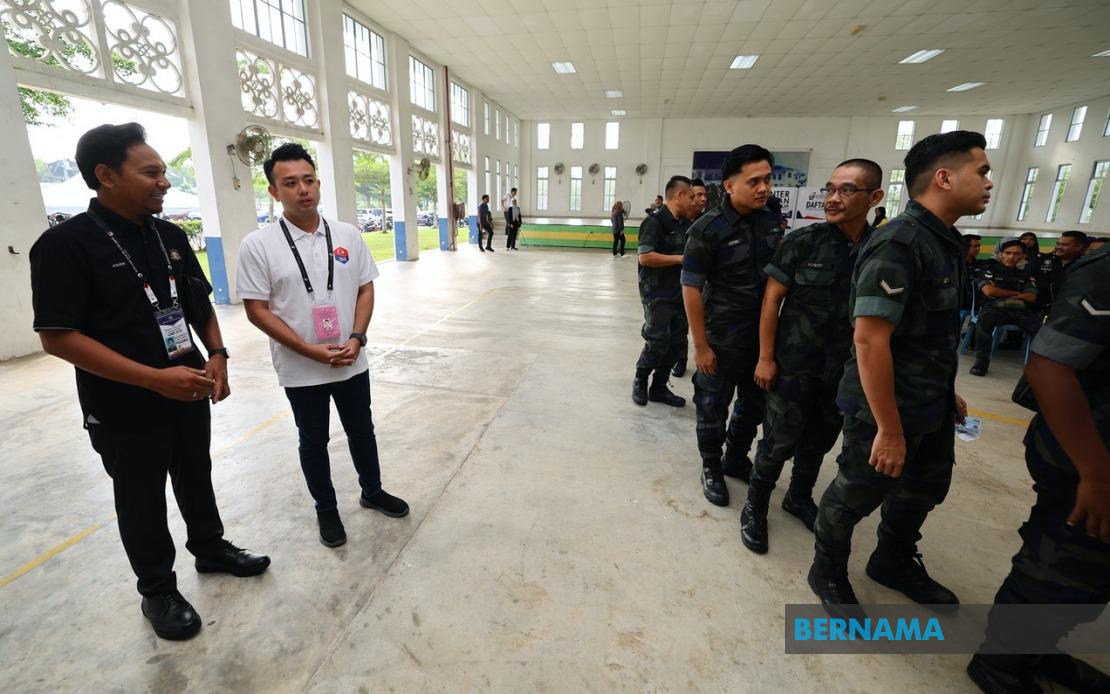
The Johor state election campaign entered its final stretch on Friday as candidates from Pakatan Harapan, Barisan Nasional and Perikatan Nasional paused their political activities to monitor the early voting exercise designated for members of the armed forces and police. The opportunity to observe the integrity of the electoral process became an impromptu campaign activity, allowing candidates to demonstrate commitment to transparent democratic procedures while simultaneously maintaining their presence in the public eye ahead of Saturday's polling day.
At the Simpang Renggam location hosting the 5th Battalion General Operations Force Camp, all three contenders for the Layang-Layang seat made appearances. Guna Balakrishnan representing Pakatan Harapan, Barisan Nasional's Chua Jian Boon and Perikatan Nasional's Abd Mutalip Abd Rahim each witnessed the voting procedures in what has become standard practice during Malaysian elections. Similarly, the three candidates vying for Tenggaroh — Muhamad Amerul Muhamad of Perikatan Nasional, Barisan Nasional's Mohd Youzaimi Yusof and Pakatan Harapan's Md Yusof Dawam — gathered at Iskandar Camp in Mersing to observe their respective constituencies' early voting operations.
Other notable participants included Lim Chin Eng, identified as the oldest candidate in the Johor contest and representing Perikatan Nasional, who observed proceedings at Johor Contingent Police Headquarters. Muhammad Faezuddin Mohd Puad, Pakatan Harapan's nominee for Kempas, attended the station designated for his constituency, while Datuk Jafni Md Shukor, the Barisan Nasional standard-bearer for Bukit Permai, was present at Kulai District Police Headquarters. The widespread attendance signalled confidence among candidates across the political spectrum regarding the Election Commission's management of the voting process.
High-ranking military officials supplemented the candidate presence, underscoring the security establishment's oversight of proceedings. Army Chief General Tan Sri Azhan Md Othman and 21st Special Service Group commander Major General Datuk Ahmad Shuhaimi Mat Wajab conducted a joint visit to Iskandar Camp in Mersing, demonstrating institutional involvement in ensuring procedural compliance. Meanwhile, Johor's police chief Datuk Ab Rahaman Arsad participated by casting his own ballot at Dewan Dato Onn within Johor IPK headquarters, symbolising law enforcement's engagement with democratic participation.
The logistics of the early voting exercise reflected meticulous Election Commission planning, with operations commencing at 8 am across all 64 designated centres. Despite intermittent rainfall affecting several locations, the infrastructure remained stable and the flow of voters proceeded uninterrupted. Security personnel arrived in scheduled batches, ensuring controlled attendance that allowed poll workers to process ballots efficiently while maintaining strict procedural standards established by Election Commission officials.
The electorate entitled to participate in early voting comprised a substantial contingent of 20,607 individuals drawn from Malaysia's security establishment. This figure encompassed 8,544 members of the Malaysian Armed Forces alongside their spouses, complemented by 12,063 police personnel and their spouses. The size of this early voting population reflects the operational demands placed on security forces, whose deployment commitments often preclude participation in regular polling day exercises. Accommodating their ballots through a dedicated early voting framework ensures that those safeguarding the nation's sovereignty retain their democratic voice.
The staggered closure schedule for early voting centres, with facilities shutting down between noon and 6 pm depending on location and voter registration numbers, demonstrated flexibility in responding to varying levels of participation across districts. This approach prevented bottlenecking while ensuring no eligible voter faced artificial time constraints. The measured pace of operations throughout the day underscored the Election Commission's commitment to balancing efficiency with accessibility, allowing candidates and observers adequate opportunity to monitor proceedings without compromising the voting experience for participants.
The broader context of the Johor State Election involves substantial political competition, with 172 candidates contesting the 56 available seats in the state legislative assembly. This represents significant engagement across multiple constituencies and reflects the electoral relevance that state-level politics continue to command in Malaysian democracy. The three major political coalitions—Pakatan Harapan, Barisan Nasional and Perikatan Nasional—have mobilised candidates comprehensively, suggesting that Saturday's polls will test the current political alignments that have characterised Malaysian politics since recent national elections.
For Malaysian readers and regional observers, the Johor state election carries implications extending beyond the state boundary. Johor functions as Malaysia's second-largest state by population and economic output, making its electoral outcomes particularly significant for understanding broader political trajectories. A swing toward any particular coalition could signal shifting voter preferences regarding governance, development priorities and the management of sensitive issues affecting multicultural constituencies. The early voting process itself, conducted with apparent procedural integrity as observed by candidates and officials, establishes a standard for Saturday's general polling that voters will evaluate when assessing the overall election's credibility.
The participation of candidates in observing the early voting process serves multiple political functions beyond mere procedural oversight. It demonstrates to their respective support bases that they remain engaged with electoral mechanics and willing to ensure that voting procedures unfold fairly. For Pakatan Harapan, Barisan Nasional and Perikatan Nasional, showing candidate presence at security force voting sites reinforces messages about democratic commitment while allowing representatives face time with observers and media present at these locations. The exercise therefore blurs the boundary between administrative observation and campaign activity, a phenomenon common in Malaysian elections where the final campaign period often encompasses such simultaneous activities.

