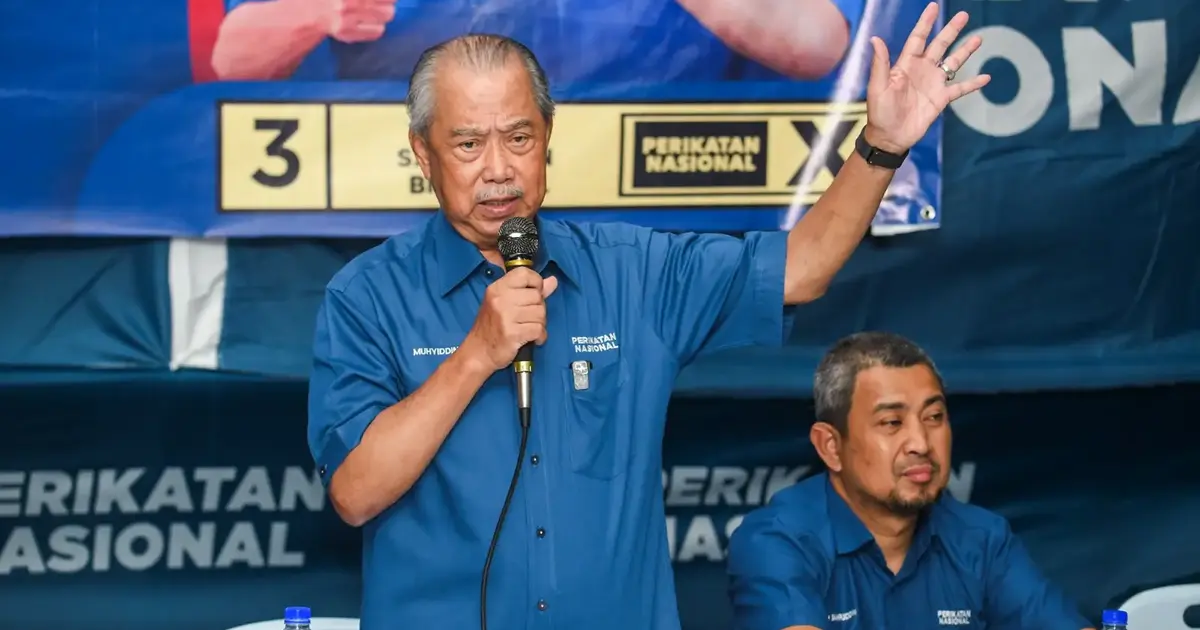
Bersatu president Muhyiddin Yassin has firmly distanced the impending Johor state election from any potential release or pardon of former Prime Minister Najib Razak, emphasizing that Razak's legal status remains a matter separate from electoral politics. The comments underscore the delicate balance within Malaysia's current political landscape, where the fortunes of different factions remain intertwined despite public assertions of independence.
Muhyiddin's statement comes as speculation mounts within political circles regarding the timing of various high-profile legal matters and forthcoming electoral contests. The Bersatu leader's clarification appears designed to counter suggestions that political calculations might influence decisions regarding Razak, whose 12-year prison sentence for money laundering has been a contentious issue since his 2020 conviction. By insisting on the separation of judicial and electoral processes, Muhyiddin seeks to shield both the upcoming Johor contest and any potential clemency decisions from accusations of political opportunism.
The conviction of Razak himself remains the foundational fact undergirding this entire discussion. In July 2020, the former premier was found guilty of abuse of power, money laundering, and criminal breach of trust related to the controversial 1Malaysia Development Berhad scandal that had dominated Malaysian politics for years. That conviction, sustained through appeal processes, means that any future release would require explicit executive clemency or pardon rather than exoneration, a distinction that carries significant political weight.
For Malaysian observers and regional analysts tracking the country's political currents, Muhyiddin's intervention highlights the persistent tension between institutional independence and factional maneuvering. Johor, as Malaysia's second-largest state and home to formidable political machinery from multiple coalitions, represents a significant prize in the electoral calendar. Any perception that outcomes in Johor might be traded for favours regarding Razak could undermine confidence in democratic processes and judicial integrity alike.
The Bersatu president's intervention also reflects his own complicated relationship with Razak and the broader politics of Malaysia's political centre. Muhyiddin himself has navigated multiple coalition configurations, serving as Deputy Prime Minister under Razak before his own political fortunes shifted. His emphatic statement rejecting electoral-legal linkages may therefore serve multiple purposes: protecting his party's credibility with voters, distancing himself from charges of transactional politics, and potentially managing expectations among allies regarding what electoral success might or might not achieve regarding other pending matters.
Within the context of Southeast Asian politics more broadly, Malaysia's handling of high-profile conviction cases carries implications for perceptions of rule of law across the region. Thailand, Cambodia, and other neighbouring states have faced criticism over the selective application of judicial processes for political purposes. Muhyiddin's public insistence that Johor and Razak's fate remain entirely separate reflects awareness that international observers monitor such connections closely.
The upcoming Johor election itself represents a critical test for the current federal coalition government, which has faced mounting pressure over inflation, economic management, and corruption allegations. Success in Johor, typically considered a stronghold of the United Malays National Organisation, could reinvigorate government confidence; conversely, setbacks might embolden opposition forces and intensify internal coalition tensions. Against this backdrop, permitting even a hint of political calculation around Razak's situation could inflict considerable damage.
Muhyiddin's statement must also be understood as part of ongoing negotiations within Malaysia's fragmented political ecosystem. Various factions maintain competing interests in potential outcomes regarding Razak, whose extended family network and business connections create cascading political implications. By publicly divorcing the Johor election from Razak considerations, Muhyiddin arguably seeks to dampen discussions that might otherwise consume political energy and generate unwanted public scrutiny.
The broader question of clemency for high-profile convicts remains constitutionally vested in the Yang di-Pertuan Agong, Malaysia's constitutional monarch, who acts on advice from the Cabinet through established processes. Any ultimate decision would theoretically follow consultations with relevant institutions, though historically such processes have occasionally been criticized as lacking sufficient transparency. Muhyiddin's preemptive framing appears designed to establish clear boundaries around what the Johor election campaign should and should not encompass.
For ordinary Malaysian voters, particularly in Johor, these political manoeuvres may feel distant from immediate concerns about employment, living costs, and service delivery. Yet the credibility of electoral processes and confidence in judicial independence ultimately rest on public perception that such matters are handled with integrity rather than factional calculation. Muhyiddin's intervention, whether intended or not, underscores both the real anxieties about linkage and the imperative felt by political leaders to insist publicly that none exists.

