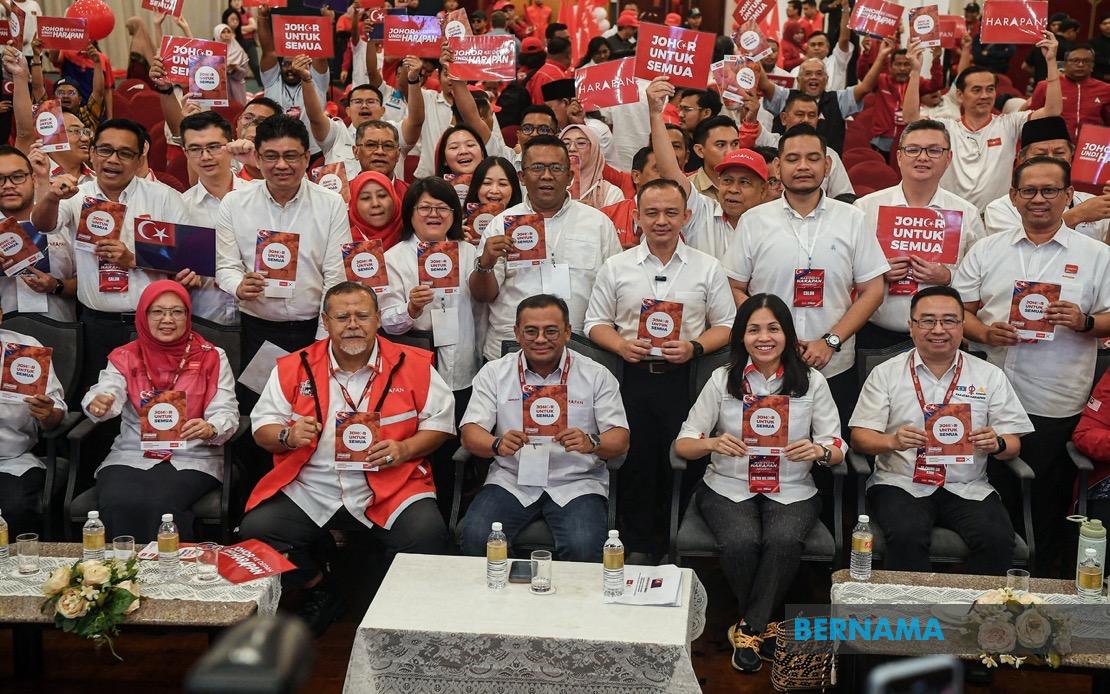
Pakatan Harapan unveiled its election manifesto for the Johor state election on July 3, positioning 'Johor Untuk Semua' (Johor For All) as a pragmatic response to the state's socioeconomic challenges rather than aspirational political posturing. The manifesto was presented as a carefully calibrated document that balances competing demands across society, from young professionals navigating career prospects to mothers juggling household responsibilities and children requiring quality educational foundations. Johor DAP chairman Teo Nie Ching, who also serves as Deputy Communications Minister, defended the platform against inevitable accusations of overpromising, framing the ten key offers as deliverable commitments contingent on sustained federal-state coordination.
The manifesto addresses several persistent pain points for Johor residents, reflecting coalition conversations with constituency representatives and grassroots stakeholders. Education emerges as a cornerstone priority, signalling PH's recognition that Johor families view schooling quality as fundamental to their children's competitiveness in an increasingly knowledge-based economy. This aligns with broader Malaysian concerns about educational standards, particularly as parents weigh public schooling against private alternatives amid middle-income anxieties. The emphasis on education policy suggests the coalition believes electoral fortunes in Johor depend partly on convincing voters that PH understands generational mobility concerns.
One notably ambitious initiative targets the chronic congestion at Johor-Singapore border crossings, proposing a 50 per cent reduction in waiting times. This commitment speaks directly to the daily frustrations of the hundreds of thousands who cross the causeway for work, commerce, and family connections. The cross-border corridor represents one of Southeast Asia's busiest land routes, and lengthy delays impose substantial economic costs on individuals and businesses. Teo's confidence in achieving this target rested explicitly on coordination with the Home Ministry, acknowledging that border efficiency depends on institutional synchronisation rather than state-level action alone. This transparency about federal dependencies distinguishes the manifesto from purely aspirational campaigning, though it also exposes PH to criticism should implementation falter due to bureaucratic friction.
The Johor Health Scheme constitutes another flagship proposal, offering subsidised or free healthcare to eligible residents. Teo explicitly invoked Selangor's parallel scheme as proof of concept, suggesting that observing a neighbouring state's successful operation could reassure Johor voters about feasibility. This cross-state learning approach reflects an emerging pattern in Malaysian politics, where state governments pilot policies before other jurisdictions adopt or adapt them. Selangor's experience demonstrates that health subsidy schemes can function sustainably, though implementation quality depends heavily on administrative capacity and budget allocation. By anchoring the proposal in an established precedent rather than theoretical modelling, PH attempts to reduce voter scepticism about whether such ambitions deteriorate post-election.
Deposit assistance for first-time homebuyers addresses another demographic anxiety across Malaysia. Housing affordability affects political preferences significantly, as younger voters particularly resent generational disadvantage in property ownership relative to their parents' era. Young professionals in Johor's urban centres face similar pressures as counterparts in Kuala Lumpur or Penang, making this manifesto element relevant across income groups. The proposal signals recognition that housing policy touches aspirational and economic concerns simultaneously, affecting marriage timing, family formation, and long-term financial security. Federal policies on foreign ownership, real estate speculation, and mortgage regulations intersect with state-level assistance, meaning delivery requires coordination across multiple bureaucratic layers.
The RM500 million youth development fund represents a substantial financial commitment, though context matters significantly. Youth unemployment and underemployment plague Southeast Asian economies generally, and Malaysia experiences particular challenges engaging young workers in non-traditional sectors. A dedicated fund for youth initiatives suggests recognition that generic development spending often fails to address young people's specific barriers to economic participation. Whether this translates into skills training, entrepreneurship support, job placement services, or wage subsidies remains unclear from the manifesto launch reporting, though the scale suggests genuine investment rather than symbolic allocation. Implementation effectiveness depends critically on administration, targeting mechanisms, and whether funds reach intended beneficiaries or dissipate through bureaucratic overhead.
The comprehensive nature of the manifesto—spanning healthcare, education, housing, youth employment, and border infrastructure—reflects PH's attempt to construct a broad coalition rather than pursue narrow sectional appeals. This inclusive approach acknowledges that Johor voters encompass diverse interests requiring multifaceted policy responses. However, bundling so many commitments creates vulnerability: if PH wins but struggles delivering on particular initiatives, cumulative dissatisfaction could undermine support for the state government and broader coalition prospects. The 16th Johor state election scheduled for July 11, with early voting on July 7, offered voters an opportunity to assess both manifesto credibility and PH's track record from previous administrations.
Teo's repeated references to cooperation requirements reveal important constraints on state government autonomy. Education authority derives partially from federal oversight, healthcare licensing depends on national regulation, and border management sits squarely within federal jurisdiction. This interdependence means manifesto delivery requires institutional relationships transcending electoral competition. If BN or another opposition coalition controlled federal government while PH governed Johor, such cooperation might prove fraught, creating dynamics where blame can diffuse across multiple power centres. The manifesto implicitly assumes continued federal-state alignment, a significant assumption given Malaysian politics' volatility.
The manifesto's emphasis on people's needs and economic realities represents rhetorical positioning designed to distinguish PH from opposition messaging. By stressing that proposals respond to tangible challenges rather than ideological commitments, PH attempts to frame itself as pragmatic and responsive. This narrative choice reflects learning from previous election cycles where aspirational pledges faced credibility deficits. Whether voters ultimately trust this positioning depends partly on demonstrated delivery from existing PH administrations in other states and federally. Johor voters would likely evaluate the manifesto partly through that lens, considering whether current PH governments have followed through on comparable commitments.
Regional implications extend beyond Johor specifically. A successful PH state government in Johor would validate the coalition's governance model and potentially influence electoral dynamics in other states. Conversely, disappointment with manifesto delivery could damage PH's credibility nationally, affecting federal electoral prospects. Johor's strategic importance as Malaysia's southernmost state and primary gateway to Singapore amplifies the stakes, making this election significant for understanding voter preferences regarding coalition competence and policy credibility across the broader region.

