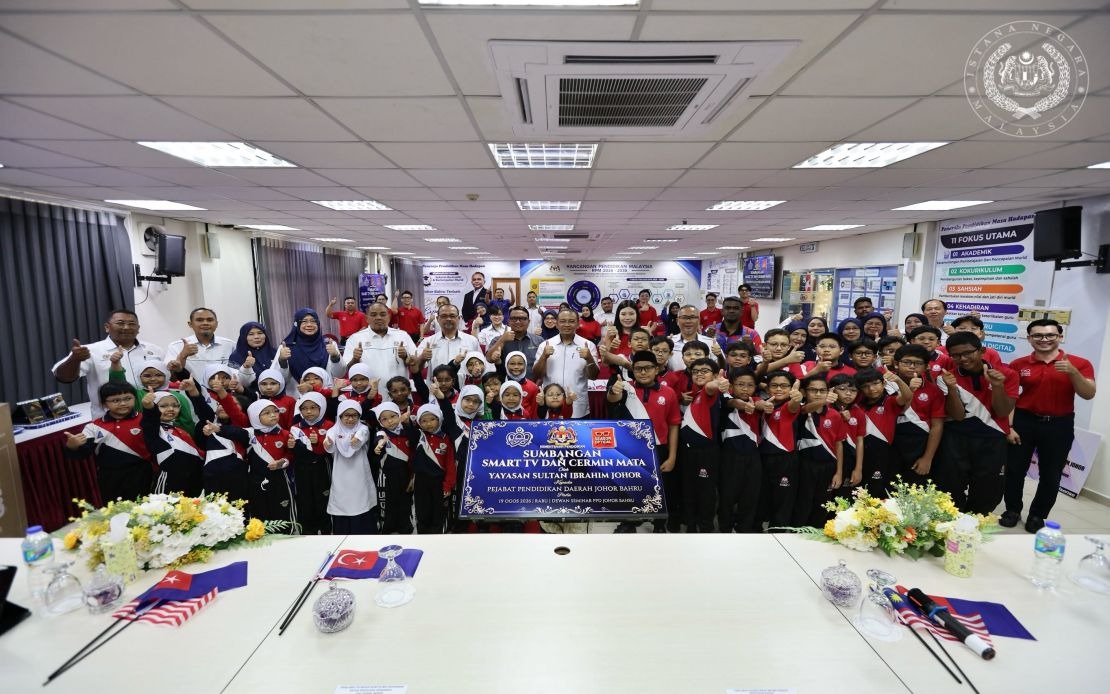
The Yayasan Sultan Ibrahim Johor (YSIJ) has continued its commitment to enhancing educational infrastructure and student welfare across the state by distributing technological resources and eyecare services to institutions under the Johor Bahru District Education Office (PPD). The initiative reflects an ongoing institutional effort to bridge gaps in classroom facilities and address health-related barriers to learning that often affect lower-income student populations in the region.
The donation package comprises 10 75-inch smart televisions allocated to selected schools alongside 2,000 pairs of spectacles distributed across 20 educational institutions. This dual-track approach acknowledges two distinct but interconnected challenges in Malaysian education: the digital divide in learning infrastructure and the prevalence of uncorrected vision problems that inhibit academic performance. By targeting both classroom technology and individual student health needs, the foundation addresses barriers that operate at different scales within the education system.
The spectacle distribution programme emerged through a strategic collaboration with Season Optical, a private optical retailer, demonstrating how public-private partnerships can scale welfare initiatives. The selection of beneficiary students focused on B40 households, the bottom 40 percent income bracket, ensuring resources reached families least able to afford vision correction independently. This targeted approach maximises the social impact of philanthropic spending in a context where many low-income families delay or forgo eyecare despite documented links between corrected vision and academic achievement.
A technological innovation underpinning the spectacle initiative is the Columba Vision Screener, an automated eye-scanning device that Sultan Ibrahim Sultan Iskandar personally donated to the programme. The device substantially reduces screening time—requiring just 10 seconds per student—making it feasible to assess vision across entire school populations without imposing prohibitive time demands on educational staff. This efficiency gain is particularly significant for resource-constrained districts managing screening protocols across dozens of institutions.
The spectacles themselves represent a quality-conscious investment. Unlike basic frames sometimes distributed through mass programmes, these pairs combine durable construction with optical quality deemed suitable for sustained student use. This durability consideration reflects practical understanding that spectacles used in school environments encounter wear patterns different from adult professional settings, and replacement cycles present financial burdens for B40 families.
The smart television component addresses a separate but equally pressing educational gap. Classroom digital infrastructure remains unevenly distributed across Malaysian schools, with rural and lower-funded urban institutions often lacking even basic audiovisual equipment. 75-inch screens represent a substantial capability upgrade, enabling teachers to present high-resolution content, stream educational videos, and facilitate interactive digital learning in ways that smaller or absent display systems cannot support. The technology bridges classrooms toward contemporary pedagogical practices increasingly emphasised in curriculum frameworks.
The formal transfer occurred during a ceremony bringing together YSIJ senior management, represented by Shah Reza Md Kanafe, alongside Johor's education apparatus. Both Mohd Khatta Muhamad from the State Education Department and Adnan Samsudin from the Johor Bahru PPD attended, signalling official institutional endorsement and integration of donated resources into district educational planning. Such ceremonial formality matters beyond symbolism—it ensures accountability tracking, prevents resource misallocation, and establishes baseline documentation for programme evaluation.
The foundation's approach reflects broader recognition within Malaysian philanthropy that student welfare encompasses more than direct academic tutoring. Vision impairment, left unaddressed, functions as a silent educational barrier; students struggling to see classroom content may be misdiagnosed as inattentive or cognitively weak when the root cause is remediable through spectacles. Similarly, insufficient classroom technology forces teachers to rely on pedagogical methods increasingly detached from how students naturally engage with information beyond school walls.
For Johor Bahru specifically, these investments arrive amid ongoing state-level efforts to modernise educational delivery across heterogeneous communities. The district encompasses both urbanised areas with reasonable infrastructure and peripheral zones where resource gaps persist. Targeting 20 schools signals attention to scale rather than isolated institution-building; the programme's structure suggests systematic identification of priority institutions rather than ad-hoc beneficiary selection.
The Season Optical partnership introduces a commercial actor into educational welfare infrastructure, reflecting pragmatic recognition that established private firms often possess supply chain efficiencies and quality control mechanisms that purely governmental procurement sometimes struggles to replicate. Optical retailers maintain standardised frame inventories, established quality metrics, and distribution logistics capable of handling 2,000-unit orders more efficiently than establishing parallel government procurement processes.
These initiatives carry particular resonance for Southeast Asian educational contexts where state budgets face competing demands and infrastructure investment cycles operate under fiscal constraints. The YSIJ model demonstrates how targeted, multi-dimensional interventions—combining technology, health services, and private-sector coordination—can compress resource scarcity's effects on student outcomes without demanding transformational budget reallocation.
Looking forward, the success of this programme may inform similar initiatives across other Malaysian states and potentially other regions grappling with educational infrastructure gaps. The combination of eye-screening technology, quality spectacles provision, and classroom technology represents a replicable package addressing tangible, measurable student needs while remaining administratively viable for state education systems to manage and scale.

