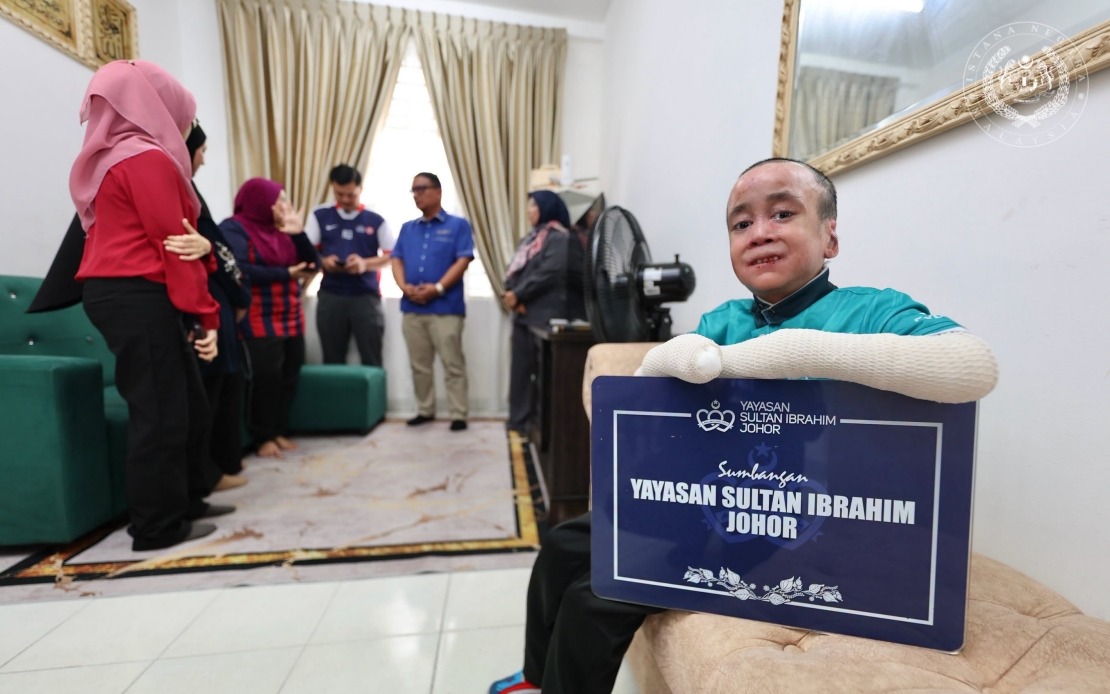
Yayasan Sultan Ibrahim Johor (YSIJ) has stepped in with financial assistance for Muhammad Hazreel Mikhail Hizar, a 15-year-old grappling with epidermolysis bullosa (EB), an exceptionally rare and distressing hereditary skin condition that has affected him since birth. The aid package was formally handed over on August 18 at the Sungai Tiram People's Housing Project (PPR) in Johor Bahru, delivered through the foundation's Ziarah Kasih community outreach initiative, which targets vulnerable families facing health and economic hardship.
Epidermolysis bullosa represents one of the most challenging chronic conditions any family can face. The disorder causes the skin to become extraordinarily fragile, blistering and tearing in response to even minor friction or temperature fluctuations. For Hazreel, this means his daily existence hinges on meticulous wound management protocols—continuous cleaning, dressing changes, and vigilant infection prevention. The condition demands that his living environment maintain consistently cool temperatures with reliable air conditioning, requirements that translate into substantial electricity costs for households already stretched financially.
The burden of Hazreel's care falls almost entirely on his mother, Noor Halimaton Hashim, a single parent raising three children on an unstable income. Her inability to work conventional full-time employment reflects a reality faced by countless caregivers across Malaysia: when a family member requires round-the-clock medical attention, someone must sacrifice earning potential. Noor Halimaton must remain perpetually available for wound care, monitoring for infection signs, temperature management, and the endless small interventions that prevent her son's condition from deteriorating into medical crisis.
Rare genetic disorders like epidermolysis bullosa place extraordinary financial strain on families, particularly those without substantial savings or comprehensive insurance coverage. Beyond the immediate costs of specialized wound dressings, medications, and climate control, families navigate a labyrinth of medical expenses—dermatology consultations, infection treatments when complications arise, and adaptive equipment modifications. For low-income households, these cumulative costs can quickly become catastrophic, forcing impossible choices between medical necessities and basic living expenses.
The Ziarah Kasih programme represents a structured approach to identifying and supporting families whose circumstances have overwhelmed conventional safety nets. By providing direct financial assistance rather than merely symbolic gestures, the foundation acknowledges that compassion without material support rings hollow for families managing serious illness. The intervention recognizes that Hazreel's condition is not a personal failing but rather a random genetic occurrence requiring community solidarity.
Noor Halimaton's response, conveyed through the Royal Press Office, captured the relief that timely assistance brings to a family long managing crisis-to-crisis survival. She emphasized that the support arrived precisely when her family's resources had been depleted, suggesting that prior to this intervention, her household was navigating an increasingly precarious financial position. Her gratitude extended beyond the monetary assistance to acknowledge the broader concern shown by institutional leadership—the recognition that her son's suffering matters and that systemic response remains possible.
Epidermolysis bullosa, though rare in Malaysia, affects hundreds of families regionally and thousands globally. Many face circumstances identical to Hazreel's: born with an incurable condition requiring lifelong specialized care, dependent on family members who sacrifice career advancement and financial security. The condition illuminates broader questions about how Southeast Asian societies structure support for families facing rare diseases, which often fall between the cracks of standard healthcare and welfare systems designed around more common conditions.
The YSIJ initiative highlights the role that royal foundations can play in addressing gaps between government services and actual community needs. While public healthcare systems provide essential infrastructure, private foundations often possess greater flexibility to respond to unusual cases and urgent humanitarian situations. Such complementary support systems prove particularly valuable in managing rare conditions where standard welfare frameworks offer insufficient assistance.
For Hazreel's family, this intervention provides immediate breathing room—resources that can be directed toward his medical care and household stability rather than perpetual financial panic. For the broader community, the case illustrates how structural support can meaningfully improve outcomes for children managing serious chronic conditions. When caregivers can focus on health management rather than survival anxiety, treatment compliance improves, complications decline, and family wellbeing stabilizes.
The story also underscores the importance of raising awareness about rare genetic conditions among both healthcare professionals and the general public. Families managing epidermolysis bullosa often struggle with inadequate understanding from medical providers unfamiliar with specialized treatment protocols. Increased recognition of such conditions can drive improvements in both institutional response and community understanding.
Moving forward, Hazreel's situation exemplifies why sustained rather than one-time assistance matters for families managing chronic illness. A single injection of resources, while valuable, addresses only immediate crises. Comprehensive support for such families requires ongoing commitment to ensuring access to specialized medical care, income support for caregiving relatives, and social recognition of the extraordinary resilience demonstrated by those managing rare hereditary conditions.

