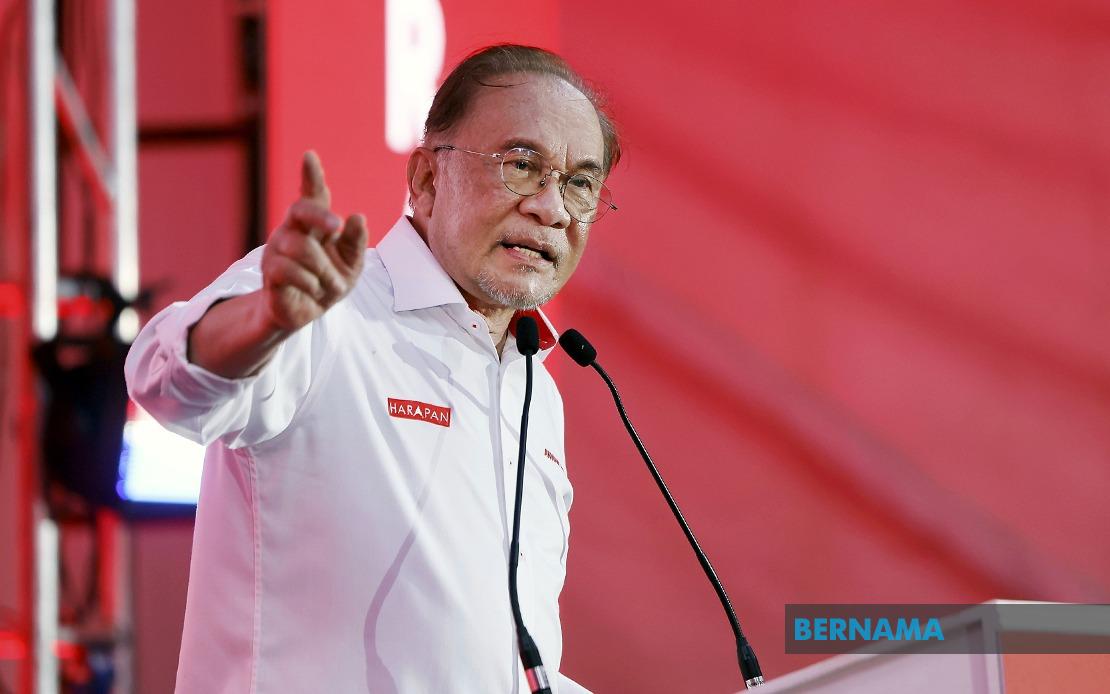
Johor voters must choose elected representatives who combine practical wisdom with political courage and a genuine connection to community concerns, Prime Minister Datuk Seri Anwar Ibrahim has urged as Pakatan Harapan launches its campaign for the 16th state election. Speaking through a video message on his official Facebook page, the PH chairman framed the upcoming election as a choice between capable leadership and the status quo, emphasising that the state requires elected officials capable of assessing priorities strategically and making difficult decisions with confidence. His messaging reflects broader concerns within PH about voter fatigue with traditional politics and a perceived need to articulate a clearer vision of leadership qualities beyond party affiliation.
Anwar's remarks came as he embarked on an intensive first day of campaigning in Johor, attending seven separate community engagement programmes across different constituencies. The varied schedule—encompassing town halls, public talks, neighbourhood visits, and local community events—was designed to build direct voter contact and demonstrate PH's ground presence ahead of polling day on July 11. This grassroots approach signals PH's strategy of relying on personal connections and retail politics rather than solely on top-down messaging, particularly important in a state where the coalition faces strong incumbent competition and where localised grievances can significantly influence electoral outcomes.
The coalition's central message frames the election around collective progress and inclusive governance. Anwar emphasised that Johor requires representatives who genuinely advocate for the people's interests and who recognise that the state's development depends on Malays, Chinese, and Indians working together toward shared prosperity. This pluralistic framing attempts to broaden PH's appeal beyond its traditional support bases and position the coalition as the party of national unity and multi-communal cooperation. For Malaysian readers, this rhetoric matters because it reflects ongoing debates about whether electoral politics in Malaysia will continue along communal lines or shift toward issue-based and performance-based competition.
Pakatan Harapan has fielded candidates in all 56 state constituencies available in this election, demonstrating the coalition's commitment to contesting every seat rather than ceding ground to rivals. The candidate distribution reflects PH's internal power-sharing arrangement, with PKR fielding 20 candidates, Amanah contributing 19, and DAP providing 17 representatives. This composition reveals how PH manages internal coalition dynamics, with PKR—Anwar's own party—holding a slight plurality but balanced by significant contributions from its partner organisations. Such arrangements are crucial for maintaining coalition stability, though they can also create tensions when candidates compete for limited resources or when specific parties feel underrepresented in high-profile constituencies.
The broader electoral context sees 172 candidates competing across all 56 seats, indicating robust participation from multiple parties and independent candidates. This fragmentation of the candidate pool reflects Malaysia's evolving political landscape, where traditional two-coalition competitions increasingly include third-force candidates and smaller parties attempting to capture specific voter segments. For Johor specifically, this crowded field complicates vote splitting calculations and makes seat predictions uncertain, potentially benefiting either established coalitions or small parties capable of consolidating niche support in particular constituencies.
The election campaign occurs amid broader discussions about governance quality and leadership standards in Malaysian politics. Anwar's emphasis on representatives who truly understand community concerns suggests implicit criticism of incumbents, presumably implying that current decision-makers lack such connection or understanding. This frames the election less as a straight ideological contest between left and right, and more as a choice between leadership approaches—one characterised as responsive and thoughtful versus another as disconnected or indecisive. Such framing can resonate with voters frustrated with political performance regardless of party affiliation.
PH's full-slate candidacy also represents a significant resource commitment. Running candidates in all 56 constituencies requires substantial financial investment, organisational capacity, and campaign infrastructure. For a coalition that has faced internal tensions and resource constraints in recent years, this universal candidacy suggests confidence in electoral prospects or a strategic calculation that contesting every seat—even unwinnable ones—maintains party morale and prevents the perception of strategic retreat. This approach contrasts with some opposition parties' selective candidacy strategies and reflects different philosophies about maintaining party relevance and momentum.
The timing of the campaign—with early voting scheduled for July 7 and polling day on July 11—compresses the campaign period into less than two weeks from the announcement date. This abbreviated schedule advantages parties with established ground organisations and incumbent advantages, potentially benefiting the ruling coalition despite PH's intensive early campaigning efforts. For voters, the compressed timeline means less time for information absorption and decision-making, potentially increasing the influence of existing partisan loyalties and informal networks.
Regionally, the Johor election carries significance beyond the state itself. As Malaysia's second-largest state by population and a major economic centre, Johor's political direction influences broader national coalition dynamics and leadership legitimacy. A strong PH performance would strengthen Anwar's position and validate his coalition's viability in competitive state-level contests. Conversely, disappointing results could embolden internal critics and complicate PH's positioning ahead of future federal elections. International observers and regional governments also monitor Johor results as indicators of Malaysia's political stability and governance trajectory.
The coalition's campaign messaging emphasises continuity with PH's federal governance record while acknowledging that state-level performance requires fresh thinking and responsive leadership. Anwar's call for representatives who understand the people's pulse implicitly critiques governance approaches that seem disconnected from ground realities—a common electoral complaint transcending party lines. Whether voters ultimately reward PH for this message or prefer continuity with incumbent administrations will clarify important questions about Malaysian electoral preferences regarding leadership style, party competition, and regional political representation.

