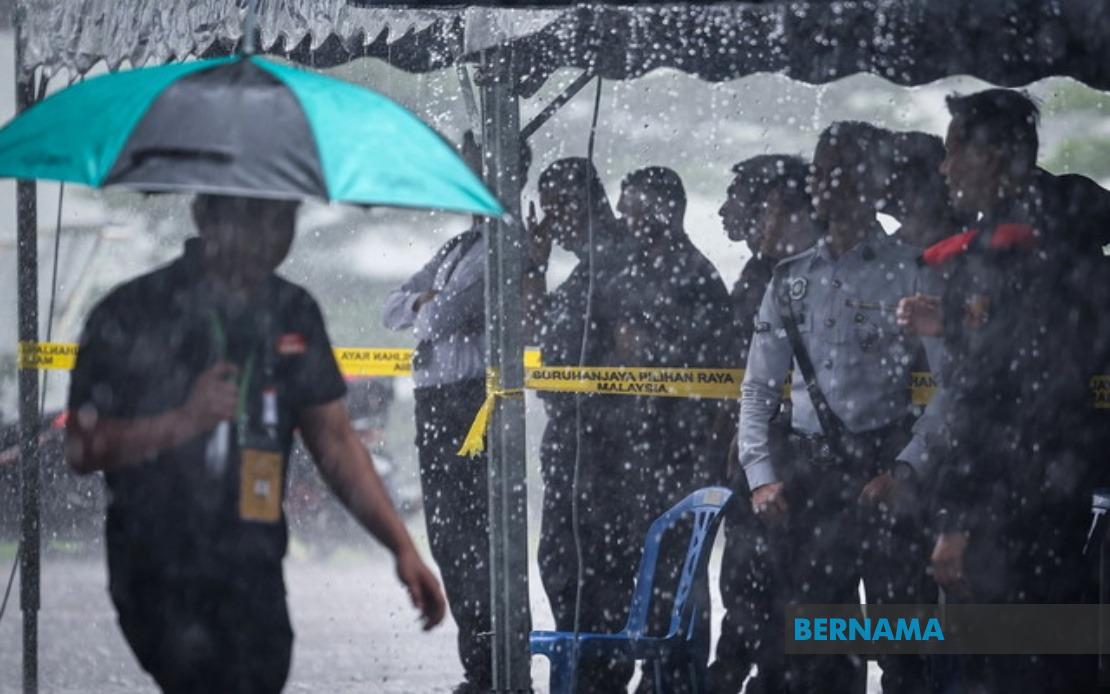
The 16th Johor state election's early voting phase moved ahead without significant disruption when a heavy downpour struck Johor Bahru on the morning of July 7, demonstrating the logistical resilience of Malaysia's electoral machinery even under adverse weather conditions. The rain, which began around 9.40 am at the State Police Contingent Headquarters, proved to be merely an inconvenience rather than an impediment, with officers and personnel navigating the wet conditions to participate in what represents a critical phase of the democratic process for law enforcement agencies across the state.
The polling centre at IPK headquarters in Johor Bahru witnessed a consistent flow of uniformed personnel throughout the day, despite the inclement weather forcing many voters to rush through heavy rainfall to reach the voting booths. The scene reflected the commitment of police staff to fulfilling their civic duties, with officers visibly prioritising their participation in the electoral exercise. Media personnel stationed outside the polling centre took refuge under temporary shelters, allowing them to document the proceedings while protecting their equipment from the downpour.
The early voting arrangement for law enforcement represented a significant logistical undertaking, with a total of 12,067 police personnel and their spouses designated to cast ballots in person at specifically allocated polling centres on this date. This deliberate staggering of the electoral process for police and their families reflects standard practice designed to ensure adequate security presence during general polling day while accommodating the participation requirements of uniformed services. The arrangement acknowledges the operational demands placed on police forces during election day itself, when their presence becomes essential for maintaining order and managing election procedures across multiple constituencies.
Beyond the in-person voting arrangement, the electoral commission had further expanded accessibility by permitting an additional 643 police personnel to participate through postal voting. This provision demonstrates the electoral authorities' recognition of the geographic and operational challenges faced by serving officers, some of whom may be stationed in locations distant from their regular polling centres or deployed on duties that preclude physical attendance at voting venues. The postal ballot mechanism thus ensures comprehensive participation across the entire police establishment.
The 16th Johor state election itself represents a significant political event in Malaysia's electoral calendar, with 172 candidates competing for 56 state assembly seats across the state. The contest will determine the composition of the Johor state legislature and the direction of state governance for the coming term. The election encompasses considerably more candidates than assembly seats, indicating competitive contests in many constituencies and reflecting active political mobilisation across the state's diverse electoral divisions.
The general polling exercise affecting more than 2.7 million ordinary voters is scheduled for Saturday, marking the culmination of an electoral process that commenced with these early voting provisions for police and military personnel. This substantial voter base across Johor underscores the significance of the state election, as Johor remains one of Malaysia's most politically important states, serving as a bellwether for national political trends and hosting crucial urban and rural constituencies with distinct demographic characteristics.
The early voting facility at the police headquarters functioned as a microcosm of Malaysia's democratic system operating effectively despite practical challenges. The continuation of voting despite weather disruptions reflected institutional commitment from both election officials managing the process and voters themselves, demonstrating that electoral participation remains valued across social strata and professional categories. The sight of police personnel queuing to vote in their official capacity carried symbolic weight, representing institutional participation in democratic renewal.
For Malaysian and Southeast Asian observers monitoring electoral governance, the smooth conduct of police early voting despite weather complications offers reassurance regarding the resilience of election administration. Heavy rainfall in tropical regions occasionally affects electoral logistics, yet the Johor exercise illustrated that adequate planning and institutional discipline can maintain voting integrity and accessibility even under meteorological stress. Such operational competence supports public confidence in electoral outcomes and the legitimacy of results produced through such processes.
The police early voting process also highlighted the broader structure of Malaysia's staggered electoral calendar, where security personnel receive advance voting opportunities due to their essential roles during general polling days. This tiered approach to election administration, though sometimes subject to political debate, attempts to balance democratic participation rights with operational necessities. Saturday's general polling will represent the culmination of this carefully choreographed electoral schedule, with police and military taking on supervisory and security functions rather than participating as voters.
As Johor's voters prepare for Saturday's exercise, the successful early voting phase suggests that election day operations will likely proceed with similar organisational effectiveness. The test of weather conditions encountered during early voting cannot be dismissed as trivial, particularly in a state where monsoon conditions and tropical storms occasionally disrupt daily activities. Yet the demonstration that electoral processes can withstand such challenges without compromise to voting procedures provides important context for understanding the maturity of Malaysia's electoral administration, even as political parties and analysts scrutinise campaign dynamics and electoral prospects ahead of Saturday's decisive voting.

