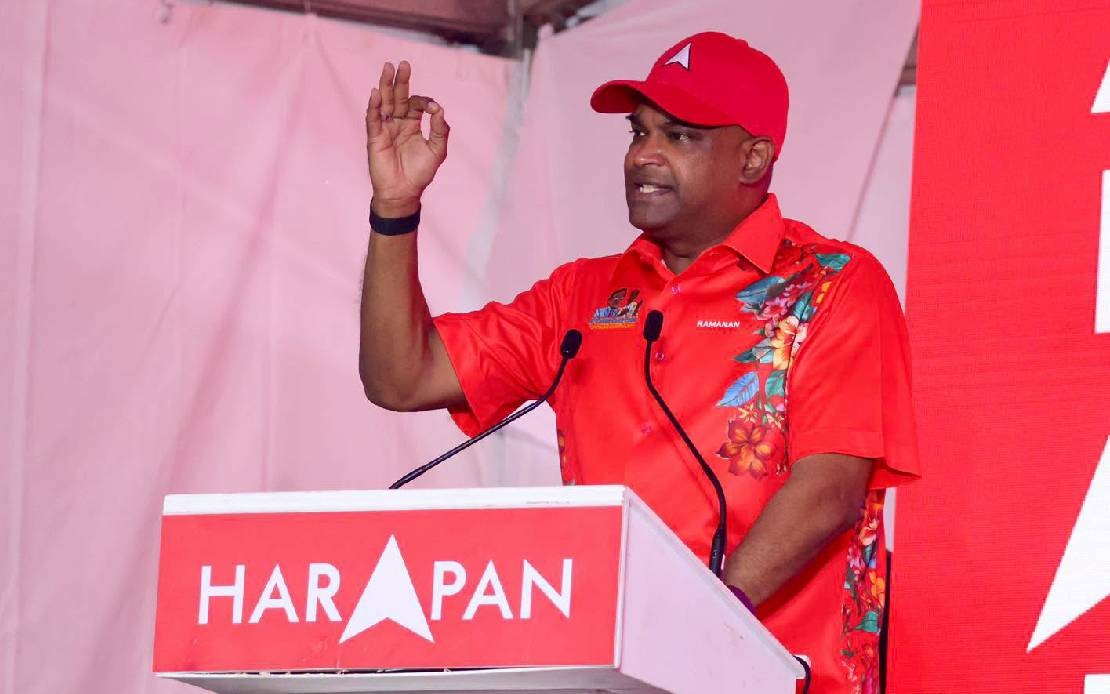
The Federal Government remains committed to positioning Johor as a cornerstone of national development strategy, according to senior Pakatan Harapan figures addressing voters in the state. Speaking at a campaign roadshow in Simpang Renggam on Wednesday evening, PKR Vice-President Datuk Seri R Ramanan underscored the administration's sustained focus on delivering tangible improvements to residents' lives through substantial capital allocation and coordinated development initiatives.
Ramanan's remarks come as Malaysia's coalition government intensifies efforts to consolidate support in Johor ahead of the state election scheduled for July 11. The state, Malaysia's second-largest and strategically positioned along the border with Singapore, carries outsized political and economic significance for the federal coalition. Success here could provide momentum for future national electoral contests, making Johor a natural flashpoint for competing policy narratives about governance effectiveness and resource distribution.
The Federal Government's investment portfolio in Johor encompasses multiple dimensions beyond traditional infrastructure spending. Ramanan highlighted assistance programmes targeted at households across different income brackets, reflecting a diversified approach to meeting constituents' material needs. These initiatives aim to ensure that development gains permeate beyond urban centres and industrial zones, theoretically reaching rural and semi-urban communities that have sometimes felt marginalised by earlier growth patterns concentrated in the Klang Valley and Penang.
The campaign message emphasises administrative coherence as a development accelerant. Ramanan explicitly urged voters to grant Pakatan Harapan state-level control to achieve operational synchronisation between Kuala Lumpur and Kota Iskandar. This argument acknowledges a practical reality: divided government between state and federal levels can create bureaucratic friction, delayed approvals, and misaligned priorities. Where the same coalition controls both spheres, project implementation theoretically flows more smoothly and resource competition diminishes. For Johor, this could translate into faster project completion and more efficient utilisation of development budgets.
Johor's political trajectory remains volatile despite historical demographic and geographic advantages. The state has experienced competing fortunes under different administrations, and voter sentiment has shifted across recent electoral cycles. The presence of multiple Pakatan Harapan component parties—PKR, Amanah, and others—at Wednesday's event reflects the coalition's attempt to project unity and shared commitment. Amanah Secretary-General Faiz Fadzil alongside PKR representatives signals an effort to transcend party boundaries in messaging, though internal coalition dynamics sometimes complicate such unified positioning.
The scale of the electoral exercise underscores the contest's competitiveness. A total of 172 candidates vying for state seats indicates a fragmented field, with multiple political coalitions and independent candidates contesting various constituencies. This fragmentation makes individual seat gains more unpredictable and suggests that ground-level organisation and local candidate credibility may outweigh broad-brush federal narratives. The roadshow strategy—bringing party leadership directly to voters in constituencies like Simpang Renggam—represents an attempt to overcome this granularity through personal political engagement.
The campaign calendar compressed around early voting on July 7 and main polling on July 11 intensifies messaging pressure on all sides. Political parties must crystallise voter preference quickly, leaving limited time for persuasion once campaigning concludes. For Pakatan Harapan, the focus on federal-state administrative alignment addresses a legitimate governance concern while simultaneously implying that non-coalition administrations may prove less effective stewards of development resources. This framing attempts to elevate the election beyond personality-driven or parochial considerations toward broader questions about institutional efficiency.
Johor's economic positioning makes development narratives particularly resonant. The state hosts significant manufacturing, petrochemical, and port operations; it serves as a crucial trade corridor to Singapore; and it contains substantial agricultural and agro-industrial activity. Federal development commitments can materially affect commercial investment climate, employment levels, and household income across Johor. Voters in Simpang Renggam and surrounding constituencies accordingly evaluate campaign promises against tangible economic realities: employment availability, cost of living, wage growth, and business opportunities in their immediate communities.
The presence of specific constituency candidates—Nur Hafiz Roslan contesting Machap, Abd Razak Ismail running in Benut, and Guna Balakrishnan seeking Layang-Layang—anchors the federal-level message to localised representation. These candidates embody the coalition's broader development vision at the grassroots level, becoming conduits through which federal resources and policies theoretically translate into localised outcomes. Their credibility with constituents, track records of service delivery, and perceived accessibility often determine electoral performance more decisively than senior party leaders' national positioning.
Pakatan Harapan's framing strategically positions the coalition as the competent administrator capable of orchestrating complex, multi-stakeholder development. This contrasts implicitly with alternative governance options by suggesting that development implementation requires sophisticated coordination across bureaucratic hierarchies, political leadership alignment, and sustained resource commitment. Whether voters ultimately find this argument persuasive will depend partly on their lived experience of service delivery under current arrangements and their assessment of alternatives presented by competing coalitions.
The broader Southeast Asian context adds dimension to Johor's political significance. As Malaysia's primary interface with Singapore—economically, demographically, and institutionally—Johor's governance quality and development trajectory influence bilateral relations and regional perceptions of Malaysian competence. Strong state administration, functioning public institutions, and visible development progress reinforce Malaysia's standing as a credible partner. Conversely, administrative dysfunction or development stagnation invites unfavourable comparisons and potentially affects investor confidence across the region.
As voting approaches, the electorate will weigh competing visions of Johor's future trajectory. Pakatan Harapan's emphasis on federal-state alignment and comprehensive development programmes presents one pathway; alternative coalitions presumably articulate different priorities and administrative models. The election ultimately reflects broader questions about governance quality, resource distribution, and political leadership effectiveness—questions equally relevant across Malaysia and Southeast Asia as nations navigate development challenges amid evolving political competition.

