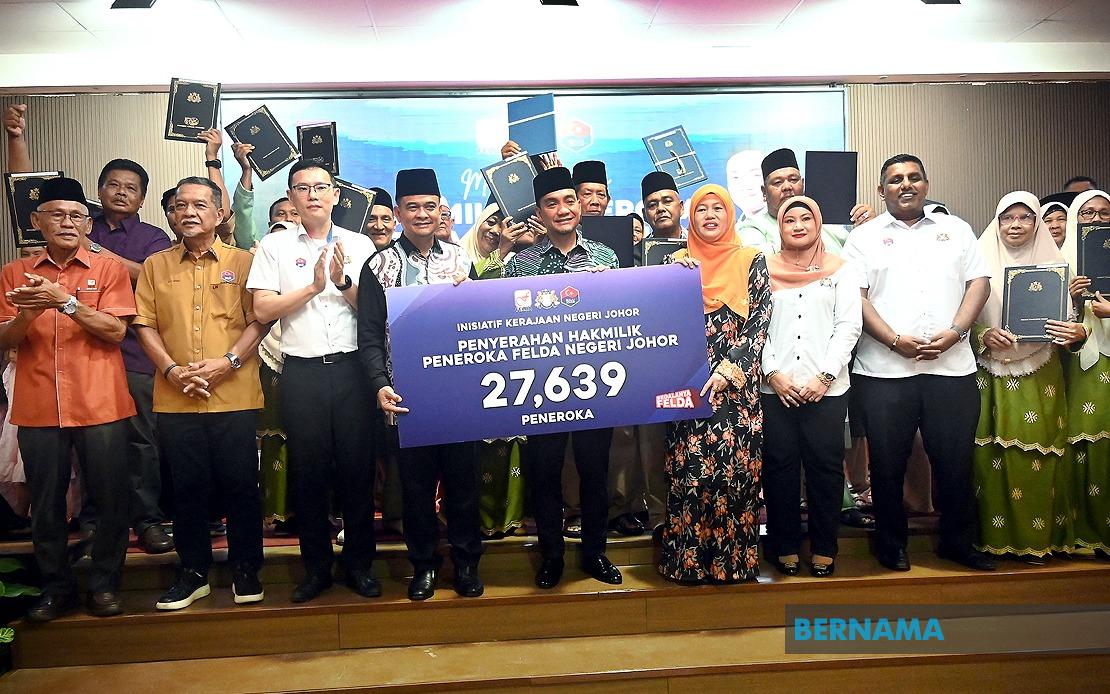
A protracted land ownership dispute that has shadowed Federal Land Development Authority communities in Johor for years has reached near-complete resolution, with the state government confirming that 27,639 of 27,642 outstanding title applications have been processed and approved. The breakthrough represents a significant administrative achievement in a state where rural land rights have long remained contentious, affecting thousands of smallholder farmers whose legal standing over their plots had remained ambiguous despite decades of occupation and cultivation.
Johor Menteri Besar Datuk Onn Hafiz Ghazi announced the milestone during a land title presentation ceremony held in Kluang on June 23, where 210 settlers from Kluang, Kota Tinggi and Mersing received formal certificates conferring legal ownership of their residential and plantation land. The ceremony represented both a practical conclusion to administrative processing and a symbolic moment for communities that had waited generations for formal recognition of their property rights. Each recipient walked away with documentation that transforms their status from long-term occupiers to registered proprietors, a distinction carrying profound implications for inheritance, mortgaging, and agricultural development.
The resolution of this issue carries particular weight in Malaysian rural politics, where FELDA settlements have historically served as both economic development engines and political constituencies. When land titles remain unresolved, settlers face practical obstacles in securing credit from financial institutions, as banks typically require clear documentary evidence of ownership before extending agricultural loans. This structural constraint has impeded agricultural modernisation and diversification across FELDA schemes, leaving farmers unable to leverage their assets for expansion or mechanisation. The completion of the titling process therefore opens pathways for economic advancement that had previously been foreclosed.
Johor's commitment to addressing this longstanding grievance reflects recognition that rural land security underpins both individual household stability and broader agricultural competitiveness. In an era when Southeast Asian nations compete increasingly on agricultural productivity and value addition, clarity around land rights becomes foundational. Without secure tenure, farmers hesitate to invest in soil improvements, irrigation systems, or transition to higher-value crops. The psychological and economic benefits of holding formal title extend beyond finance; they encompass dignity, intergenerational stability, and the psychological investment that ownership status confers. For FELDA communities that have known uncertainty about their fundamental asset, this resolution carries meaning that transcends paperwork.
The state government framed this achievement as integral to a broader rural development strategy rather than merely a bureaucratic clearance exercise. Datuk Onn Hafiz Ghazi positioned FELDA settlements as priority constituencies within Johor's development architecture, signalling that the state administration views smallholder welfare and land security as strategic state matters rather than marginal concerns. This rhetorical positioning, backed by tangible action, attempts to rebuild confidence among rural constituencies that may have grown sceptical of government responsiveness to their concerns. For FELDA settlers, many of whom occupy politically significant constituencies, this attention carries electoral implications alongside practical benefit.
The 99.99 percent resolution rate represents a near-total administrative success, though the remaining handful of unresolved applications warrant attention. These final cases likely involve unusual circumstances—disputed boundaries, conflicting claims, inheritance complications, or documentation irregularities—that prevented straightforward processing. Understanding why these cases remain pending, and what timeline exists for their resolution, will indicate whether the state government truly considers the matter closed or whether loose ends persist. Complete transparency about remaining obstacles would strengthen public confidence in the finality of the achievement.
Felda land settlement schemes throughout Malaysia have long operated in a legal grey zone where occupancy extended far longer than formal title recognition. This gap between possession and documented ownership reflected historical patterns of land development under which settlers received use rights without immediate legal formality. Over decades, as settlement communities matured and property took on inheritance significance, the absence of formal title became increasingly problematic. Young people raised within these settlements found they could not formally claim their family land, creating generational tensions and blocking wealth transfer. Resolution of this issue therefore addresses accumulated injustices extending across multiple family generations.
The involvement of Johor Agriculture, Agro-based Industry and Rural Development Committee chairman Datuk Zahari Sarip at the ceremony underscores government efforts to position land titling within broader agricultural modernisation initiatives. By connecting land security to agribusiness development and rural competitiveness, state authorities attempt to link individual farmer welfare with state-level economic diversification goals. Johor's agricultural sector, whilst historically significant, has faced pressure from urbanisation, labour scarcity, and competition from cheaper regional producers. Clarifying land rights and strengthening farmer confidence may contribute modestly toward agricultural revitalisation, though wider structural challenges remain.
For Malaysian policymakers beyond Johor, this resolution effort offers a replicable model for addressing similar land title backlogs in other states. Federal Land Development Authority schemes operate nationally, and comparable unresolved title applications likely persist in other regions. The Johor experience demonstrates that administrative focus, political will, and adequate resourcing can substantially reduce such backlogs. Other states contemplating similar initiatives might examine Johor's approach, timelines, and resource allocation to establish their own clearance programmes. Nationwide resolution of FELDA land title issues would constitute major social policy achievement with implications extending across Malaysia's rural economy.
Looking forward, completion of title processing opens subsequent questions about how FELDA settlements evolve within contemporary rural governance frameworks. With secure ownership established, settlers and their families may pursue agricultural intensification, land consolidation, or alternative economic activities. The policy environment surrounding FELDA schemes—including support for crop diversification, market access, agricultural financing, and value-chain participation—becomes increasingly relevant. Land security alone does not guarantee prosperity; it creates necessary conditions upon which other developmental initiatives must build. The Johor government's follow-through on supporting FELDA communities beyond title resolution will determine whether this administrative achievement translates into genuine economic advancement for settlers and their families.