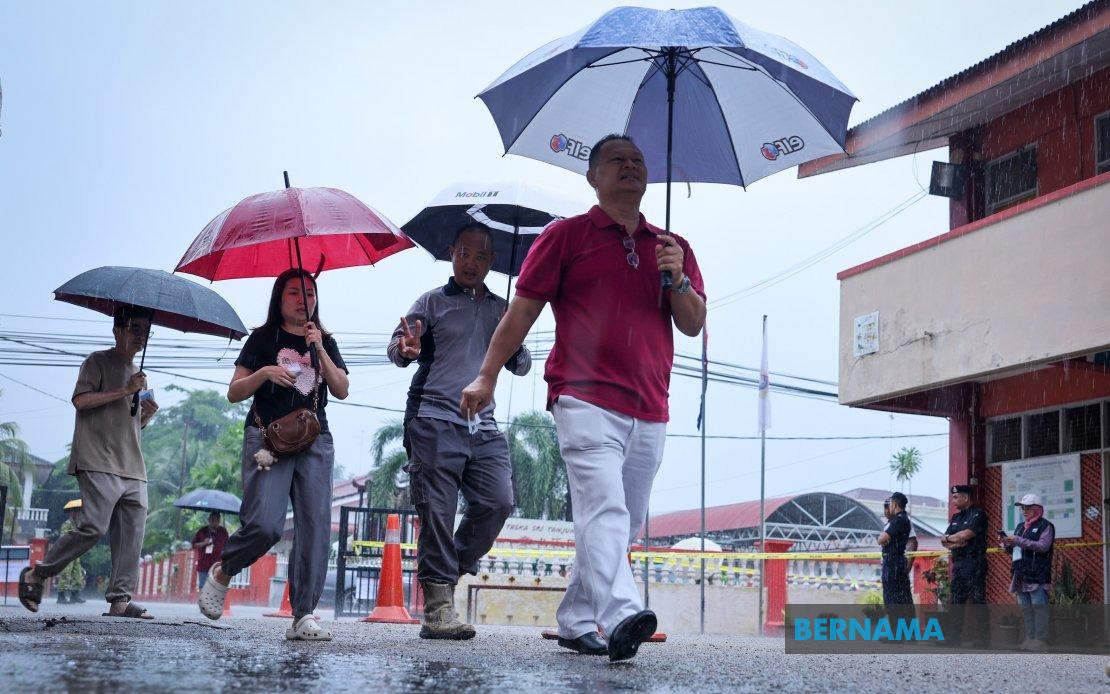
Voting for Johor's 16th state election unfolded on July 11 under predominantly clear skies, though residents in the Muar area faced persistent heavy rain from early morning—a weather pattern that proved typical for the monsoon season but did little to suppress voter participation across the state's 1,076 polling stations.
The Election Commission had mobilised its officers, security contingents, and official observers to polling centres nationwide well before the 8am start time, with teams arriving at facilities as early as 7am to ensure smooth operations. This advance positioning reflected the scale and complexity of managing simultaneous voting across a state with significant geographic spread, from coastal towns like Mersing to urban centres and rural communities in Batu Pahat and Kulai.
At Sekolah Kebangsaan Seri Pantai in Mersing, bright sunshine welcomed early voters including elderly citizens and persons with disabilities who exercised their voting rights before the midday heat intensified. The pleasant conditions at the school contrasted sharply with the morning atmosphere in Muar, where continuous rainfall created challenging conditions for both voters navigating slippery paths and poll workers managing paper-based voting materials under temporary shelter arrangements.
Comparable fair weather greeted voters at Dewan Raya Taman Ungku Tun Aminah in central Johor Bahru, the state capital, as well as at SMK Senggarang in Batu Pahat and SJKC Kulai. These multiple reports of clear conditions suggested that the rainfall pattern affecting Muar represented a localised phenomenon rather than a statewide weather system, a distinction important for understanding voter accessibility issues across different districts.
The Muar district's experience with heavy precipitation demonstrates how Malaysian weather patterns can impact electoral logistics without necessarily affecting voter commitment. Despite the challenging conditions, citizens still arrived at SJKC Limbong and Sekolah Kebangsaan Ismail 1 in that district to cast their votes, suggesting that weather considerations ranked secondary to the civic imperative many Johoreans felt about participating in state governance.
Approximately 2.7 million registered voters across Johor had the opportunity to select representatives for 56 state assembly seats, with 172 candidates competing for these positions. This substantial voter population and candidate field made the election one of Malaysia's more significant state-level political contests, with outcomes potentially reshaping regional influence among the country's major political coalitions and emerging forces.
Voting commenced punctually at 8am, with the Election Commission having established staggered closing times for different polling stations—a standard mechanism to manage the physical logistics of vote counting and allow sequential tallying rather than creating bottlenecks at central counting facilities. This phased approach meant that results began emerging gradually as evening progressed rather than in a compressed rush that might invite procedural errors or scrutiny challenges.
Entering the election, the political landscape reflected significant fragmentation across Malaysia's multiparty system. Barisan Nasional had previously controlled 40 of the 56 seats before the state assembly's dissolution on June 1, a commanding but not overwhelming majority that left room for substantial opposition influence. Pakatan Harapan held the second position with 12 seats, Perikatan Nasional maintained three seats, and the newer Malaysian United Democratic Alliance (MUDA) occupied one seat—a distribution suggesting that Johor politics involved not merely a two-bloc contest between BN and PH, but increasingly complex three-way or four-way competition depending on district-level dynamics.
This electoral configuration carried implications extending beyond Johor's borders. As Malaysia's second-largest state by population and a crucial economic centre, Johor's political direction influences federal politics and the broader regional balance of power in Southeast Asia's most politically volatile democracy. A substantial shift in state assembly composition could affect the Pakatan Harapan coalition's overall parliamentary strength at the federal level, potentially reshape Perikatan Nasional's positioning ahead of future national elections, and signal whether newer parties like MUDA could consolidate or expand their foothold.
For Malaysian voters and observers tracking state-level developments, the Johor election represented a test of how political preferences have evolved since previous electoral contests. Regional factors including economic performance, development priorities, communal relations, and leadership perceptions would all manifest through the voting patterns recorded across the state's diverse constituencies, from urban Johor Bahru to agricultural zones and established Malay-majority rural districts.
The operational success of conducting elections across such geographic and demographic diversity—managing polling centres in areas experiencing heavy rainfall, accommodating vulnerable voter groups, and coordinating security and election oversight—demonstrated the institutional capacity that sustained Malaysia's democratic practices despite their occasional controversies and polarisation. Weather challenges and geographic variation ultimately presented minor complications compared to the fundamental organisational achievement of facilitating mass democratic participation.

