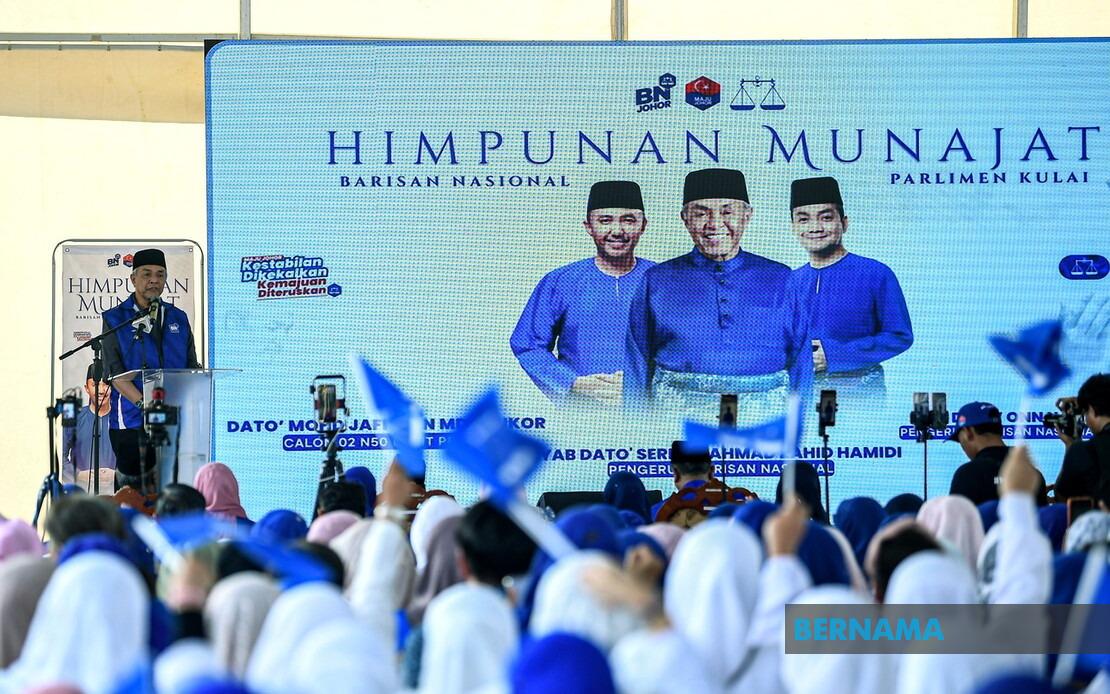
Malaysia's federal government will remain stable regardless of tomorrow's Johor state election outcome, according to Barisan Nasional chairman Datuk Seri Dr Ahmad Zahid Hamidi, who sought to reassure both coalition partners and the public that competing political interests at the state level will not fracture the national administration.
The Deputy Prime Minister and Rural and Regional Development Minister made the assurance while addressing supporters at a Barisan Nasional gathering in Kulai on July 10, ahead of voting in the 16th Johor State Election. His comments reflect growing attention to potential friction within the federal coalition as both major political blocs intensify campaigns across all 56 state constituencies.
Ahmad Zahid emphasised that the federal government has continued functioning smoothly throughout the campaign period, with no signs of institutional strain despite the competitive dynamics playing out on the ground in Johor. He highlighted the conduct of Cabinet members, crediting them with maintaining clear separation between their roles in the national administration and their political activities in the state contest.
The underlying concern addressed by his remarks speaks to a broader challenge facing Malaysia's coalition government: balancing intense electoral competition at the state level with the need for cohesion at the federal level. Barisan Nasional and Pakatan Harapan are pitted against each other in Johor, yet both blocs contain parties and ministers who must work together in Cabinet meetings and parliamentary proceedings. This structural reality has occasionally tested Malaysian political discipline, particularly when state elections touch on sensitive governance issues or resource allocation.
Ahmad Zahid's statement that ministers and deputy ministers have "consistently demonstrated professionalism" serves as both an observation and an implicit appeal for continued restraint. He acknowledged that campaign rhetoric inevitably becomes more pointed during elections, with party representatives highlighting policy differences and attacking rivals' track records to boost their candidates' prospects. However, he drew a distinction between the heated nature of electoral competition and the measured deliberation that characterises Cabinet operations.
The minister noted that despite differing views articulated during the Johor campaign, Cabinet members engage in "deliberate, amicable and professional" discussions when governing the nation. This framing attempts to normalise the apparent contradiction between aggressive political competition and cooperative governance, suggesting that both can coexist if leadership maintains appropriate boundaries and discipline.
Ahmad Zahid also extended an appeal to grassroots party members and supporters, urging emotional restraint in the aftermath of election results. He referenced the maturity demonstrated by top leadership of both Barisan Nasional and Pakatan Harapan, suggesting that senior figures have set an example of professionalism that should cascade through party structures. This appeal carries particular significance given the historical tendency for election results to trigger celebrations or recriminations that sometimes spill into broader political tensions.
The timing of his statement—on the eve of voting—underscores the precautionary nature of the messaging. By preemptively addressing potential disruption, Barisan Nasional leadership appears conscious of vulnerabilities within the federal coalition. Any perception of instability or backbiting following the election could damage the government's credibility and provide ammunition to opposition figures.
For Malaysian observers, the statement also reflects the complexity of the country's current political configuration. Unlike systems where a single party dominates government or where electoral competition is clearly demarcated, Malaysia operates with fluid coalitions where parties sometimes cooperate federally while competing intensely at state level. This requires extraordinary levels of political discipline and mutual trust, particularly when elections occur frequently across different levels of government.
The Johor election carries particular weight because the state has historically been a Barisan Nasional stronghold, and its governance significantly influences national political dynamics. A convincing Barisan Nasional victory would strengthen the coalition's position nationally, while a Pakatan Harapan breakthrough would mark a significant realignment. Either outcome could trigger internal reassessments within the coalitions about partnership sustainability and resource allocation, making Ahmad Zahid's advance reassurances about federal stability strategically important.
The minister's emphasis on procedural professionalism rather than substantive policy harmony also reflects a pragmatic acknowledgment of reality. The federal government comprises parties with sometimes divergent interests and ideologies; maintaining unity requires focusing on operational competence and institutional respect rather than pretending deep philosophical differences do not exist.
Looking forward, the extent to which federal government stability withstands the Johor election outcome will provide important signals about the resilience of Malaysia's current political arrangement. If the coalitions manage to compartmentalise state-level competition without federal consequences, it would demonstrate that the system can accommodate multiple levels of political contestation. Conversely, any subsequent federal instability would suggest that such compartmentalisation has limits, carrying implications for how future state elections and federal governance intersect across Southeast Asia's largest democracy.

