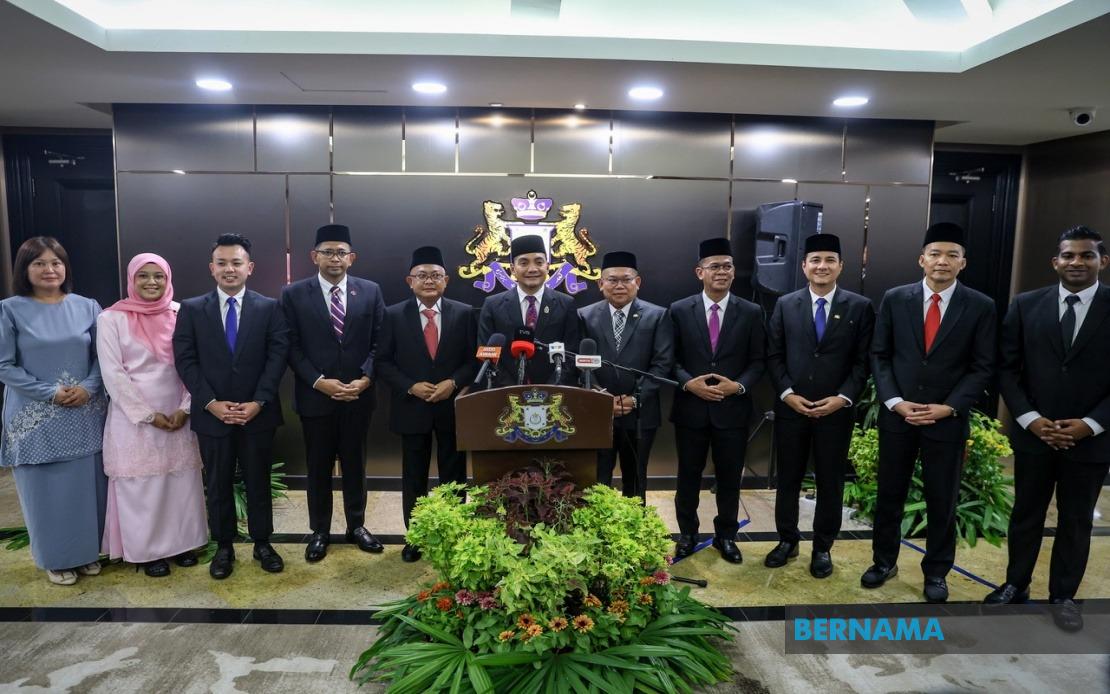
Johor is restructuring its state executive apparatus by installing ten deputy chairmen across key government committees, a move announced by Menteri Besar Datuk Onn Hafiz Ghazi in Kota Iskandar. The administrative reshuffle signals the state government's commitment to managing an increasingly complex development agenda whilst maintaining momentum towards its 2030 targets for economic and social transformation.
The appointment decision emerged from recognition that Johor's expanding policy commitments and infrastructure projects require deeper institutional capacity than existing arrangements can provide. As the state pursues ambitious industrialisation, urban development, and service improvement initiatives simultaneously, officials identified bottlenecks in committee-level coordination that warranted structural relief through additional leadership roles. The appointments received formal approval from Tunku Mahkota Ismail, the Regent of Johor, underscoring their constitutional significance within the state's governance framework.
Onn Hafiz positioned the reshuffling within Johor's broader developmental architecture, specifically referencing alignment with the Maju Johor 2030 framework and the Johor Economic Transformation Plan. These are not routine administrative housekeeping measures but tactical deployments designed to accelerate implementation of high-priority state initiatives. The deputy committee structure essentially creates an additional operational layer capable of handling intensive project supervision, inter-agency coordination, and constituent troubleshooting that might otherwise overwhelm existing chairmen managing increasingly diverse portfolios.
The functional expectations placed upon these appointees extend considerably beyond ceremonial positions. Each deputy chairman must establish close working relationships with their corresponding full committee chairman, coordinate across relevant government departments and statutory bodies, and maintain field presence ensuring grassroots communities understand and benefit from state programmes. This operational proximity to implementation—rather than merely strategic oversight—represents a deliberate attempt to translate policy announcements into tangible service improvements that Johor residents experience directly.
For Malaysian watchers of state governance, the expansion is instructive regarding how regional governments approach institutional adaptation under growth pressure. Whilst federal-level administrative reform often moves slowly through bureaucratic and political resistance, state-level restructuring can proceed more agilely when political leadership achieves consensus around developmental imperatives. Johor's decision reflects pragmatic recognition that good intentions and ambitious plans produce disappointing results without corresponding institutional machinery to shepherd implementation.
The timing carries secondary significance as well. Johor, traditionally Malaysia's economic powerhouse alongside Selangor, faces intensifying inter-state competition for investment and talent in Southeast Asia's post-pandemic economy. States demonstrating organisational effectiveness and delivery capability gain competitive advantage in attracting foreign direct investment and domestic capital. Strengthening committee structures signals to investors and markets that Johor's government possesses both clear vision and practical capacity to execute it, differentiating the state from competitors offering aspirational frameworks without comparable institutional grounding.
The appointment process itself also reflects continuity in Onn Hafiz's leadership approach since his 2022 assumption of the Menteri Besar position. His administration has consistently emphasised collaborative governance, multi-level coordination, and institutional strengthening over personality-driven leadership. This structural approach builds resilience into state administration by embedding accountability and responsibility across multiple officials rather than concentrating power and decision-making in individual hands, an increasingly important consideration given Malaysia's vulnerability to leadership transitions and political uncertainty.
For businesses operating within Johor, the expanded committee structure potentially accelerates permit approvals, project clearances, and regulatory compliance processes. Deputy chairmen focused specifically on economic sectors or sectoral development could expedite transactions that previously languished in single-chairman bottlenecks. Industrial operators, property developers, and infrastructure contractors have material interest in whether institutional reconfiguration translates into measurable improvements in government responsiveness and decision velocity.
The appointment announcement also provides implicit recognition that Johor's past administrative arrangements, whilst adequate for previous stages of development, require augmentation to accommodate current complexity. Rather than viewing this as administrative failure, it represents appropriate institutional evolution matching organisational design to actual operational demands. Successful governments periodically refresh their structures; stagnation typically indicates either complacency or incapacity to acknowledge changing requirements.
Looking forward, the success of this restructuring will ultimately depend on whether deputy committee chairmen receive genuine decision-making authority and resource allocation rather than serving as figurehead positions absorbing blame without wielding influence. The Malaysian political context contains numerous examples of structural reforms that produced magnificent organisation charts whilst preserving traditional power concentrations that rendered new positions largely ceremonial. Onn Hafiz's track record suggests greater commitment to substantive devolution, but implementation monitoring will remain essential.
The appointments also occur within Johor's broader positioning within Malaysia's evolving federal balance. As states increasingly assume responsibility for service delivery and economic development whilst federal governance faces recurrent transitions, regional governments demonstrating organisational sophistication and results-orientation gain political leverage within national policy conversations. Johor's visible commitment to administrative strengthening subtly reinforces its claim to continued resource allocation and policy autonomy from Kuala Lumpur.
For regional observers across Southeast Asia, Johor's institutional adaptation offers modest but genuine lessons regarding how subnational governments can incrementally upgrade capacity without requiring complete bureaucratic overhauls or external consultation. The expansion remains fundamentally conservative—adding positions rather than restructuring fundamentals—yet potentially effective if executed with genuine commitment to empowering new appointees and measuring performance outcomes rather than merely creating additional hierarchical layers that duplicate existing decision-making without improving it.

