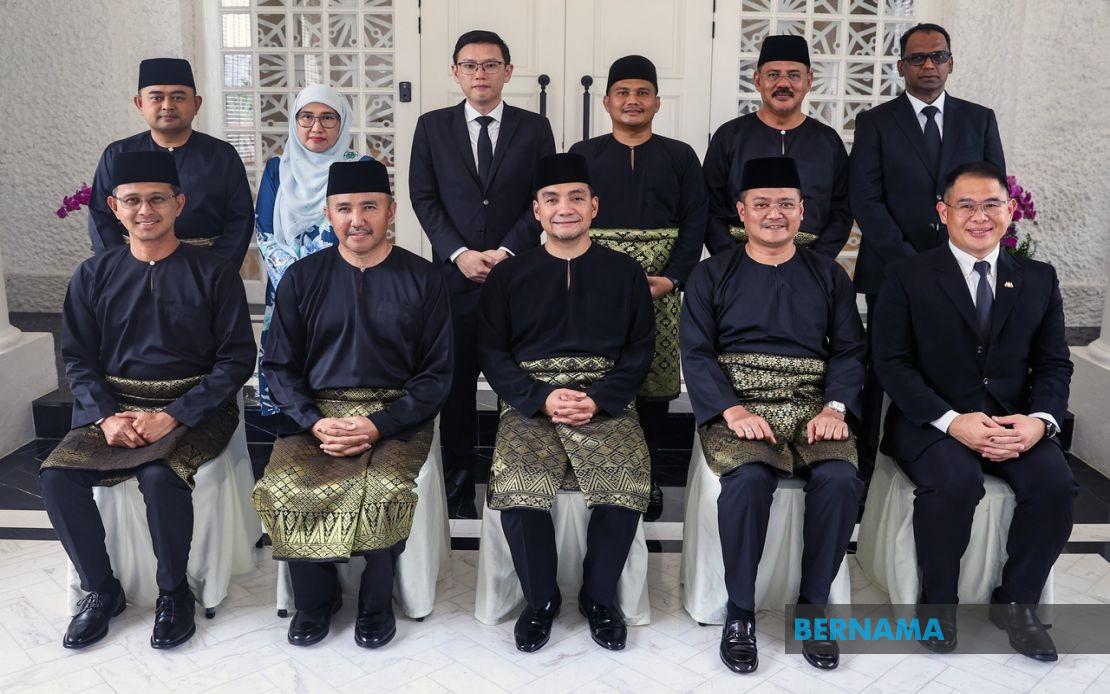
Johor's new state executive council has formally taken shape with the appointment of ten members at a ceremony held at Istana Bukit Serene in Johor Bahru on July 18, marking the final piece in the state government's administrative puzzle following the recent state election. The Regent of Johor, Tunku Mahkota Ismail, presided over the oath-taking and presentation of appointment letters, cementing the leadership structure that will guide the state through its new term. The composition balances continuity with fresh perspectives, retaining six experienced council members from the previous administration while integrating four new faces into the governing body.
The four newly appointed executive council members each bring specific mandates to their respective portfolios. Md Israk Abdullah, representing the Kukup constituency, assumes leadership of the Agriculture, Agro-Based Industry and Rural Development Committee, positioning him to oversee the state's crucial agricultural sector and rural economy initiatives. P. Pannir Selvam, the assemblyman for Perling, takes charge of the Unity, Heritage and Culture Committee, reflecting the state's commitment to preserving and promoting its diverse cultural landscape. Hasrunizah Hassan, who represents Pulai Sebatang, leads the Women, Family and Community Development Committee, addressing social welfare and family-centred policies. Dr Muhammad Naqib Md Ghazali heads the Education and Information Committee, shouldering responsibility for the state's educational framework and public information dissemination.
The appointments came in the aftermath of a commanding electoral performance by Barisan Nasional in the 16th Johor State Election, where the coalition secured 48 of 56 state assembly seats. This overwhelming mandate provided the incoming administration with substantial political capital and legitimacy to pursue its agenda across the state's diverse regions. The decisive victory underscored public confidence in BN's governance model and policy direction, setting a strong foundation for the new leadership team to operate without parliamentary obstruction or significant legislative challenges.
Menteri Besar Onn Hafiz, the Machap assemblyman, commenced his second consecutive term as chief executive just days before the executive council was sworn in. His re-election to the position reflected both his personal political strength—he retained the Machap seat with a commanding majority of 15,375 votes—and the broader voter endorsement of his administration's track record. As concurrent chairman of Johor BN, Onn Hafiz's leadership extends beyond the state government into the coalition machinery, providing him with enhanced influence over party dynamics and strategic direction in the state's political landscape.
The retained members of the executive council bring institutional memory and established expertise to their respective domains. Datuk Mohd Jafni Md Shukor continues overseeing housing and local government matters from the Bukit Permai seat, an area often considered crucial for managing urban development and municipal governance. Mohd Hairi Mad Shah remains responsible for youth, sports, entrepreneurial ventures and cooperative development from Larkin, sectors vital for economic diversification and youth engagement. Mohd Fared Mohd Khalid maintains his grip on Islamic religious affairs from Semerah, a sensitive portfolio given the religious and cultural composition of Johor's population. Ling Tian Soon, representing Yong Peng, continues leading health and environmental initiatives, addressing public health concerns and sustainability challenges. Lee Ting Han from Paloh heads the investment, trade, consumer affairs and human resources committee, critical for attracting business investment and managing labour relations. Mohamad Fazli Mohamad Salleh oversees public works, transport, infrastructure and communications from Bukit Pasir, a portfolio managing essential state services and connectivity.
The composition of the executive council reflects deliberate efforts at demographic and geographic representation. The presence of four new members signals openness to injecting fresh perspectives and ideas into governance structures, potentially bringing younger legislators and diverse viewpoints into decision-making circles. Simultaneously, retaining six experienced council members ensures continuity in policy implementation and institutional knowledge transfer, avoiding the disruption that wholesale administrative overhauls might create. This balance between innovation and stability represents a measured approach to governance consolidation.
For Malaysian observers, Johor's executive council restructure offers insights into how state-level administrations manage transitions following electoral victories. Unlike some state capitals where administrative appointments might become sources of internal coalition tension, Johor's relatively smooth transition suggests effective coordination between party leadership and the Menteri Besar's office. The ethnic and professional diversity represented across the ten-member council—from agricultural specialists to religious affairs administrators—indicates recognition that modern state governance requires portfolios addressing interconnected economic, social and cultural dimensions.
The strategic importance of agriculture and rural development portfolios, evident from Md Israk's appointment as committee chairman, reflects broader recognition of Johor's significant agricultural base and the need to modernise farming practices while supporting rural communities. Similarly, the emphasis on education and information through Dr Muhammad Naqib's appointment acknowledges the state government's role in shaping public discourse and investing in human capital development. These portfolio assignments suggest the incoming administration's policy priorities will extend beyond standard infrastructure and security concerns to encompass economic transformation and social development.
The women, family and community development portfolio gains prominence with Hasrunizah Hassan's appointment, signalling potential focus on social policies affecting households and vulnerable populations. In an era where inclusive governance increasingly depends on addressing specific community needs, this portfolio's leadership carries weight in determining whether state policies adequately reflect and support diverse family structures and women's participation in economic and civic life. The appointment of a woman to lead this committee, rather than assigning it to a male counterpart, represents a deliberate choice about portfolio ownership and lived experience in policy formulation.
The unity, heritage and culture committee, now under P. Pannir Selvam's charge, manages a particularly sensitive brief in Johor given the state's role as a major economic centre attracting workers from across Malaysia and the region. How this committee balances the promotion of Johor's distinctive cultural identity with fostering integration among diverse populations may influence social cohesion and community relations across state lines. The appointment of a non-Malay legislator to this position potentially enables different approaches to heritage preservation and cultural promotion compared to previous configurations.
Looking forward, the established executive council must navigate several interconnected challenges: managing Johor's economic competitiveness amid regional and global shifts, addressing infrastructure bottlenecks in rapidly urbanizing areas, securing sufficient resources for rural development while supporting urban growth, and maintaining social harmony within an increasingly diverse population. The quality of coordination between this executive council and the state assembly, and the effectiveness of the Menteri Besar's leadership in harmonizing different portfolio holders' interests, will largely determine whether this administration's tenure becomes remembered as one of progress or missed opportunities for the nation's most developed state outside the federal territories.

