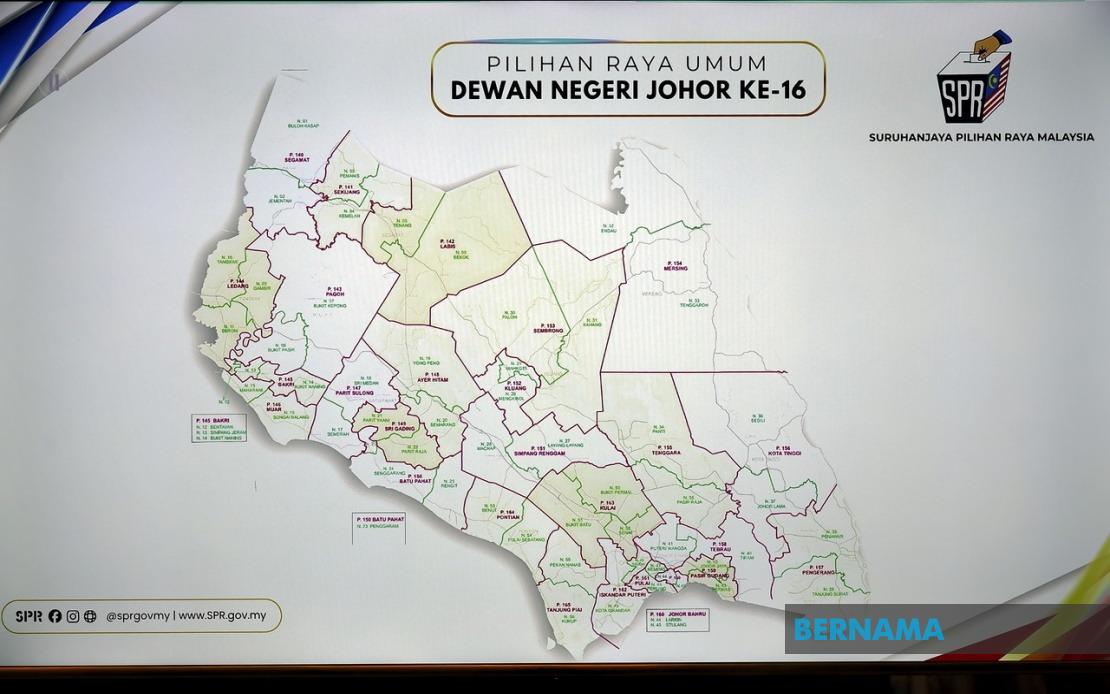
Johor's political landscape shifts into overdrive tomorrow as nomination day formally inaugurates the 16th state election, transforming months of preparation and speculation into a concrete electoral contest. The event represents a watershed moment for the southern state's politics, with candidates from competing coalitions set to file their nomination papers between 9 am and 10 am at designated centres across the state. Once the Election Commission completes its screening process, the full roster of contenders will become public, crystallising the actual battle lines for the July 11 polling day and marking the end of the pre-election manoeuvring that has dominated Johor's political discourse since the state assembly's dissolution on June 1.
The 2.73 million registered voters eligible to participate in this contest represent a substantial electoral force within Malaysia's broader political ecosystem. The electorate comprises more than 2.7 million ordinary voters, augmented by 12,041 military personnel and their spouses as well as 12,710 police officers and their families. This voter composition reflects not merely numerical strength but also the diverse constituencies that shape Johor's political priorities, ranging from urban centres to rural agricultural zones and military-dependent communities. The inclusion of security personnel voting blocs has historically influenced outcomes, particularly when candidates can successfully mobilise these organised constituencies. Early voting opportunities on July 7 will provide flexibility for voters whose work schedules or other commitments might otherwise prevent participation on the main election day.
Pakatan Harapan has committed to contesting every single seat available, deploying 20 PKR candidates, 19 from Amanah, and 17 from DAP across the 56 state assembly divisions. This total commitment strategy signals the coalition's determination to leverage its organisational capabilities and competitive positioning in the state, particularly in urban and semi-urban areas where component parties maintain established support bases. By fielding candidates universally, the coalition avoids strategic retreats that might invite accusations of weakness while simultaneously testing its reach even in traditionally hostile territories. Such comprehensiveness also maximises the coalition's ability to direct second-preference votes and manage tactical voting arrangements with sympathetic constituencies.
Barisan Nasional has matched Pakatan Harapan's full-slate approach with its own 56-candidate lineup, distributing nominations among UMNO's 36 candidates, MCA's 16, and MIC's four representatives. This composition reflects both BN's traditional hierarchical structure and the continuing challenges facing component parties beyond UMNO. The significant gap between UMNO's allocation and the other partners underscores the Malay-majority composition of Johor's electoral landscape, though MCA's 16-seat presence acknowledges the persistent Chinese voting bloc that remains electorally consequential in multiple constituencies. MIC's limited four seats reflects the broader marginalisation of Indian-associated political representation across Malaysian electoral contests, a structural reality that continues to constrain its negotiating position within the broader coalition framework.
Perikatan Nasional's entry into the contest via PAS, Bersatu, and MIPP candidates introduces another layer of complexity to Johor's political dynamics. Fielding 11 PAS candidates, 16 Bersatu, and five from MIPP, Perikatan competes as a coalition alternative with distinctive ideological positioning and organisational structures compared to the other major blocs. PAS's presence particularly matters given its success in capturing Islamic-oriented constituencies across northern Malaysia, though its southern Johor footprint has historically been more limited than BN and increasingly challenged by PH. Bersatu's 16 candidates represent a significant organisational commitment for a relatively newer entity, suggesting leadership invested substantially in contesting for state-level representation.
Beyond the three main coalitions, several smaller parties and new political entrants have announced candidacies, diversifying the electoral landscape further. MUDA, the youth-focused movement that captured significant support in the 2022 federal election and Selangor state polls, is vying for four seats, attempting to sustain momentum from previous performances. The Socialist Party of Malaysia is fielding one candidate, representing ideological diversity on the left end of the political spectrum. Most notably, Parti Bersama Malaysia is making its electoral debut with 15 candidates across the state, representing an attempt by a new entity to establish relevance in Johor's political arena during a state election cycle rather than waiting for federal contests.
The Election Commission has issued explicit reminders to prospective candidates regarding procedural requirements that, while appearing merely administrative, carry substantive implications. Candidates must complete nomination forms and present them within specified timeframes, settle deposit payments promptly, and retain receipts as evidence when submitting final papers. These requirements, though standard across Malaysian electoral contests, become critical pressure points during actual nomination periods when logistical complications can emerge. The EC's proactive communication reflects lessons from previous elections where technical disqualifications eliminated candidates due to documentation failures rather than substantive grounds, a pattern that occasionally generated controversy regarding whether procedural rigidity served democratic principles effectively.
Corruption prevention and electoral integrity enforcement represent parallel concerns animating the regulatory apparatus surrounding this election. The Malaysian Anti-Corruption Commission has issued formal guidance to all candidates and political parties warning against conduct that violates the MACC Act 2009 or the Election Offences Act 1954 as amended in 2012. Such warnings carry both practical and symbolic weight, signalling government commitment to maintaining electoral conduct standards while also establishing a formal record that officials expect compliance. The MACC has bolstered enforcement capacity by activating five dedicated 24-hour operations rooms located strategically across Tampoi, Batu Pahat, Kluang, Segamat and Mersing, creating physical spaces for investigative coordination and public reporting mechanisms. This distributed approach acknowledges Johor's geographic expanse and ensures investigative resources remain proximate to potential violations rather than centralised in distant state capital offices.
The historical context of the 2022 state election provides essential interpretive frameworks for understanding tomorrow's nominations and the subsequent campaign. In that previous contest, Barisan Nasional secured 40 seats, establishing clear dominance, while Pakatan Harapan captured 12, Perikatan Nasional secured three, and MUDA obtained a single seat. This outcome reflected BN's continued strength among Johor's predominantly Malay and Muslim voter populations, though the competitive positioning of opposition parties suggested underlying vulnerabilities in BN's structural support. The intervening two years have witnessed significant national and state-level political developments that may have shifted voter preferences, including evolving perceptions of coalition competence, ideological orientations, and leadership personalities. The extent to which such national currents translate into altered voting behaviour at the Johor state level remains an open empirical question that nomination day's candidate roster and subsequent campaign dynamics will help illuminate.
Johor's electoral significance transcends merely regional relevance given the state's size, economic importance, and historical role as a bellwether indicator of broader Malaysian political trends. As Malaysia's second-largest state economy and a demographic heavyweight, Johor's election outcomes influence national political calculations and coalition positioning in ways that smaller state contests cannot replicate. Control of the state administration carries implications for development priorities, resource allocation, and administrative direction affecting millions of residents. Moreover, Johor's electoral results frequently predict subsequent national-level political movements, making tomorrow's nominations and the ensuing campaign particularly consequential for observers monitoring Malaysia's longer-term democratic trajectory and coalitional realignments.

