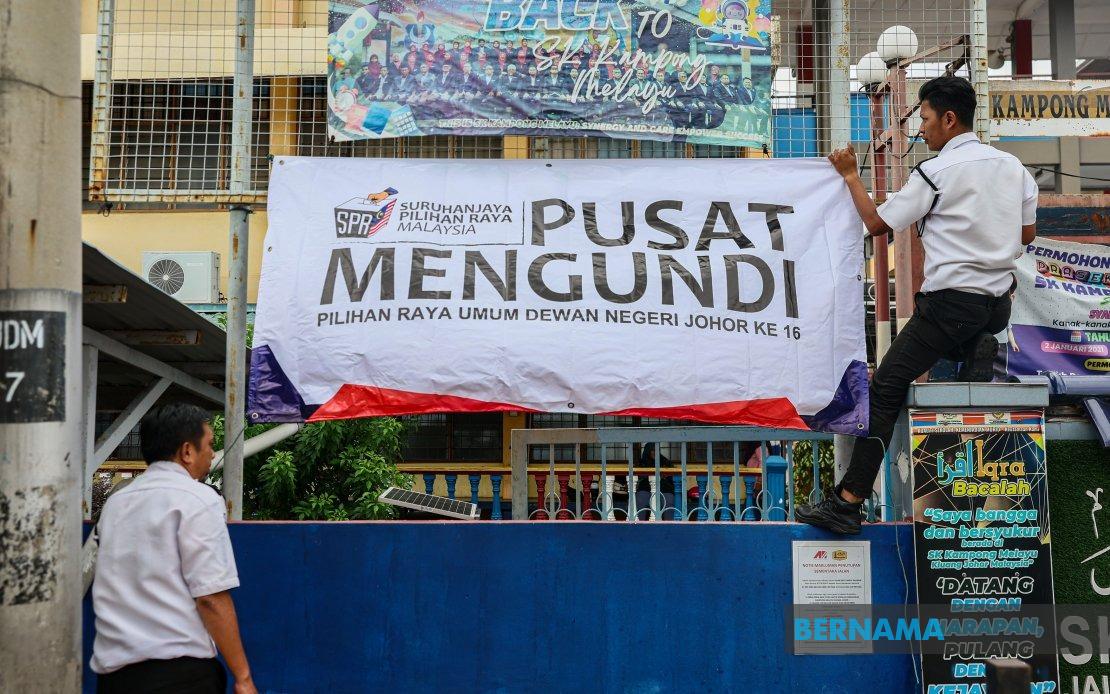
Johor is experiencing a pivotal moment in its political calendar today as more than 2.7 million registered voters head to polling stations across the state to determine representation in the State Legislative Assembly through the 16th state election. The ballot is taking place following the conclusion of a 14-day campaign period that ended at midnight yesterday, with voting now underway to select all 56 state seats. The exercise represents a crucial test of voter sentiment in one of Malaysia's most significant and populous states, where political dynamics have shifted noticeably since the last state election.
Voting commenced simultaneously at 8 am across the state, with a substantial electoral infrastructure deployed to manage the polling process efficiently. The Election Commission has established 1,076 polling centres operating 4,889 individual voting streams to accommodate the large voter population. This extensive logistical operation requires coordination across multiple districts and requires careful management of resources. To support these efforts, the EC has stationed 43,036 election workers throughout Johor, ensuring that voting procedures are conducted smoothly and transparently. The scale of this deployment underscores the complexity of managing elections in a state with Johor's population size and geographical spread.
Polling stations are closing in stages throughout the day, with operations concluding between 11 am and 6 pm depending on location. Remote polling stations on Pulau Besar close earliest at 11 am, while those on Pulau Aur and Pulau Pemanggil conclude voting at noon. The staggered closing schedule accommodates the practical challenges of conducting elections on islands and in geographically dispersed locations. Additionally, 24,677 postal ballots issued to voters must be returned by 6 pm today. Vote-counting is expected to commence immediately after polling closes, with the EC targeting full results as early as 10 pm, allowing for rapid declaration of winners across all contested constituencies.
The Election Commission is targeting approximately 70 per cent voter turnout, representing a significant uplift from the 2022 state election when only 54.92 per cent of eligible voters cast their ballots. This improvement in expected participation reflects growing political engagement and possibly heightened interest in determining Johor's direction following recent political shifts. Should the 70 per cent target materialise, it would demonstrate renewed voter commitment to the democratic process and suggest that issues affecting the state have resonated with the electorate. Weather conditions may influence participation levels, with the Malaysian Meteorological Department forecasting morning rain in Johor Bahru, Batu Pahat, Kulai, Muar, Pontian and Tangkak, though afternoon conditions are expected to improve. Afternoon thunderstorms are anticipated in Kluang, Kota Tinggi and Segamat, with evening thunderstorms likely in Mersing.
Before dissolution of the State Legislative Assembly on June 1, the political landscape showed clear dominance by Barisan Nasional, which held 40 seats compared to Pakatan Harapan's 12 seats. Perikatan Nasional controlled three seats while MUDA held one, reflecting a competitive but clearly stratified political environment. The holding of this election provides an opportunity for parties to contest these positions afresh and potentially reshape the composition of the legislative body. A total of 172 candidates are contesting seats across the 56 constituencies, with both BN and PH fielding 56 candidates each, demonstrating their commitment to contesting comprehensively. Perikatan Nasional is contesting 33 seats, while Parti Bersama Malaysia has put forward 15 candidates. Smaller political entities including MUDA with four candidates, Parti Orang Asli Malaysia with one candidate and Parti Sosialis Malaysia with one candidate are also in the fray, alongside six independent candidates.
The competitive nature of this election reflects broader shifts in Malaysian politics, where state-level contests have become increasingly complex and multipolar. The presence of multiple parties contesting significant numbers of seats suggests fragmentation of the voter base, creating scenarios where coalition-building may prove necessary to form government. Perikatan Nasional's decision to contest 33 seats indicates its ambition to expand influence in Johor, while parties like Parti Bersama Malaysia field candidates to test their political viability. For Malaysian observers, the Johor result will provide important signals about regional political preferences and the health of support for various political coalitions ahead of potential future federal elections.
Employers throughout Johor have been reminded to grant employees reasonable time off to fulfil their voting obligations, ensuring that work commitments do not prevent citizens from exercising their democratic rights. This directive reflects the importance placed on facilitating broad participation and recognising voting as a fundamental civic responsibility. Early voting took place on Tuesday, when 20,607 personnel from the police force, armed forces and their spouses cast ballots ahead of the main election day. This advance voting mechanism accommodates the needs of disciplined forces whose operational requirements may prevent attendance during the main polling day, ensuring their voices are included in the democratic process. The early voting figures, while modest relative to the overall electorate, demonstrate organised participation among specific voter groups.
Johor's political importance within the Malaysian federation cannot be overstated, given its size, economic significance and strategic location. The state is home to major urban centres including Johor Bahru and significant industrial areas, making political control consequential for regional development policy and resource allocation. The composition of the State Legislative Assembly will determine policy priorities for areas including education, infrastructure development and economic management. Results from this election will reverberate across Malaysian politics, signalling voter priorities and potentially influencing strategies adopted by parties in subsequent electoral contests. Political analysts across the region will closely scrutinise the outcome to assess changing voter preferences and the viability of various political formations.
The conduct of the election today represents a moment of democratic exercise for Johor, with voters making choices that extend beyond their state legislative assembly representatives. These ballots will help determine the ideological and policy direction of state governance for the coming years and may influence broader coalition dynamics at the federal level. The expected results by 10 pm will provide clarity relatively quickly, allowing political leadership to begin transitional processes and policy formulation promptly. For Malaysian citizens watching developments in Johor, this election serves as a reminder of the ongoing vitality of democratic processes in the nation and the capacity of voters to shape their political future through participation at the ballot box.

