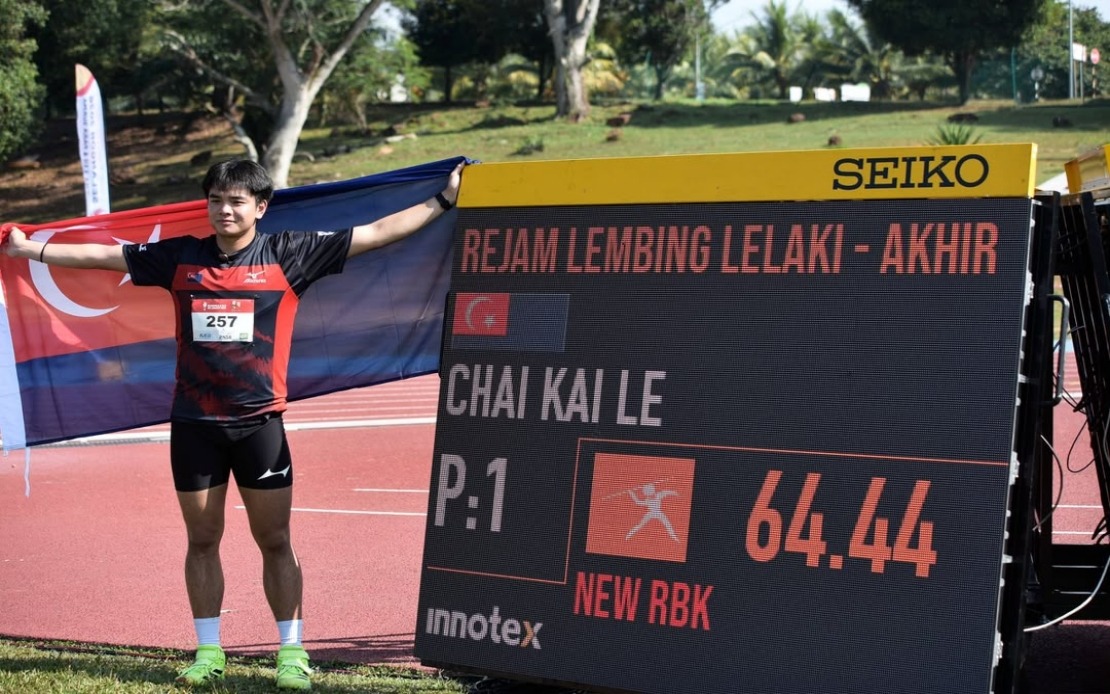
Johor's rising athletic star Chai Kai Le has rewritten Malaysian Games history, obliterating a 26-year-old javelin record that had stood since the turn of the millennium. The 18-year-old produced a commanding performance at the Selangor 2026 SUKMA edition hosted at the Universiti Putra Malaysia Sports Centre in Serdang, launching the javelin 64.44 metres on his second attempt to claim the men's gold medal and erase the previous Games mark of 62.33 metres established by Sarawak's Kho Mei Kuan during the 2000 Penang Games.
Kai Le's dominance in the discipline extended to the podium itself, with his Johor teammate Mohd Noor Iman Norman collecting the bronze medal courtesy of a 59.04-metre throw. Penang's Tan Chun Wei secured the silver position with a respectable 60.43-metre effort, demonstrating the competitive calibre of Malaysian javelin at this year's Games. The trio's results underscore the depth of throwing talent now emerging across the country's athletic pipeline, with younger competitors continuously pushing performance boundaries.
The record-breaking throw assumes greater significance when considered against Kai Le's existing accomplishments at the junior level. The Johor athlete currently holds the national under-20 record of 65.65 metres, a mark that sits just above his Games-winning distance and signals considerable room for further improvement as he progresses through the competitive ranks. This gap between his personal best and today's result hints at the technical refinements and physical conditioning advances that could propel him toward elite international standards within the next few years.
In post-competition remarks to assembled media, Kai Le acknowledged that breaking the Games record fell squarely within his pre-competition objectives, a confidence grounded in sustained preparation spanning two years. His systematic approach to training and competition planning reflects a maturity uncommon in teenage athletes, suggesting coaching support of considerable quality within Johor's athletic development system. The athlete expressed satisfaction with his overall performance, though circumstances during the competition prevented him from executing his complete technical arsenal.
Kai Le disclosed that his second throw, whilst producing the record-breaking distance, came with an unwanted physical cost. A technical miscalculation during the execution phase triggered lower back discomfort and fatigue, sensations that prompted him to adopt a conservative approach for the remainder of the competition. Rather than risk exacerbating any underlying injury, he shifted his strategic focus toward managing his physical condition and preventing further damage. This pragmatic decision-making demonstrates tactical intelligence beyond his years, prioritising long-term athletic development over the temptation to chase additional metres that might have carried injury risks.
Elsewhere on the athletics track, Penang's Mohammad Aiman Haikal Sahrudin claimed the men's 10,000-metre race walk title in dominant fashion, crossing the finish line in 47 minutes and 28.84 seconds. The performance solidified his position as Malaysia's premier race walker at the senior Games level, establishing clear separation from the competition. Kelantan's Ahmad Farish Irfan Ahmad Fahmi secured the silver medal with a time of 47 minutes and 37.17 seconds, while Khor Jing Hong representing the Federal Territories collected bronze in 47 minutes and 49.27 seconds.
Mohammad Aiman's victory represents significant progress in his competitive trajectory, notably upgrading from the silver medal he captured in the same discipline at the previous SUKMA held in Sarawak. The 18-year-old hails from Kampung Tanah Liat in Penang and has begun charting an ambitious pathway through Malaysian sport's competitive ecosystem. His immediate post-victory commentary revealed carefully calibrated ambitions extending beyond SUKMA success, targeting qualification for Malaysia's national race walking squad and eventual participation in the 2027 Southeast Asian Games.
The Penang race walker's strategic planning incorporates an important practical consideration: the SEA Games programme does not feature the 10,000-metre race walk event that constitutes his current specialisation. Consequently, Mohammad Aiman has already identified the 20,000-metre distance as his primary focus moving forward, a discipline he will contest during the current SUKMA edition. This forward-thinking approach to event selection and medium-term planning demonstrates the calibre of support and guidance available to developing Malaysian athletes within the Games system.
Mohammad Aiman's trajectory at SUKMA mirrors a broader pattern of incremental improvement among Malaysian track and field competitors. His transition from silver to gold across consecutive Games editions reflects not merely improved fitness but refined technical execution and competitive maturity. The race walking discipline, long considered a relative strength within Malaysian athletics, continues producing athletes capable of international competitiveness, particularly within the Southeast Asian regional context where the sport maintains higher participation levels than in many other Asian territories.
The achievements of both Kai Le and Mohammad Aiman illuminate important dimensions of how SUKMA functions beyond serving as a mere domestic competition. The Games platform provides crucial developmental opportunities for teenage and junior athletes to test themselves against regional peers, establish baseline performance standards, and build the competitive confidence necessary for progression toward elite representation. The records being broken and personal bests being achieved at Selangor 2026 represent not endpoints but waypoints along longer trajectories of athletic development.
For Malaysian sports administrators and coaches, the performances emerging across Selangor 2026 offer cautiously optimistic indicators regarding the country's athletic capacity for upcoming regional and international competitions. The consistency of record-breaking performances and the visible improvement curves among competitors suggest that investment in grassroots development programmes and targeted coaching infrastructure is beginning to yield tangible results. However, sustaining this momentum will require continued commitment to comprehensive athlete support systems and strategic resource allocation across Malaysia's athletic talent development pathways.

