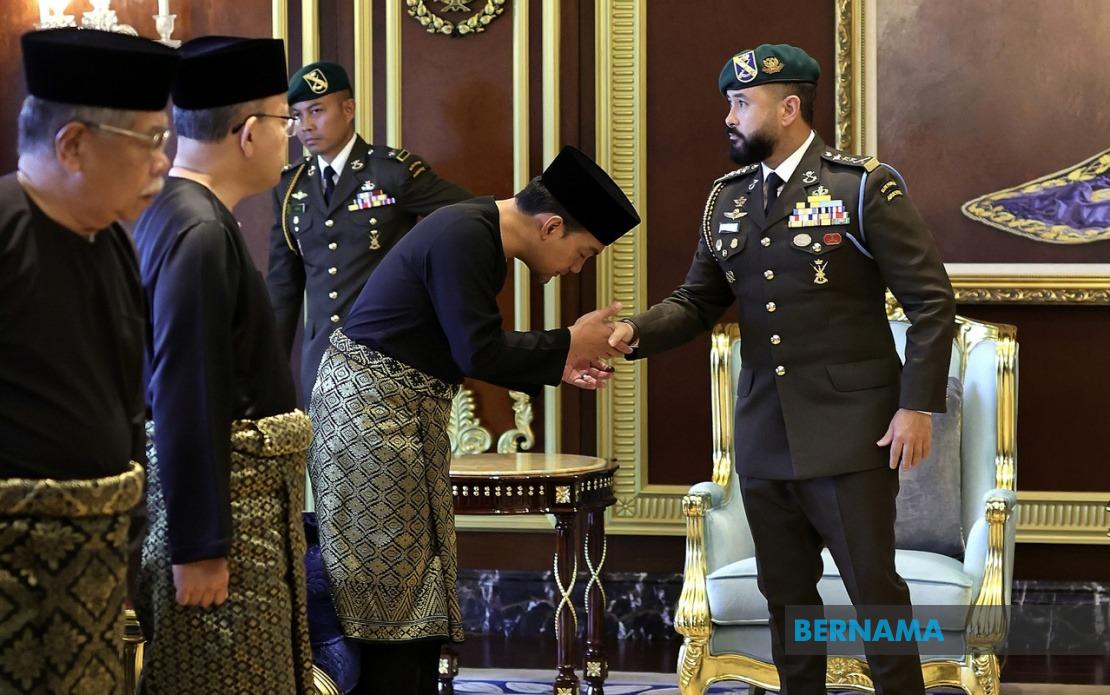
The newly constituted Johor State Executive Council will be formally sworn in tomorrow at Istana Bukit Serene, marking an official transition in the state's administrative leadership. The ceremony represents the culmination of institutional procedures following the state elections and underscores the ceremonial importance placed on formal appointments within Malaysia's constitutional monarchy framework. The Regent of Johor, Tunku Mahkota Ismail, will grace the occasion, reflecting the symbolic role of the royal institution in validating the state's executive authority.
Menteri Besar Datuk Onn Hafiz Ghazi, who was sworn in as Johor's chief executive on July 12, will oversee the swearing-in process as the elected leader mandated to form the government. His participation signals continuity and formal acknowledgment of the chain of command within Johor's political hierarchy. Other dignitaries expected to attend include Johor Council of Royal Court president Datuk Dr Abdul Rahim Ramli and state secretary Datuk Mohammed Ridha Abd Kadir, whose presence underlines the collaborative nature of state governance across administrative and royal institutions.
The timing of this ceremony follows closely on the heels of Datuk Onn Hafiz Ghazi's own investiture, which took place four days earlier. This rapid succession of formal proceedings demonstrates the efficiency with which Johor's political establishment has moved to consolidate its administrative structure following the recent electoral exercise. The compressed timeline reflects the urgency of establishing a fully functional executive body capable of executing government policy and decision-making at the state level.
Barisan Nasional's commanding performance in the 16th Johor State Election provides the political foundation for this new Exco's formation. The coalition captured 48 of 56 state seats, a result that grants substantial legislative authority and allows the government to operate without significant parliamentary constraints. This electoral mandate has empowered Datuk Onn Hafiz Ghazi to construct an executive council aligned with his strategic vision for Johor's development and governance priorities during the forthcoming term.
The palace has extended media invitations to cover the swearing-in ceremony, demonstrating a commitment to transparency in institutional proceedings. Media practitioners will be granted access through the main palace entrances beginning at 9:30 am, allowing public documentation of the formal oath-taking process. This openness reflects evolving standards of governance communication in Malaysia, where ceremonial and constitutional moments are increasingly subject to public scrutiny and media documentation.
For Malaysian readers across the peninsula, Johor's political transition carries significance beyond the state's borders. As the nation's second most populous state and a major economic contributor, Johor's governance trajectory influences broader regional stability and economic performance. The smooth transition of power through constitutionally sanctioned procedures reinforces institutional confidence in Malaysia's federal system, even as different states experience varying political alignments and electoral outcomes.
The composition of the incoming Exco will determine policy direction on critical matters including economic diversification, infrastructure development, and social services delivery. The performance of this particular executive council will be closely monitored by other state governments and analysed by political observers assessing the effectiveness of different coalition arrangements across Malaysia's federal structure. Johor's governance outcomes contribute to the broader national conversation about coalition stability and administrative competence.
The ceremonial dimension of the swearing-in ceremony, presided over by the Regent, reflects constitutional traditions that intertwine royal and democratic authority in Malaysia's system. The Ruler's formal participation in validating the Exco members' oaths reinforces the principle that executive power derives from both electoral legitimacy and constitutional monarchy. This dual legitimacy framework distinguishes Malaysia's political system and remains central to understanding how authority is constituted and exercised within individual states.
Looking forward, the nascent Exco faces inherited challenges and emerging priorities. Infrastructure projects initiated under previous administrations, economic competitiveness concerns in the face of regional competition, and social policy implementation will test the council's administrative capacity. The quality of governance during the coming months and years will substantially influence how stakeholders assess the decision-making capability of this particular leadership configuration and, by extension, the broader competence of the Barisan Nasional coalition in state-level administration.

