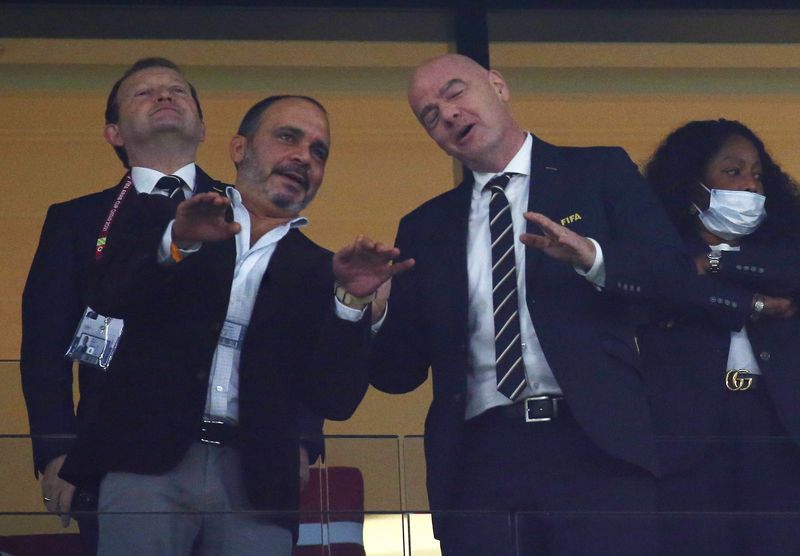
The Jordan Football Association has become the latest body to challenge FIFA's leadership, with President Ali bin Hussein launching a scathing public attack on FIFA President Gianni Infantino. Bin Hussein accused the world soccer governing body of attempting to coerce his endorsement by suggesting that backing Infantino "would go a long way to helping our FA out" — a proposal that came after months of FIFA stonewalling requests for assistance. Speaking through social media on Tuesday, the Jordanian official rejected what he characterised as extortion wrapped in diplomatic language, stating that his association would not bend to such pressure regardless of the consequences.
The confrontation reflects deepening friction within FIFA's upper echelons as Infantino's grip on power weakens. The Swiss administrator had recently attempted to push through a controversial scheme to sell minority stakes in FIFA's commercial operations, a move intended to generate billions in revenue for global sports development. However, national associations and continental confederations soundly rejected the proposal after Infantino imposed a September 19 deadline for acceptance. This high-handed approach backfired spectacularly, prompting even FIFA's own Secretary General Mattias Grafstrom and renowned football strategist Arsene Wenger to distance themselves from the initiative, signalling cracks in the organisation's internal consensus.
For small nations like Jordan, FIFA's bureaucratic maze and apparent indifference to their specific needs have become sources of mounting frustration. Bin Hussein articulated grievances that will resonate across less wealthy football associations across Southeast Asia and the broader Global South. His federation operates with what he termed a "minimal budget", yet must navigate FIFA's complex regulatory framework that often imposes costs disproportionately on smaller football nations. The practical consequences are severe: Jordan's supporters faced exorbitant ticket prices for World Cup matches, and many were denied entry visas despite having legitimate reasons to travel, a failure that combines exclusion with financial burden.
The tax burden imposed on Jordan's World Cup participation stands out as particularly unjust in Bin Hussein's assessment. FIFA facilitated U.S. government taxation of the Jordanian delegation's tournament involvement, a cost that teams from Canada and Mexico avoided despite competing in the same venue. This reveals an arbitrary disparity in how FIFA manages participating nations' obligations, essentially penalising Jordan for geography. The financial hit has been significant, with funds that should have been redirected to players and coaching staff instead flowing to American tax authorities through FIFA's administrative apparatus.
Jordan's maiden World Cup qualification in 2022 was a historic achievement for the kingdom's football programme, yet the experience has been tainted by unresolved financial matters and administrative obstacles. Having impressively reached the Arab Cup final in Qatar, the association remains owed substantial prize money months after the tournament concluded — funds that FIFA claims to have in abundant reserve. This delay underscores what Bin Hussein sees as FIFA's casual disregard for smaller associations' operational needs. The contrast between FIFA's self-proclaimed financial robustness and its reluctance to promptly settle legitimate payouts highlights the governance gap between the world body's affluence and its accountability.
Bin Hussein framed these grievances as symptomatic of leadership dysfunction at FIFA. The pattern of withholding support conditional on political backing, combined with seemingly arbitrary cost allocation and delays in promised payments, paints a picture of an organisation more focused on internal power consolidation than on serving its global membership equitably. His public stance demonstrates that smaller nations are increasingly willing to challenge FIFA's authority when their basic operational needs go unmet and when they perceive coercive conduct.
The timing of Bin Hussein's denunciation carries strategic significance. Infantino's World Cup minority stake proposal foundered largely because confederations and national associations recognised the scheme's self-serving nature. By allowing the FIFA president to face sustained opposition without mounting a coordinated defence, football's leadership has signalled reduced appetite for Infantino's expansionist ambitions. Bin Hussein's intervention adds another voice to a growing chorus questioning whether FIFA's current administration can effectively represent the interests of its diverse membership.
For Malaysian and Southeast Asian football associations, Jordan's experience offers cautionary lessons about navigating FIFA's labyrinthine structures. Nations of modest football infrastructure and budgets must contend not only with competitive disadvantages on the pitch but also with institutional biases that favour larger, wealthier confederations. The expectation that smaller associations should provide political support in exchange for basic operational assistance represents a corruption of FIFA's fundamental purpose.
The allegations also underscore broader governance concerns within international sports organisations. When a world body operates with minimal transparency, delegates uncertain accountability mechanisms, and leadership capable of weaponising support allocation, smaller member nations become vulnerable to manipulation. Bin Hussein's public refusal to compromise on principles despite potential consequences demonstrates that some football leaders are willing to absorb short-term disadvantage rather than legitimise FIFA's coercive methods.
Going forward, these revelations may embolden other associations to raise long-festering grievances. If Jordan's voice catalyses broader demands for FIFA reform — particularly around transparent cost allocation, timely payment of tournament winnings, and equitable treatment regardless of national football market size — Infantino's presidency could face its most serious internal challenge yet. The Jordanian chief's stance suggests that even peripheral players within FIFA's hierarchy are beginning to question whether current leadership serves the world game's democratic ideals or merely perpetuates a patronage system benefiting the few at the expense of the many.

