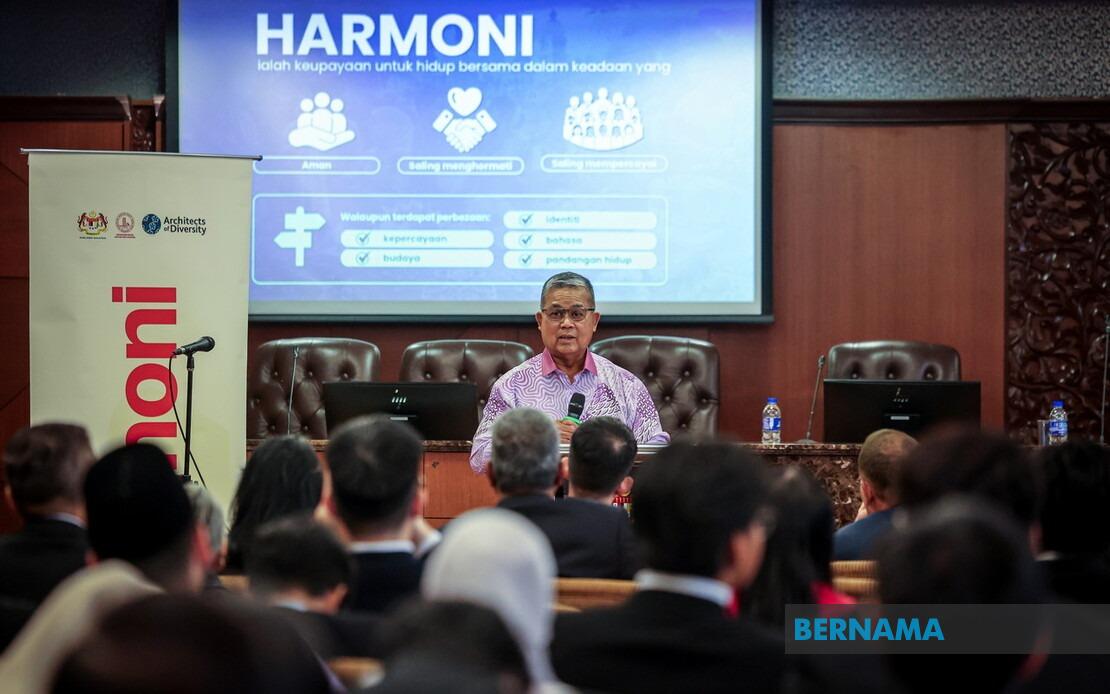
The Department of National Unity and National Integration (JPNIN) is undertaking a comprehensive research initiative to develop a Community Tension Index that will serve as a sophisticated tool for measuring social cohesion and tracking the prevalence of racial and religious sensitivities throughout Malaysia. The effort represents a significant shift toward data-driven policymaking in the nation's approach to preserving inter-community harmony, reflecting growing recognition that early warning systems are essential in a rapidly digitalising society where tensions can escalate with unprecedented speed.
According to Datuk Aaron Ago Dagang, Minister of National Unity, the index findings will function as a strategic reference point for government decision-making, enabling officials to develop preventive interventions before sensitive issues escalate into broader social friction. By establishing baseline measurements and tracking trends over time, the government aims to move away from reactive crisis management toward proactive community engagement that strengthens the bonds holding Malaysia's ethnically and religiously diverse population together.
The initiative gains particular urgency given the rapid migration of social tensions into the digital realm. Between January and the end of January 2026, the Malaysian Communications and Multimedia Commission (MCMC) removed 1,493 pieces of online content specifically related to religion, royalty and race—the so-called 3R issues that constitute the most sensitive flashpoints in Malaysian society. This substantial volume of problematic posts within a single month underscores the scale of the challenge authorities face in maintaining a harmonious information environment.
Minister Dagang highlighted a troubling digital phenomenon that compounds these concerns: the algorithmic creation of "filter bubbles" and "echo chambers" on social media platforms. These self-reinforcing information environments allow users to encounter predominantly viewpoints matching their existing beliefs, effectively narrowing exposure to diverse perspectives and reducing opportunities for genuine cross-community understanding. The resulting polarisation creates widening psychological and ideological gaps between different segments of Malaysian society, even as physical proximity in shared urban spaces might suggest greater interaction opportunities.
The timing of JPNIN's initiative coincides with broader governmental efforts to strengthen institutional frameworks around national harmony. As part of this longer-term strategy, the department has commenced extensive consultation sessions with multiple stakeholder groups—including representatives from civil society, religious organisations, community leaders, and academic institutions—to gather preliminary feedback on a proposed National Harmony Commission (SKN). These engagement processes reflect recognition that sustainable solutions require buy-in from society rather than top-down mandates alone.
The envisioned National Harmony Commission would establish a dedicated institutional mechanism oriented toward three core functions: early prevention of conflicts before they metastasise into wider social fractures, mediation between aggrieved parties when tensions do emerge, and systematic investigation of incidents that carry implications for broader national unity. By consolidating these functions within a single authoritative body, the government aims to create clearer accountability and more coordinated responses to harmony-threatening developments.
The proposed commission represents a structural innovation in Malaysia's governance approach to unity issues. Rather than relying solely on scattered responsibilities across multiple ministries and agencies, a unified commission could coordinate intelligence gathering, develop consistent methodologies for assessing threat severity, and deploy standardised intervention protocols. This institutional consolidation would theoretically enable faster response times and more coherent messaging during periods of heightened sensitivity.
For Malaysian stakeholders concerned with social stability, the Community Tension Index offers both promise and potential pitfalls. On the positive side, quantified measurement of social cohesion could provide objective evidence for policy decisions and help allocate resources toward communities experiencing greatest strain. However, critics might question whether mathematical indices can adequately capture the nuanced, contextual nature of inter-community relations or whether increased monitoring and intervention could inadvertently signal distrust toward communities or create perceptions of surveillance.
The initiative also reflects Malaysia's broader strategic positioning within Southeast Asia as a multiethnic, multireligious nation navigating globalised information flows. As regional competitors and international actors increasingly employ digital influence campaigns, Malaysia's investments in community cohesion measurement represent defensive infrastructure protecting internal stability. The region's experience—from social media-fueled riots in Myanmar to religious-ethnic tensions surfacing through digital networks across the region—demonstrates that harmony cannot be taken for granted in diverse societies lacking robust early warning systems.
Implementation of both the Community Tension Index and the proposed National Harmony Commission will require careful attention to data privacy, community consent, and transparent governance. Public understanding of how tension measurement data will be collected, analysed, stored, and utilised will be critical for maintaining public trust in these institutions. Poorly designed or opaque processes could themselves generate suspicion among communities concerned about surveillance or targeting.
As Malaysia advances these initiatives, the broader challenge remains converting institutional mechanisms into genuine shifts in how Malaysians engage across communal lines. Technology and indices offer tools for measurement and early intervention, but authentic harmony ultimately depends on citizens choosing daily to engage constructively despite differences. The government's structural initiatives can create enabling conditions for such engagement, yet success ultimately depends on sustained commitment throughout society to valuing cohesion over polarisation.
The 2026 Harmony Symposium where Minister Dagang unveiled these plans hosted representation from Malaysia's Parliamentary Cross-Party Group on Racial and Religious Harmony, suggesting recognition that unity concerns transcend partisan politics. This cross-party consensus on the importance of institutional innovation and measurement-based approaches to harmony represents a rare point of agreement in contemporary Malaysian politics, potentially enabling smoother implementation if consensus holds through the legislative process.

