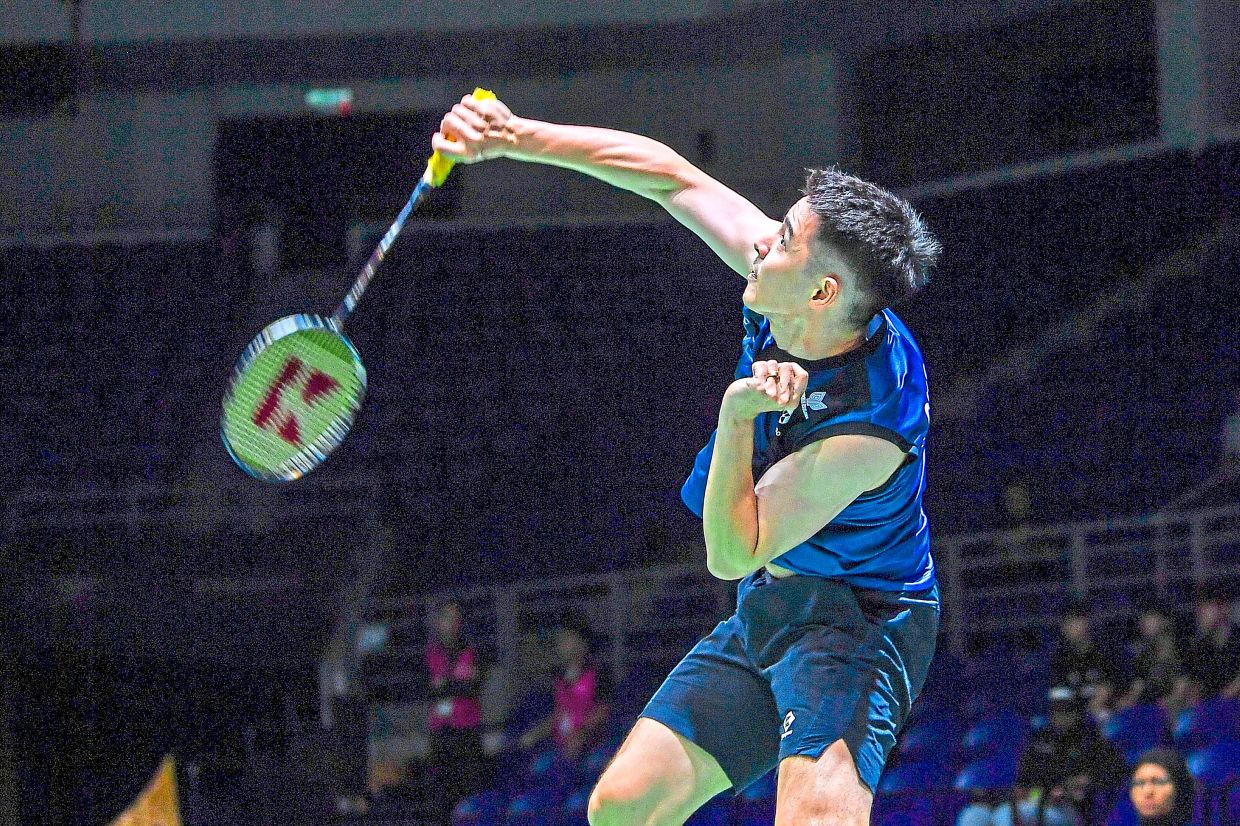
Cheam June Wei has emerged as one of the surprise packages at this week's Korean Masters badminton championship, advancing to the semi-finals after dispatching seventh seed Su Li-yang of Taiwan in a gripping quarter-final match on Friday. Playing at the Asan Yi Sun-sin Gymnasium, the independent Malaysian shuttler secured a 23-21, 10-21, 21-18 victory in a contest that tested his mental resolve and technical prowess across three sets of contrasting quality.
June Wei's path to the last four represents a remarkable achievement for a player operating outside the traditional support structures of a national badminton association. The 23-year-old's composure under pressure has been the defining characteristic of his campaign thus far. In explaining his approach to the demanding quarter-final, he emphasised his ability to remain focused on incremental gains rather than becoming overwhelmed by the magnitude of the occasion. His tactical discipline—concentrating on individual points rather than fixating on match outcome—reflects a maturity that has served him well against increasingly difficult opposition.
The Malaysian's journey to this stage has already produced several scalps that would typically be considered beyond his reach. In the opening round, he toppled world number 29 Jason Teh in an upset that caught many observers by surprise. That victory proved to be no mere flash in the pan. He followed up by eliminating China's Dong Tianyao, ranked 49th globally, in the second round, demonstrating that his early success was grounded in genuine competitive ability rather than fortunate seeding or draws.
June Wei's current trajectory carries implications for Malaysian badminton's broader competitiveness in men's singles. The country has long relied on a small core of elite players to generate international success, with limited emergence of alternative contenders at the highest level. His performance here suggests that pathways exist for talented individuals willing to navigate the challenges of independent competition, particularly when combined with strong technical fundamentals and psychological resilience.
On the doubles front, Malaysian fortunes proved decidedly mixed. The men's doubles pairing of Man Wei Chong and Soh Wooi Yik secured a comfortable passage to the semi-finals by overwhelming India's Krishna Prasad Garaga and Pruthvi Krishnamurthy Roy with a dominant 21-7, 21-8 scoreline. The magnitude of their victory indicates they moved through the encounter with minimal resistance, controlling rallies and dictating tempo throughout. Meanwhile, in an all-Malaysian clash, Tee Kai Wun and Yap Roy King displayed superior tactical acumen to defeat Aaron Chia and Aaron Tai 21-12, 21-15, with the scoreline suggesting a considerable gulf in performance between the two Malaysian pairs.
The mixed doubles competition proved considerably less rewarding for Malaysian aspirations, with the delegation suffering a clean sweep of eliminations in the quarter-final stage. Jimmy Wong and Cheng Su Yin fell to South Korea's second-seeded Kim Jae-hyeon and Jang Ha-jeong, losing 17-21, 18-21 in a match where they struggled to impose their game on the higher-ranked pairing. The result underscores the challenges Malaysian mixed doubles combinations face against the established contenders from East Asia, who enjoy superior resources and consistent competitive opportunities at home.
Loo Bing Kun and Noraqilah Maisarah Ramdan's elimination at the hands of China's third seeds Gao Jiaxuan and Wu Mengying reflected a similar pattern. Their 14-21, 15-21 defeat to the Chinese combination illustrated the significant gap in net play and court positioning that separates Malaysian mid-tier pairings from the continental powerhouses. This category has historically been an area of relative weakness for Malaysian badminton, and the Korean Masters results provide little encouragement that this trend is reversing.
Chen Tang Jie and Clarissa San completed Malaysia's mixed doubles disappointment by succumbing to Japan's Haruki Kawabe and Kokona Ishikawa in a closely contested affair that went to 20-22, 17-21. The narrow margin of defeat suggests they came close to advancing, yet the inability to convert pressure moments ultimately cost them progression. For Malaysian mixed doubles, the question now becomes whether systematic improvements in training methodology and tactical preparation can help the national contingent bridge an increasingly visible gap with Japanese, Chinese, and Korean combinations.
June Wei's continued presence in the tournament carries particular significance beyond his individual achievement. As an independent player, his success challenges assumptions about the necessity of federation backing for competitive viability at international level, though it simultaneously highlights the substantial disadvantages such competitors typically face in terms of travel support, coaching resources, and administrative assistance. His presence in the semi-finals will provide Malaysian badminton officials with valuable data regarding potential talent development pathways for players currently outside the elite pipeline.
Looking ahead, June Wei now faces opponents seeded even higher than Su Li-yang, with the semi-final draw likely to present considerably stiffer opposition. His mental and physical conditioning over coming days will prove crucial in determining whether his tournament run culminates in a medal or merely a creditable performance that nonetheless showcases his potential for future development and selection consideration at national level.

