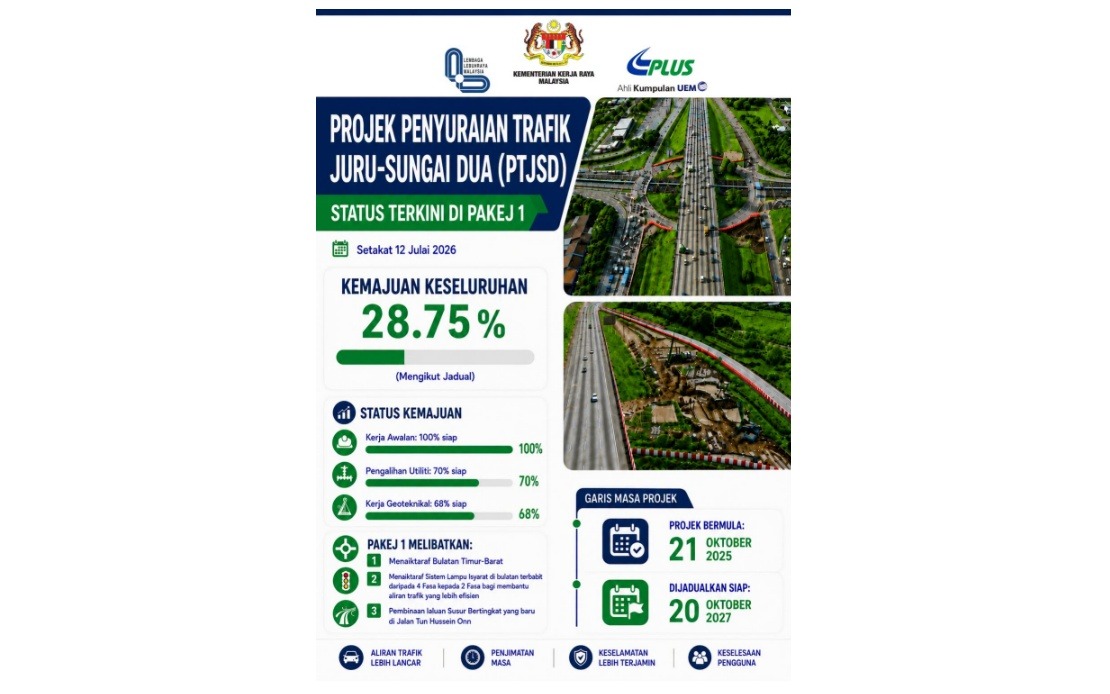
Malaysia's ambitious Juru-Sungai Dua Traffic Dispersal Project (PTJSD) is demonstrating solid forward momentum, with Package 1 achieving 28.75 per cent completion as of July 12 and maintaining its targeted delivery timeline. PLUS Malaysia Berhad, which oversees the highway improvements, has confirmed that the initiative continues to track within the expected schedule despite the complexity of undertaking major infrastructure work across a congested corridor serving the northern region of Peninsular Malaysia.
The initiative represents a coordinated effort between PLUS Malaysia, the Ministry of Works, and the Malaysian Highways Authority to fundamentally reshape how traffic moves through the Juru-Sungai Dua corridor, which has emerged as a critical bottleneck connecting Penang to states further north. The project's centerpiece involves upgrading the East-West Roundabout, implementing a more sophisticated traffic management system at the intersection, and constructing a new elevated slip road at Jalan Tun Hussein Onn. These specific interventions address longstanding congestion patterns that have frustrated commuters and freight operators alike.
The RM3 billion investment reflects the scale of ambition required to tackle this particular transportation challenge. The 17.3-kilometre project stretches across three distinct local districts—South, Central, and North Seberang Perai—and will ultimately serve approximately 200,000 daily users once fully operational. This user base encompasses not only private commuters but also commercial vehicles dependent on reliable passage between Penang and northern peninsula destinations, making the project's successful execution a matter of regional economic significance.
Work completion milestones reveal a project making tangible progress on multiple fronts. Preliminary construction works have been entirely finished, eliminating one of the initial barriers to rapid implementation. Utility relocation, a critical but often time-consuming phase that requires coordinating with water, electricity, and telecommunications providers, has advanced to 70 per cent completion. Geotechnical investigations, which establish soil and ground conditions necessary for safe foundation work, have progressed to 68 per cent. These parallel workstreams demonstrate that the project management team has structured the execution to allow multiple activities to proceed simultaneously rather than sequentially, accelerating overall delivery.
When completed in October 2027, the PTJSD promises transformative benefits for the corridor's users. Traffic engineers project that the new direct Juru-Sungai Dua route will absorb 30 per cent of current traffic volumes, redistributing the load across the improved network. More impressively, the project's design is expected to compress travel times from the current hour-long journeys during peak periods down to just 20 minutes—a 67 per cent reduction that would substantially improve the cost-benefit equation for regular commuters and logistics operators. Beyond speed, the improvements should enhance overall road safety and provide a smoother travel experience by reducing the stop-start conditions that currently characterize movement through the roundabout.
The project's regional significance cannot be overstated for Malaysian readers and businesses. Penang serves as an industrial hub and tourist gateway for northern Malaysia, and its accessibility directly influences economic activity and investment flows throughout the region. The bottleneck at Juru-Sungai Dua has functioned as a constraint on growth, deterring investors and adding operational costs for businesses requiring regular transport links northward. Once resolved, the improved corridor should catalyze increased economic integration between Penang and neighbouring states, benefiting everyone from manufacturers seeking supply chain efficiency to logistics firms operating express courier services.
For daily commuters, particularly those traveling from northern peninsula towns into Penang for employment, the time savings translate into immediate quality-of-life improvements. A 40-minute reduction in commuting time represents five hours per week or roughly 260 hours annually—equivalent to six-and-a-half working weeks of recovered time. When multiplied across 200,000 daily users, this collective time benefit constitutes an enormous productivity gain for the Malaysian economy beyond the direct benefits to individual road users.
The project's structure as a public-private collaboration involving PLUS Malaysia's operational expertise, government policy direction through the Ministry of Works, and regulatory oversight from the Malaysian Highways Authority reflects evolved thinking about major infrastructure delivery. This governance model pools technical capabilities, financial resources, and regulatory authority in ways designed to ensure both quality execution and alignment with broader national transportation strategy. The framework also creates accountability mechanisms spanning multiple institutions, theoretically reducing the risk of project abandonment or indefinite delays that have historically plagued some Malaysian infrastructure initiatives.
Looking forward to the October 2027 completion target, maintaining the current trajectory will require sustained attention to the remaining 71 per cent of work. The utility relocation phase, now 70 per cent complete, typically encounters unforeseen complications as crews uncover underground infrastructure not precisely documented in original plans. Similarly, the geotechnical work at 68 per cent may reveal ground conditions requiring design modifications. However, the project's early-stage performance suggests that the PLUS Malaysia team has built sufficient schedule buffers and contingency planning to accommodate normal challenges without requiring timeline extensions.

