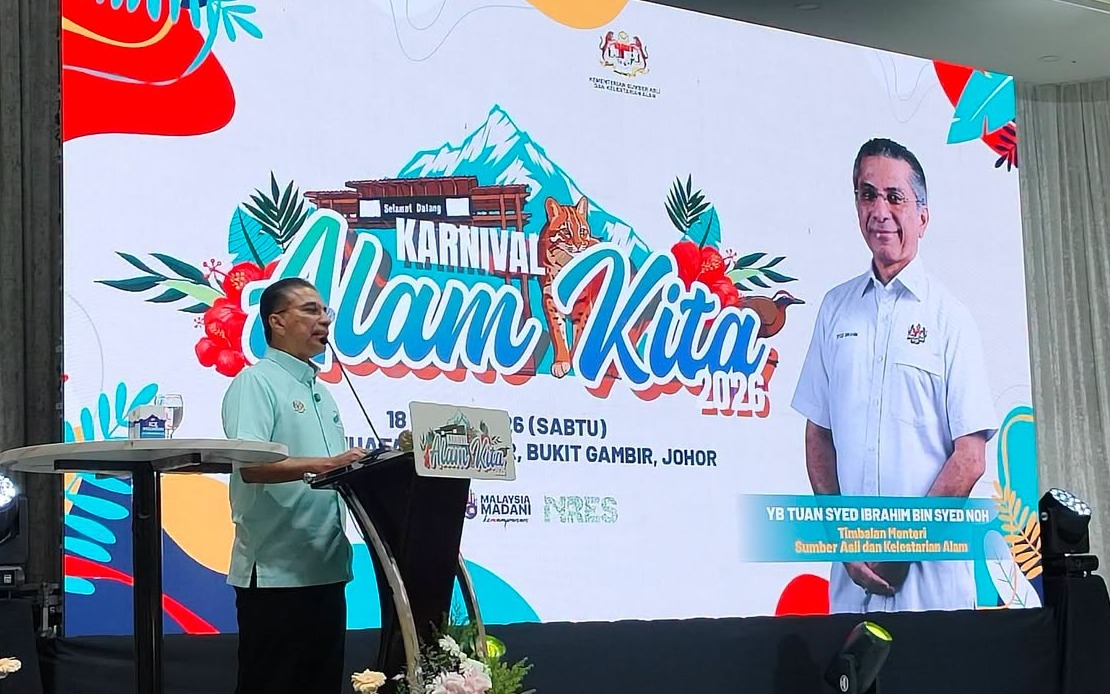
Malaysia's push toward environmental sustainability gained fresh momentum this week as the Ministry of Natural Resources and Environment unveiled Karnival Alam Kita 2026 in Johor Bahru, a nationwide campaign designed to translate complex ecological concepts into practical, everyday actions for ordinary Malaysians. The carnival represents a deliberate shift in how government agencies communicate sustainability challenges, moving away from technical jargon toward messaging that resonates with households, schools, and workplaces across the nation.
Deputy Natural Resources and Environment Sustainability Minister Syed Ibrahim Syed Noh articulated the government's reasoning behind this grassroots approach during the launch ceremony at Dewan Muafakat Bukit Gambir. Rather than treating environmental protection as an isolated policy domain, the ministry envisions sustainability as a shared responsibility that begins at home and radiates outward through schools, businesses, and neighbourhoods. This perspective reflects growing recognition that top-down environmental mandates often fail without community buy-in and individual behavioural change. By bringing tangible demonstrations of green practices directly to citizens, the carnival aims to demystify sustainability and show how it connects to daily decisions about consumption, waste, and resource use.
The terminology itself signals a reframing. When Malaysians hear about environmental sustainability, many reflexively picture rare earth element extraction, electronic waste management, or forestry policy—sectors that feel distant from personal experience. The KAK 2026 campaign deliberately bridges that gap, showing how recycling, energy conservation, and waste reduction at the household level contribute to national climate goals. This pedagogical strategy acknowledges a fundamental challenge facing environmental movements worldwide: translating aggregate ecological imperatives into individual motivation and action.
Central to this year's carnival is the newly launched Young Environmental Ambassador Programme, a school-based training initiative intended to cultivate teenage environmental leaders who can influence their families and peer networks toward sustainable living. By targeting adolescents, the ministry taps into a demographic increasingly aware of climate issues yet often excluded from decision-making forums. These young ambassadors become multipliers, carrying sustainability messages back into households and communities where parents and grandparents may be more receptive to peer influence than government messaging. This represents an investment in long-term behavioural change rather than short-term compliance.
Parallel to educational components, the carnival incorporates practical waste management activities. The KUDAH clean-up initiative, executed by the NRES Lestari Squad in partnership with Bateriku (M) Sdn Bhd, demonstrates the scale of Malaysian waste streams and quantifies the environmental return on collection efforts. During the Johor launch, volunteers gathered 37 kilograms of waste, including 17.3 kilograms of plastic bottles, which collectively prevented an estimated 43.2 kilograms of carbon dioxide equivalent from entering the atmosphere—equivalent to emissions avoided by removing a petrol vehicle from roads for approximately 100 kilometres. While the figures from a single event may seem modest, they illustrate how aggregated local action contributes to national decarbonisation targets.
Malaysia's commitment to achieving net zero carbon emissions by 2050 underpins these initiatives. The KAK 2026 carnival serves as a visible manifestation of that long-term pledge, demonstrating that the transition toward a green economy requires cultural transformation, not merely regulatory frameworks or technological innovation. For Malaysian readers, particularly in urban centres like Johor Bahru, the carnival's emphasis on green product sales, electronic waste recycling campaigns, and used cooking oil collection addresses waste streams that touch their lives immediately. The visibility of such efforts at community level can shift perceptions about what sustainability actually demands.
The carnival's collaborative structure reflects the complexity of environmental governance in Malaysia. Involvement of multiple government agencies, non-governmental organisations, and private sector partners like Bateriku acknowledges that no single institution can catalyse the behavioural shifts required. This ecosystem approach distributes responsibility while creating more touchpoints for citizen engagement. For communities in Johor and beyond, it means sustainability conversations and practical resources increasingly become embedded in existing community spaces rather than confined to environmental ministry offices.
Deputy Secretary-General (Natural Resources) Datuk Khalid Mohamed and local education officials' presence at the launch ceremony signals institutional commitment extending beyond ministerial rhetoric. Educational authorities' involvement particularly underscores recognition that schools represent crucial sites for embedding sustainability values in younger generations. As Malaysia continues rapid urbanisation and economic development, ensuring that growth trajectories remain environmentally conscious requires institutional coordination precisely of this kind.
The broader implications for Southeast Asia are substantial. Malaysia's experience with large-scale sustainability carnivals and youth ambassador programmes may offer replicable models for neighbouring nations grappling with rapid environmental degradation, plastic pollution, and pressure to balance economic development with ecological preservation. The KAK 2026's emphasis on translating sustainability into accessible, locally-relevant language addresses a communication challenge shared across the region, where environmental regulations often outpace public understanding and support.
For Malaysian communities, particularly those in Johor where the inaugural KAK 2026 event took place, the carnival represents more than ceremonial government activity. It signals that achieving net zero by 2050 will require sustained engagement with everyday practices: how households manage waste, which products they purchase, how they dispose of electronic devices and cooking oil. The Young Environmental Ambassador Programme suggests that this engagement will intensify, with young people becoming advocates and monitors of family sustainability practices. Whether such initiatives translate into measurable shifts in consumption patterns and waste reduction across the broader population remains to be seen, but the institutional commitment demonstrated through KAK 2026 indicates that Malaysia's environmental transition will increasingly touch Malaysian homes directly.

