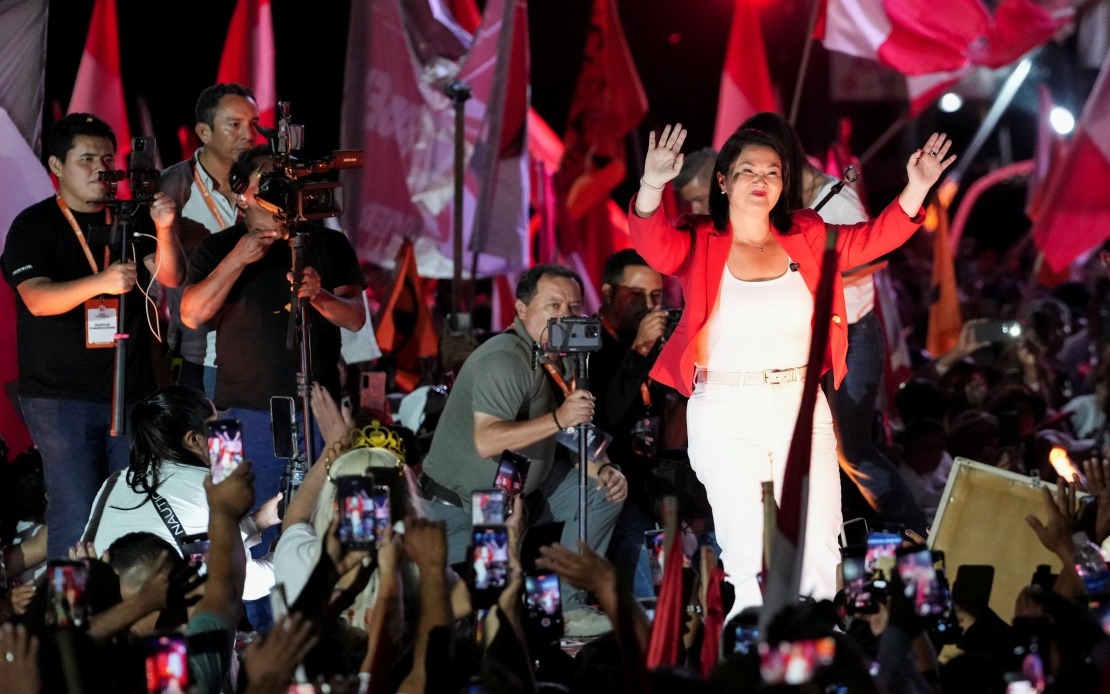
Keiko Fujimori has secured victory in Peru's presidential election following the completion of the official vote count, clinching the top office with marginally more than half of all valid votes cast. The final tally released by Peru's National Office of Electoral Processes confirmed that Fujimori, the right-wing candidate from the Popular Force party, received 50.135 per cent of valid votes compared to 49.865 per cent for her closest competitor, Roberto Sanchez, representing the Together for Peru coalition. The numerical difference proved decisive yet wafer-thin: 9,223,396 votes separated her from Sanchez's 9,173,755 votes, a margin of merely 49,641 ballots in an election that captured the nation's deeply polarised political sentiments.
The completion of the 100-per-cent official count represents the exhaustive processing of all 92,766 tally sheets from the June 7 election, effectively resolving weeks of uncertainty in one of South America's most contested democratic contests. Roberto Burneo, president of the National Jury of Elections, has signalled that the electoral authority plans to formally proclaim the official results on Friday, finalising what will become one of Peru's most narrowly decided presidential races in recent memory. The drawn-out counting process reflected the intensity of competition between the two candidates and the significance many Peruvians attached to the election outcome.
Fujimori's victory carries particular weight given her personal political trajectory and family legacy. The daughter of Alberto Fujimori, who held the presidency throughout the 1990s and into the early 2000s before his tenure ended in 2000 amid controversy and subsequent imprisonment, she has pursued the nation's highest office on three previous occasions without success. Her election now ends a string of defeats and positions her to lead a country grappling with economic challenges, political instability, and deep social divisions. Her ascent also represents a significant conservative reassertion in Peruvian politics after years dominated by left-leaning and anti-establishment movements.
Sanchez, her defeated opponent, emerged from a distinctly different political background. As a government minister serving under then-President Pedro Castillo from 2021 to 2022, Sanchez represented the continuity of reformist and leftist governance that had captured significant segments of the Peruvian electorate. Castillo's presidency itself ended controversially in late 2022 amid political turmoil and institutional breakdown, complicating Sanchez's positioning as a successor to that political project. The fact that he remained competitive despite these headwinds demonstrates the fractured nature of Peruvian politics and the substantial portion of voters seeking alternatives to the establishment right.
The election's outcome carries implications extending beyond Peru's borders. Political analysts across Latin America view developments in Peru as instructive regarding broader regional trends, particularly the competition between left-leaning reformism and centre-right or right-wing conservatism that has defined recent electoral contests throughout the continent. Peru's struggles with institutional stability, corruption, and economic management have made the nation a bellwether for understanding how voters respond to political crises and competing visions of governance.
For Malaysia and other Southeast Asian nations, Peru's experience underscores the importance of robust electoral institutions and transparent counting processes, even when results are demographically divided. The Peruvian electoral authority's methodical approach to completing a full recount and releasing detailed results demonstrates institutional discipline despite political temperature running high. Malaysian electoral observers and officials have historically monitored such processes internationally, recognising that democratic health depends upon counting accuracy and public confidence in results, regardless of outcome preferences.
The extraordinarily narrow margin separating Fujimori and Sanchez suggests that Peru remains deeply fractured along ideological lines. Approximately half the electorate supported a right-wing candidate associated with her family's controversial governance legacy, whilst almost exactly half backed a successor to more recent leftist experiments. This perfect bifurcation indicates limited middle ground and points toward potential governing challenges ahead, regardless of Fujimori's legislative support. She will assume office without a clear mandate for transformational change and facing substantial organised opposition.
Fujimori's path to victory also illuminates persistent questions about how voters in polarised democracies make electoral choices. Her ascent despite significant opposition suggests that for many Peruvians, factors such as governance competence, economic management credibility, or desire for institutional stability outweighed concerns about her family's authoritarian legacy. Conversely, Sanchez's near-parity showing despite governmental unpopularity indicates that significant portions of the electorate rejected what they perceived as conservative restoration, preferring to gamble on reformist alternatives despite recent disappointments.
The official proclamation scheduled for Friday will formally mark the transition point in Peru's political cycle, even as the country manages substantial institutional and economic challenges. Fujimori's narrow victory mandates coalition-building and pragmatic governance, as she cannot claim overwhelming popular endorsement. Her first months in office will likely reveal whether the Peruvian electorate's closely divided preferences translate into constructive compromise or continued polarisation. The election's competitive nature suggests that political tensions will persist throughout her administration, shaping how effectively she can implement her policy agenda across an increasingly fractured legislature.

