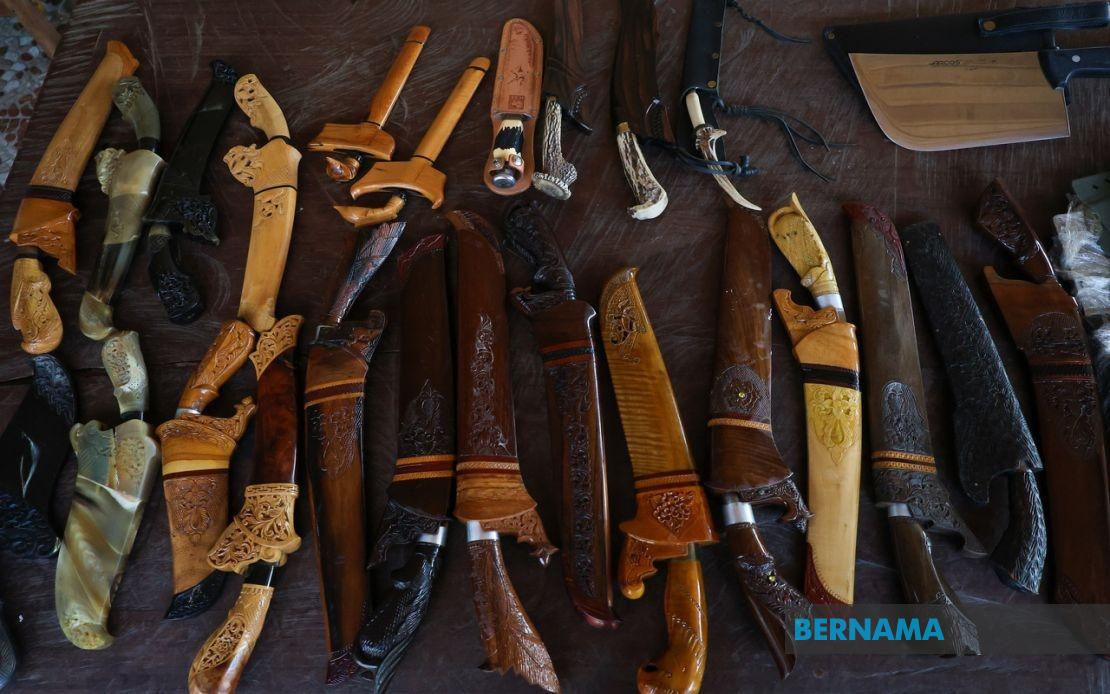
The distinctive bird-headed golok stands as a tangible reminder of Kelantan's disappearing tradition of master blacksmithing, a craft facing extinction as the generation of skilled artisans dwindles and few young people seek to learn the trade. Ahmad, 71, has emerged as an unlikely custodian of this heritage, personally stewarding a collection of more than 100 traditional and modern weapons valued at approximately RM20,000 that document decades of craftsmanship from blacksmiths across the region—many of whom have since passed away.
The iconic bird-shaped hilt that adorns many traditional Kelantan weapons represents far more than aesthetic choice. According to Ahmad, the bird motif carries profound historical resonance, drawing inspiration from the Petalawali bird figure that once graced the ancient boats commissioned by the Kelantan Sultanate. These vessels served critical ceremonial and transportation functions in the sultanate's maritime operations, making the bird symbol a tangible link to pre-modern Kelantan's power and cultural identity. This continuity of design across centuries underscores how traditional craftsmanship encoded regional history and royal patronage into everyday objects.
Ahmad's journey into weapon collecting began two decades ago when he initially assisted a friend who practiced traditional blacksmithing, learning to craft hilts and scabbards from hands-on experience. What started as a casual apprenticeship evolved into a consuming passion, transforming him into a serious collector and inadvertent archivist of a fading craft. His extensive acquisitions span continents, with pieces sourced from Germany, Sweden, Denmark, England, the United States, Japan, China, Spain and Portugal—reflecting the global appeal of traditional Southeast Asian blade-work among international collectors and museums.
The collection's diversity reveals the sophistication of pre-modern weapon manufacture in the region. Among his most valued pieces are a knife featuring a deer-antler hilt sourced from Sarawak and an intricately crafted keris with a black kemuning wood blade complemented by a golden kemuning wood hilt. These items showcase the regional specialisation that once characterised Southeast Asian weapon production, where different timber varieties and materials were selected for both functional and symbolic properties. Each acquisition represents not merely an object, but evidence of specific blacksmiths' working methods and aesthetic preferences—many of which have disappeared irreplaceably with their makers' deaths.
The fundamental crisis Ahmad articulates is one of knowledge transfer and cultural discontinuity. When a master blacksmith passes away without training successors, the accumulated technical knowledge—tempered through years of experimentation and refinement—vanishes permanently. Ahmad emphasises that handcrafted weapons derive their escalating value from the irreproducibility of each piece; every blade embodies the maker's distinctive identity and creative choices, transforming functional objects into heritage artefacts. This economic appreciation paradoxically underscores the pieces' vulnerability, as their historical significance makes them increasingly attractive to collectors outside Malaysia, risking dispersal of the national heritage.
Preserving these weapons demands rigorous curatorial practice that Ahmad has implemented meticulously. He maintains his collection in a dedicated cabinet, conducting inspections every three months and applying protective oil to blade surfaces to forestall oxidation and deterioration. This disciplined conservation approach reflects his understanding that these are not merely decorative acquisitions but fragile historical documents requiring active maintenance. Without such care, the physical degradation would compound the loss of the knowledge they embody, leaving future generations with rusted fragments rather than functional examples of traditional craftsmanship.
Despite receiving offers from collectors interested in acquiring pieces from his holdings, Ahmad has consistently refused to sell, recognising that his collection functions as a living archive of deceased blacksmiths whose techniques and innovations can never be replicated. This curatorial stance elevates his role beyond that of a mere enthusiast; he functions as a custodian of cultural memory, preserving material evidence of artisanal excellence that would otherwise be lost to inheritance dispersal, commercial sale, or degradation. His refusal positions collecting itself as a form of cultural activism rather than acquisitiveness.
The broader implications for Malaysian cultural heritage are substantial. Kelantan's blacksmithing tradition represents only one of numerous traditional crafts facing similar pressures from modernisation, shifting economic priorities, and generational disengagement. The state's metalworking heritage, once central to regional identity and royal court patronage, has contracted to a handful of surviving practitioners. Unlike basket-weaving or batik production—which have received government support and tourism promotion—traditional weapon-making occupies an uncomfortable cultural space, simultaneously celebrated as heritage and marginalised as economically unviable.
Ahmad articulates a vision reconciling preservation with innovation, arguing that Malaysia's weapon-making legacy can endure through evolving techniques while maintaining the artistic identity and cultural values that distinguish the craft. This formulation acknowledges that tradition is not inherently opposed to change; rather, authentic continuity involves transmitting core principles and aesthetic sensibilities across generations while permitting contemporary expression. Without such evolution, traditions risk becoming museum displays rather than living practices.
The collector's efforts highlight the inadequacy of institutional heritage preservation when undertaken by isolated individuals. While Ahmad's personal commitment has salvaged historical knowledge and prevented the dispersal of significant artefacts, the broader crisis of blacksmithing skills extinction persists. Addressing this requires systemic intervention—apprenticeship support, market development for contemporary pieces, documentation projects recording masters' techniques before they disappear, and integration of traditional craftsmanship into cultural education. Without such support, future generations will access Kelantan's blacksmithing legacy only through Ahmad's carefully preserved collection, rather than through the lived practice of thriving workshops.
The bird-headed golok ultimately symbolises both achievement and loss. It testifies to the technical brilliance and aesthetic refinement Malaysian artisans achieved within pre-modern frameworks, offering contemporary viewers tangible connection to their heritage. Simultaneously, it represents a form of cultural knowledge that has largely vanished from active practice, surviving only in museum pieces and private collections. Ahmad's stewardship of this heritage, while admirable, cannot substitute for the systematic support required to sustain traditional blacksmithing as a genuine living craft capable of attracting new practitioners and evolving organically within contemporary Malaysian society.

