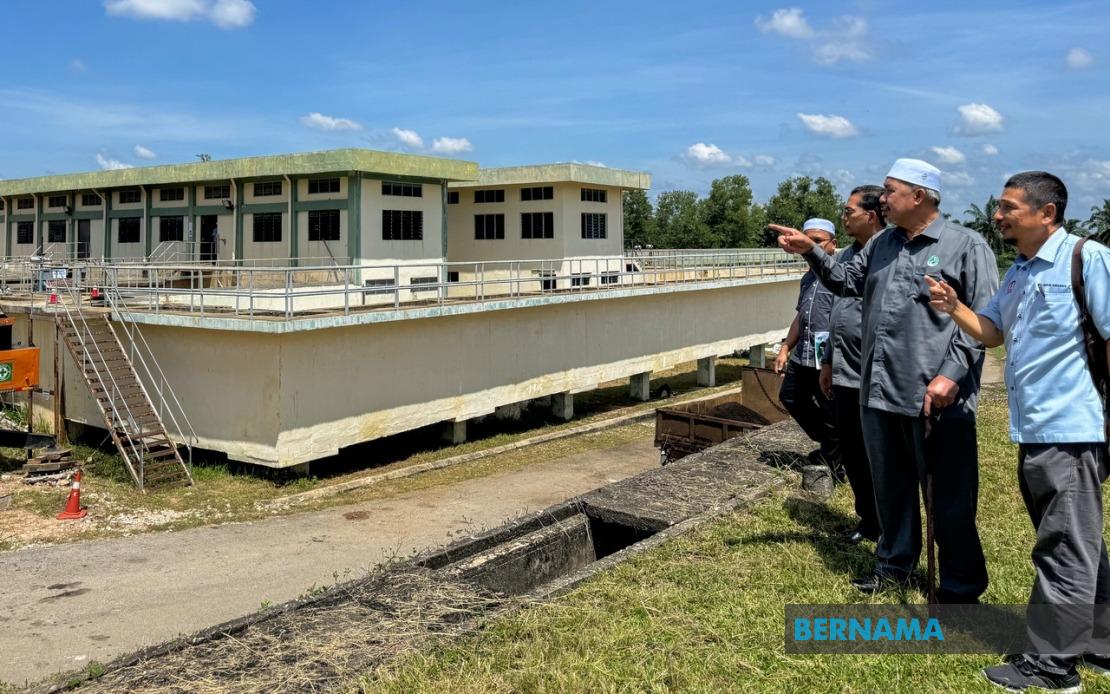
Kelantan is set to ease one of its most persistent infrastructure headaches as a major overhaul of the Merbau Chondong Water Treatment Plant nears completion. The RM11.5 million project, which upgrades filtration systems and substantially increases processing capacity, signals a turning point for households across three districts that have endured chronic water shortages. Beginning in September, some 34,000 account holders in Machang, Pasir Puteh, and southern Kota Bharu will receive more reliable water service, marking tangible progress on an issue that has frustrated residents and strained local authorities for years.
The expansion hinges on advanced filtration technology introduced through the Xylem Underdrain Leopold system, which allows the plant to process significantly higher volumes of raw water without compromising purity. Previously, Air Kelantan Sdn Bhd faced a difficult constraint: the plant's existing infrastructure could technically handle more throughput, but operators feared that increasing flow would degrade water quality. This bottleneck meant that even as demand grew across affected districts, the utility could not safely boost supply. The new system eliminates that trade-off by enabling the treatment facility to process up to 90 million litres of raw water daily while maintaining strict quality standards.
According to Datuk Dr Izani Husin, chairman of Kelantan's Public Works, Infrastructure, Water and Rural Development Committee, the upgrade will lift treated water output from 45 million litres per day to 80 million litres per day. That 78 percent increase represents a watershed moment for the state's water management strategy. The timing is crucial for Kelantan, where rapid urbanisation in key towns has outpaced infrastructure development, leaving many residents dependent on irregular supplies and increasingly frustrated with rationing. The September launch will coincide with the onset of the monsoon season, when water availability naturally peaks, allowing the new capacity to be fully utilised.
Beyond volume, the upgrade delivers measurable improvements in water quality. The turbidity level—a key metric of water clarity and purity—has been substantially reduced through the enhanced filtration process. Readings have dropped from over 10 Nephelometric Turbidity Units to three NTU, bringing the treated water closer to international standards and reducing the likelihood of contamination-related health issues. For households relying on public supply, this quality improvement may prove as important as the increased volume, as cleaner water reduces scaling in pipes, extends appliance lifespan, and builds confidence in the safety of tap water.
The project is expected to reach full completion by the end of July, with distribution commencing in early September. The tight timeline reflects pressure from state authorities to deliver tangible results to constituents and demonstrates Air Kelantan's commitment to modernising ageing infrastructure. However, the completion of this single facility, while significant, forms only one piece of a much larger puzzle that Kelantan is working to assemble over the coming years.
Looking beyond the immediate upgrade, the state government and Pengurusan Aset Air Berhad have announced plans to construct the Machang 1 Water Treatment Plant, a RM120 million facility designed to process 50 million litres daily. Scheduled for completion by 2030, this new plant will ease pressure on Merbau Chondong and free up existing capacity at the older facility for distribution to other districts facing shortages. The strategic logic is clear: by spreading production across multiple treatment centres, the state can achieve more resilient supply networks less vulnerable to single-point failures or maintenance bottlenecks.
The Machang 1 project remains in a preliminary phase, contingent on finalising agreements between the state government and PAAB and subsequent contractor selection. This bureaucratic process, while necessary, underscores that longer-term solutions require coordination across multiple agencies and significant capital deployment. The staggered timeline—immediate relief from the Merbau Chondong upgrade, followed by the Machang 1 facility by 2030—suggests the state recognises that water infrastructure challenges cannot be solved overnight but require sustained investment and phased expansion.
Currently, Air Kelantan has resolved approximately 70 percent of water supply problems affecting around 270,000 user accounts across the state. The utility has set an ambitious target to reach 90 percent resolution by 2035. These figures reveal the scale of the challenge: even after resolving seven out of every ten problem cases, tens of thousands of households continue to experience inadequate supply. The gap between current performance and the 2035 goal indicates that projects like the Merbau Chondong upgrade and Machang 1 facility will need to be complemented by additional interventions, network rehabilitation, and demand management strategies.
For Malaysian readers, especially those in Kelantan and neighbouring states, the Merbau Chondong upgrade exemplifies a broader pattern in Malaysia's water sector. Many facilities, originally designed and constructed decades ago, are being retrofitted with modern technology rather than entirely replaced. This approach balances cost constraints with the urgent need to improve service quality. However, it also highlights the perennial challenge facing water utilities across Southeast Asia: aging infrastructure, rapid urbanisation, and climate variability are straining systems that were not built with current demand in mind. Kelantan's experience will likely inform water management strategies in comparable states facing similar pressures.
The success of the September launch will be closely watched, not only by residents in the three affected districts but also by state policymakers evaluating the returns on infrastructure spending and the effectiveness of PPP arrangements with PAAB. If the Merbau Chondong upgrade delivers stable supply and measurably improved water quality, it will strengthen the case for accelerating the Machang 1 project and pursuing similar upgrades at other facilities. Conversely, any implementation delays or quality issues could undermine public confidence and complicate future funding negotiations. For now, residents can mark September on their calendars as the date when one of Malaysia's water infrastructure challenges begins, at long last, to ease.

