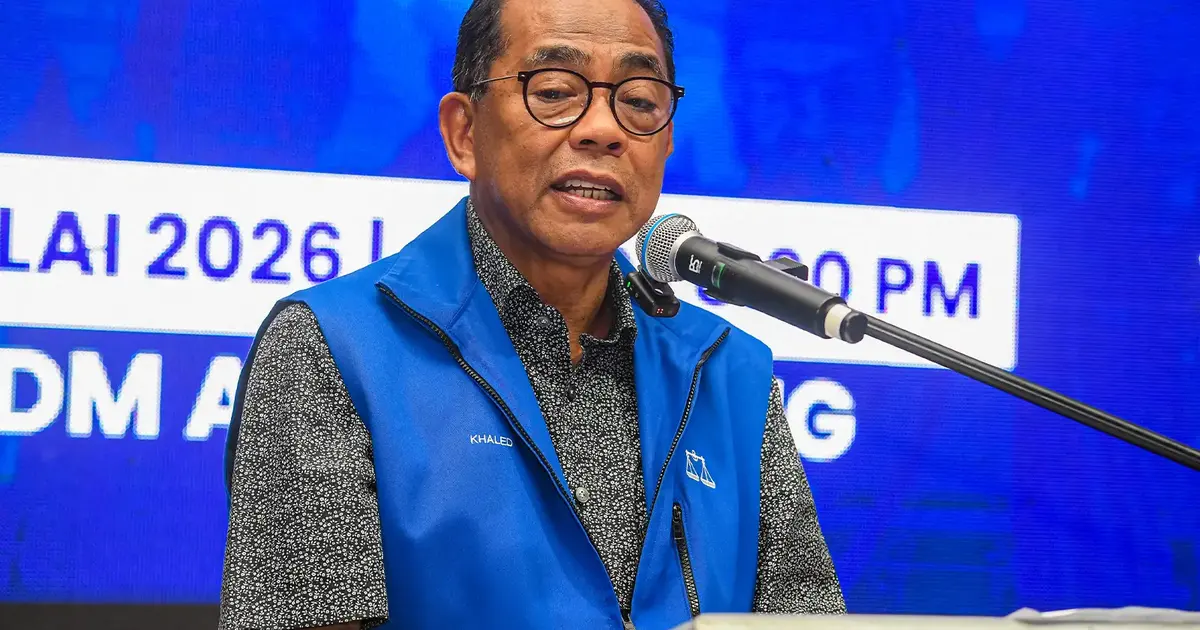
Umno vice-president Khaled Nordin has intensified calls for voters in Negeri Sembilan to deliver a comprehensive electoral rejection of Bersatu, reinforcing the coalition's messaging that the maverick party must be entirely eliminated from the political landscape before the next general election cycle. His appeal draws a deliberate parallel to the 2023 Johor state election, where Bersatu suffered a devastating loss and failed to secure a single state assembly seat despite entering the contest as part of the Perikatan Nasional alliance.
Khaled's intervention reflects growing anxiety within Umno's hierarchy about Bersatu's political trajectory and its capacity to exploit discontent at both state and federal levels. By repeatedly invoking Johor's outcome, Umno strategists are attempting to establish a narrative that a blanket voter rejection of Bersatu is both achievable and essential to prevent the Muhyiddin Yassin-led faction from rebuilding organisational strength ahead of GE16. The Johor precedent has become a powerful rhetorical weapon for the coalition, suggesting that voters can and will vote decisively against Bersatu when presented with credible alternatives.
Negeri Sembilan holds particular strategic significance in the broader electoral calculus. As a smaller, more cohesive state with nine state assembly constituencies, it represents an opportunity for Umno to demonstrate across multiple electoral cycles that Bersatu has been decisively marginalised. A comprehensive rejection in Negeri Sembilan would strengthen claims within the Barisan Nasional coalition that Bersatu's defection from the broader Malay-Muslim political consensus has permanently damaged its viability. The state's voting patterns often correlate with national sentiment, making it a barometer for broader coalition health.
Bersatu's position has become increasingly precarious since the 2022 political realignment that saw Muhyiddin distance the party from Pakatan Harapan and align with Perikatan Nasional. The party's inability to translate its grassroots presence into electoral success in Johor—despite fielding candidates across the state—exposed fundamental weaknesses in either party machinery or voter acceptance. Khaled's intervention suggests Umno believes these vulnerabilities remain acute and exploitable through concerted voter mobilisation campaigns.
For Malaysian politics more broadly, the push for Bersatu's electoral annihilation reflects the intensifying consolidation of Malay-Muslim political representation around fewer poles. Rather than fragmenting into multiple competing parties as occurred in the 2018-2020 period, the trajectory appears to favour stronger concentration within established structures. This consolidation carries implications for Malaysia's federal equilibrium, as it potentially increases the voting power of those voters who remain within the Barisan framework while marginalising alternative voices and coalitions.
The timing of Khaled's appeal is also instructive. Coming well in advance of Negeri Sembilan's next electoral cycle, the message is calibrated to build momentum and discourage Bersatu supporters from investing organisational effort in the state. By creating an expectation of defeat, Umno and its allies hope to create a self-fulfilling prophecy where Bersatu members lose enthusiasm and voters see the party as increasingly irrelevant. This psychological dimension of electoral politics is often underestimated in analysis but drives significant voter behaviour patterns.
Bersatu's strategic response to such pressure will be consequential. The party faces a choice between doubling down on its Perikatan alliance and attempting a political realignment that might improve its electoral prospects. However, the Johor result and subsequent electoral setbacks have significantly constrained Bersatu's negotiating position within coalition structures. This weakness may leave the party with limited options for repositioning itself as a meaningful political force.
The broader context of GE16 preparation is essential to understanding Khaled's intervention. Both Barisan Nasional and Perikatan Nasional are already positioning themselves for the next federal election cycle, which could occur anytime from late 2024 onwards depending on parliamentary and political circumstances. Neutralising Bersatu's capacity to contest elections effectively would reduce the number of competitive races and potentially simplify Barisan's path to federal majorities. For Perikatan, Bersatu's weakness becomes a liability that complicates coalition strategies.
Regional perspectives are also relevant. Southeast Asian observers watching Malaysian politics have noted how political fragmentation and consolidation cycles affect governance stability and institutional development. A Malaysian political system with more consolidated major parties might reduce transaction costs in coalition formation but could also reduce representation diversity. The current trajectory suggests movement toward the former outcome, with implications for minority political representation and democratic contestation mechanisms.
Umno's emphasis on voter mobilisation against Bersatu, rather than focusing primarily on Pakatan Harapan as the main opposition force, also signals a recalibration of electoral priorities. This suggests Umno views internal coalition management and the neutralisation of splinter forces as more pressing than traditional inter-coalition rivalry. Such tactical shifts often presage larger strategic reorientations in political competition patterns.
For voters in Negeri Sembilan, Khaled's appeal represents part of a broader campaign narrative designed to influence their electoral choices and self-perception as a voting bloc. Whether such messaging proves persuasive will depend on local economic conditions, incumbent performance, and whether Bersatu can construct a sufficiently compelling alternative narrative. The 2023 Johor precedent suggests voter appetite for rejecting Bersatu does exist, though each election operates under unique circumstances.
The Bersatu question will remain central to Malaysian politics through the GE16 cycle. Khaled's intervention indicates that senior Umno figures see ongoing vigilance against Bersatu's resurgence as strategically necessary. Whether this pressure ultimately succeeds in permanently marginalising the party or merely contains it for the election cycle ahead remains an open question that will shape Malaysia's political evolution over the coming years.

