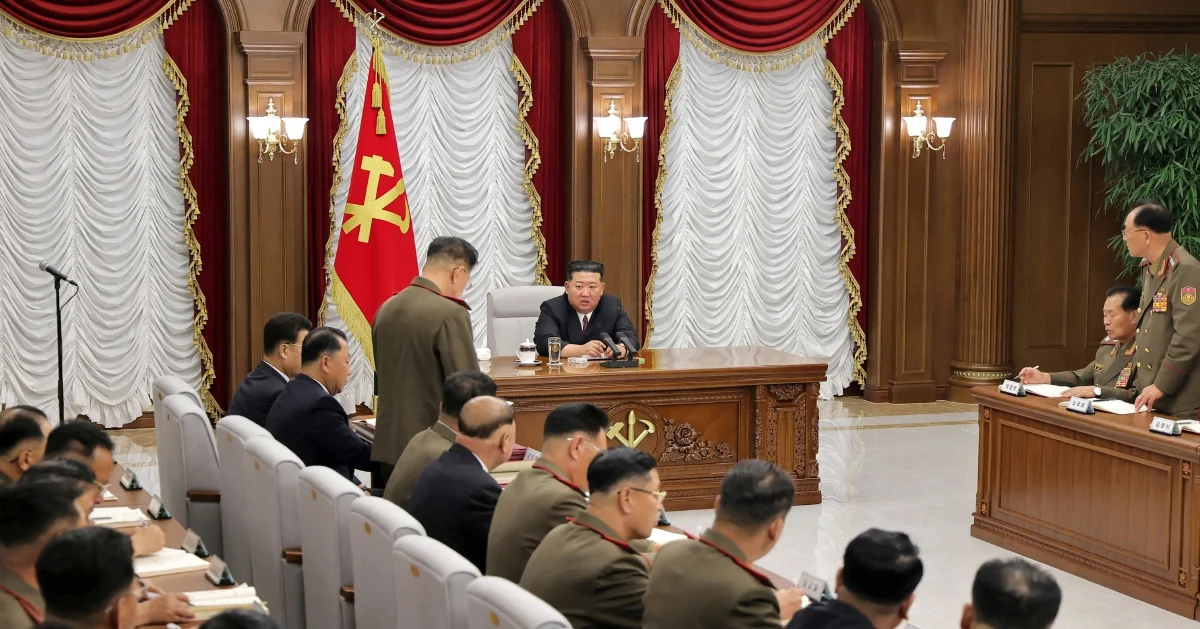
North Korean leader Kim Jong Un has moved decisively against a senior military official, removing him from the ruling party and branding his alleged misconduct a "political crime." The action, reported by state media on Saturday, underscores the ongoing internal disciplinary measures within Pyongyang's military hierarchy and reflects Kim's approach to rooting out what officials characterize as institutional corruption.
The expulsion carries significant weight within North Korea's tightly controlled system, where party membership represents a crucial marker of political standing and access to state privileges. Officials and military personnel removed from the party face severe consequences, including loss of position, restrictions on movement, and potential investigation into their financial dealings. The official's removal represents one of several recent disciplinary actions that suggest tensions within the military apparatus under Kim's leadership.
Kim's characterization of the alleged bribery as a political crime rather than merely a corruption matter indicates the seriousness with which Pyongyang treats such violations. In the North Korean system, describing misconduct in political rather than criminal terms often implies ideological betrayal alongside material wrongdoing. This framing suggests the leadership views such corruption as a fundamental challenge to the regime's authority and organizational integrity.
The timing of the announcement and its prominence in state media suggest the regime intends to use this case as a warning to other officials and military commanders. Public denunciations of high-level figures serve multiple purposes in Pyongyang's governance model: they demonstrate the leadership's commitment to fighting corruption, reinforce hierarchical discipline, and deter similar behaviour among other elites. Such public announcements often precede broader institutional reforms or reshuffles within the military structure.
Corruption within North Korea's military remains an ongoing challenge for the regime, despite efforts to maintain strict ideological discipline. Officers and officials occasionally exploit their positions for personal gain through black market dealings, extortion, or bribery—activities that can prove lucrative given the chronic scarcities affecting ordinary citizens. The existence of such corruption undermines the regime's narrative of a unified, disciplined state apparatus devoted entirely to the leadership's vision.
For regional observers, including officials in Seoul and other neighbouring governments, such purges offer limited but important insight into internal North Korean political dynamics. Military stability remains a critical concern for the region, particularly given Pyongyang's nuclear arsenal and ballistic missile programmes. Disruptions within the defence establishment could theoretically affect command structures, though the regime's tight control mechanisms typically prevent such instability from escalating into broader institutional breakdown.
Malaysian and Southeast Asian observers monitor North Korean internal developments with particular attention, given the regime's historical engagement with the region through economic channels, diplomatic missions, and occasional high-level visits. Understanding the composition and loyalty of North Korea's military leadership provides context for assessing the regime's strategic reliability and the potential for policy shifts. Military purges sometimes precede changes in foreign policy orientation, as new officials bring different perspectives to security considerations.
The removal also reflects the broader challenge facing any authoritarian system that must balance the need for institutional loyalty with the practical reality that corruption often proves endemic within hierarchical structures. North Korea's approach—periodic, high-profile purges accompanied by ideological reinforcement—differs markedly from other regional governments but serves similar disciplinary functions. The system relies on fear and uncertainty to discourage potential wrongdoing among officials who might otherwise exploit their positions.
Historically, North Korea has experienced significant turbulence when military leadership becomes fractious or when succession dynamics create competition for influence. Kim Jong Un's consolidation of power following his succession in 2011 involved numerous military purges, some of considerable brutality. The current action suggests the regime maintains ongoing vigilance regarding military discipline, viewing corruption cases as windows into broader potential disloyalty or factional behaviour.
The alleged bribery charge carries particular weight in a state perpetually claiming to prioritize national strength and military readiness. Officials accepting bribes represent not merely personal enrichment but theoretical distraction from their duties to strengthen national defence. This framing allows the regime to present disciplinary action as essential to maintaining the military effectiveness that leadership considers vital to national survival against perceived external threats.
Regional analysts note that while public purges demonstrate regime control, they simultaneously reveal underlying institutional vulnerabilities. The necessity of repeatedly announcing anti-corruption campaigns suggests these problems persist despite official claims of revolutionary discipline. For countries managing diplomatic or economic relations with North Korea, such information provides useful context about internal stability and the potential reliability of official counterparts in negotiations or agreements.
Looking forward, such disciplinary actions may intensify if the regime perceives increasing pressure to modernize military capabilities while maintaining fiscal resources for other priorities. The tension between military expansion and economic development often creates conditions where officials resort to corrupt practices to supplement inadequate official funding. Kim's regime appears committed to preventing such parallel economic structures from developing unchecked within the military establishment.

