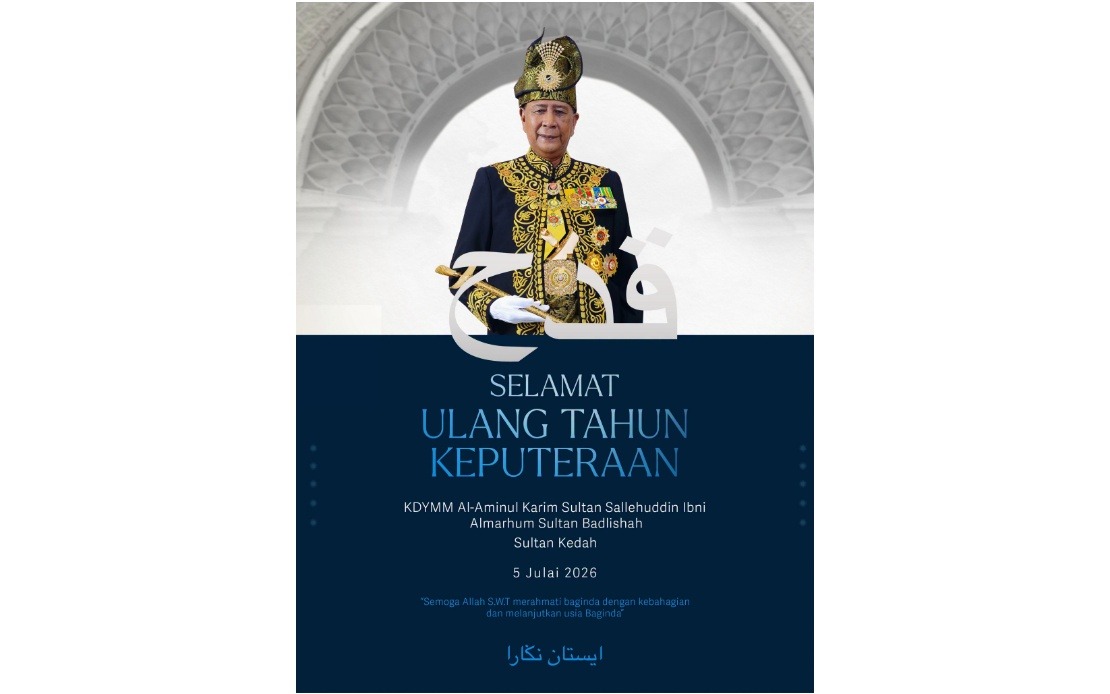
His Majesty Sultan Ibrahim, King of Malaysia, has conveyed warm birthday wishes to the Sultan of Kedah, Al-Aminul Karim Sultan Sallehuddin Sultan Badlishah, marking the distinguished royal's entry into his 84th year. The greeting, shared through the official Facebook channel of the Malaysian monarch, reflects the customary exchange of courtesies that characterises the relationship between Malaysia's paramount ruler and the heads of the country's constitutional sultanates.
The message from His Majesty centred on spiritual blessings and longevity, with the King invoking divine favour upon the Kedah Sultan. In his public post, Sultan Ibrahim expressed hope that Allah SWT would grant Sultan Sallehuddin sustained happiness, robust health, and an extended lifespan. Such expressions of goodwill are integral to Malaysia's constitutional monarchy framework, which recognises the unique status of the nine hereditary rulers who constitute the Conference of Rulers, the nation's pre-eminent consultative body on matters of state and royal protocol.
Prime Minister Datuk Seri Anwar Ibrahim likewise seized the occasion to recognise Sultan Sallehuddin's milestone, releasing his own message of felicitation through social media channels. The Prime Minister's tribute expanded the scope of well-wishes to encompass the broader Kedah royal household, specifically acknowledging Sultanah Maliha Tengku Ariff, the Sultan's consort, and extending prayers for the entire state royal family's continued prosperity and spiritual guidance.
The Prime Minister's sentiments encompassed hopes for sustained divine mercy and favour upon the royal household, coupled with wishes for enduring good health and the preservation of the sultanate's sovereignty. His use of the traditional Malay phrases "Daulat Tuanku" and "Dirgahayu Tuanku" underscored the formal respect accorded to the institution of hereditary rulership within Malaysia's constitutional system. These ceremonial expressions, rooted in Malay-Muslim royal traditions, carry significant cultural weight and reflect the continued reverence for the sultans as custodians of Islamic faith and Malay custom within their respective states.
Sultan Sallehuddin's long tenure as head of Kedah state reflects his significance within Malaysia's broader political architecture. The occasion of his 84th birthday demonstrates the established protocols through which Malaysia's highest-ranking political figures—the King and Prime Minister—acknowledge the milestones of state rulers. Such public recognition serves multiple functions beyond mere courtesy: it reaffirms the constitutional bonds linking the federal government with the state sultanates, reinforces the traditional hierarchy of the realm, and demonstrates national unity across Malaysia's complex system of divided sovereignty.
The exchange of birthday greetings between Malaysia's head of state and the Sultan of Kedah carries particular resonance given the ongoing evolution of the Malaysian monarchy's role in contemporary governance. While constitutionally circumscribed, the sultans retain substantial cultural authority and formal prerogatives, particularly in matters touching Islamic administration and Malay customary law within their respective states. The public acknowledgment of significant royal milestones thus serves as a reminder of the continued importance of these institutions within the Malaysian federation.
Kedah, one of Malaysia's oldest sultanates with a lineage tracing back centuries, holds strategic importance as a northern border state. The Sultan's leadership during transformative periods in the state's economic and social development has shaped Kedah's evolution from a predominantly agricultural region into a more diversified economic centre. Public tributes to the Sultan's longevity and continued reign subtly acknowledge his stewardship during such transitions and the stability that institutional continuity provides.
The timing of such public greetings also reflects the ceremonial calendar that structures Malaysia's public life around royal occasions. Birthday celebrations of sultans serve as moments when government officials from various levels formally reaffirm their recognition of the monarchy's constitutional position. These acts, though seemingly routine, reinforce the legitimacy and continuity of traditional institutions within a modern nation-state, particularly important in a federation where power is distributed between federal and state authorities.
For Malaysian observers, the exchange between King Ibrahim and Prime Minister Anwar Ibrahim regarding Sultan Sallehuddin's birthday illuminates the careful protocols that govern interactions between the nation's various power centres. While the monarchy in Malaysia operates within constitutionally defined boundaries, the public respect and formal acknowledgment extended by the highest political leaders demonstrates how traditional institutions maintain relevance and symbolic authority in contemporary Malaysian governance. The cordial exchanges between federal and state leadership, crystallised through such ceremonial observances, underscore the institutional pluralism that characterises the Malaysian political system.

