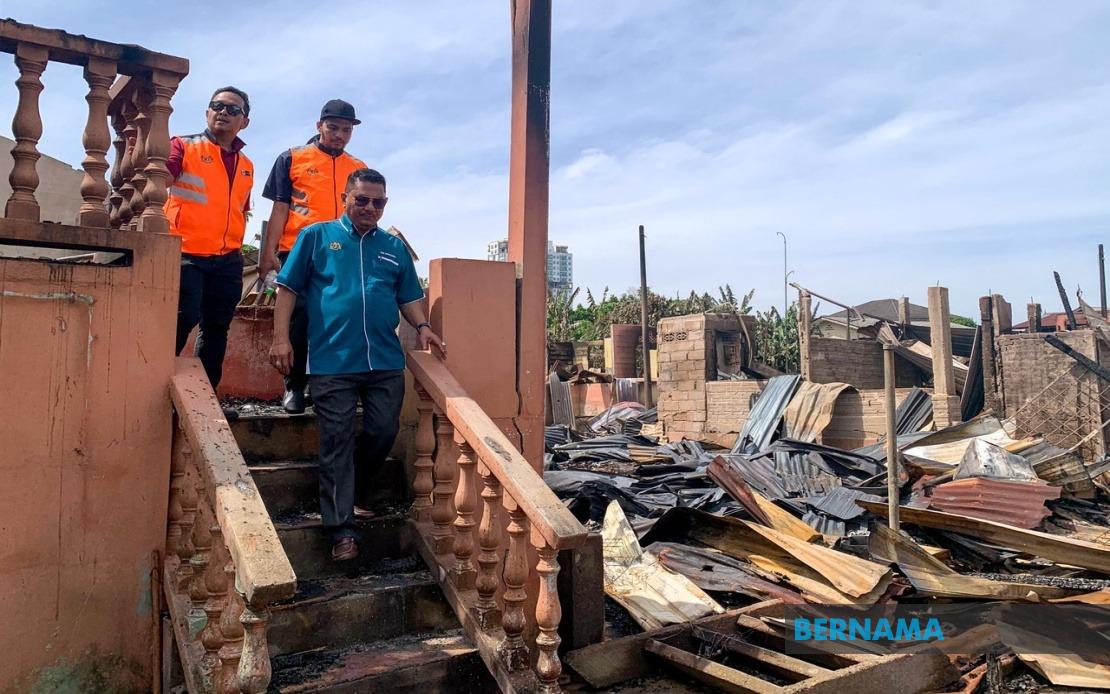
The devastating fire that swept through Kampung Gok Kapur in Kota Bharu on June 8 had its origins in a simple act of negligence inside a residential kitchen. According to the Kelantan Fire and Rescue Department (JBPM), an open flame source—specifically a gas lighter—was used directly on a pile of papers, igniting what would become one of the month's most destructive residential incidents in the state. The forensic investigation team has now completed their analysis and confirmed the circumstances surrounding the disaster that left more than a hundred residents displaced.
The department's findings reveal a chain of events that began when flammable materials surrounding the initial fire source caught alight before the flames rapidly spread throughout the affected house and beyond. Farhan Sufyan Borhan, the director of Kelantan's JBPM, explained that the investigation combined both physical evidence collection and witness statements to reconstruct how the incident unfolded. The precise location of the ignition point—within the kitchen area of the original house—suggests that residential spaces where daily cooking activities occur remain particularly vulnerable to uncontrolled fire incidents when open flames are introduced carelessly.
What makes this case particularly significant is the explicit determination that human negligence, rather than equipment malfunction or structural defect, was the root cause. This finding has immediate implications for fire prevention strategies across Malaysian residential communities, where kitchen-based activities remain a leading source of accidental fires. The investigation process itself demonstrates the importance of rigorous forensic analysis in understanding disaster causation, allowing authorities to move beyond speculation and provide evidence-based conclusions to inform public safety messaging.
The scale of the destruction speaks to how rapidly uncontrolled fire can escalate in densely populated village settings. Twenty-seven residential structures were ultimately consumed by the blaze, and the adjacent positioning of these homes in Kampung Gok Kapur meant that once the fire breached the original house's walls, neighbouring properties faced immediate risk. This pattern of fire spread is characteristic of traditional village layouts throughout Kelantan and neighbouring states, where closely-built timber or semi-timber houses amplify the danger when one structure ignites.
The human toll extended well beyond property damage. A total of 110 villagers were rendered homeless by the incident, suddenly losing their primary residences and possessions. The Mukim Banggol Mosque served as an emergency shelter, providing temporary refuge for displaced families while they grappled with the immediate aftermath. Although fortunately no fatalities or serious injuries were recorded, the psychological and economic disruption to affected households represents a significant community trauma that extends far beyond the visible destruction.
Kelantan JBPM's decision to forward the investigation report to police and other relevant authorities reflects standard procedure for fire incidents attributed to human negligence. This next phase creates the possibility for regulatory action or legal consequences depending on how investigating officers and prosecutors evaluate the evidence. The threshold between simple negligence and criminal negligence can significantly influence whether charges are pursued, making the thoroughness of the forensic investigation particularly important for subsequent judicial proceedings.
The department's public advisory following the investigation carries particular weight given the specificity of the identified hazard. Officials urged residents across Kelantan and potentially the wider region to exercise extreme caution with open flame sources and to avoid burning activities within or immediately adjacent to residential zones entirely. This guidance directly addresses the mechanism that sparked the Kampung Gok Kapur fire and reflects lessons drawn from this incident's consequences.
The incident highlights a broader challenge for fire safety in Malaysia's residential sector. While urban apartments increasingly incorporate modern fire prevention systems, village and semi-urban housing stock often lacks comprehensive fire suppression infrastructure. Open burning for waste disposal or other purposes remains common practice in rural communities, particularly in states like Kelantan where traditional practices persist alongside development. Public education campaigns addressing these specific behaviors could yield meaningful reductions in preventable residential fires.
From a regional perspective, the fire demonstrates how rapidly disasters can overwhelm community resources. The requirement to establish a temporary evacuation center within hours, combined with the challenge of providing sustained shelter to 110 displaced persons, underscores the need for improved disaster preparedness planning in villages throughout Southeast Asia. Kelantan and neighbouring Terengganu contain numerous settlements with similar building patterns and demographic profiles to Kampung Gok Kapur, suggesting that vulnerability to large-scale residential fires remains widespread across the East Coast region.
Looking forward, the investigation's completion provides a crucial window for implementing preventive measures. Fire safety education could be integrated into community programmes, particularly targeting kitchen safety and the dangers of indoor burning. Local authorities might also consider reviewing building codes and spacing requirements in densely populated village settlements to create greater firebreaks. The Kampung Gok Kapur incident ultimately represents a preventable tragedy, one whose root cause—careless burning—remains entirely within human control.