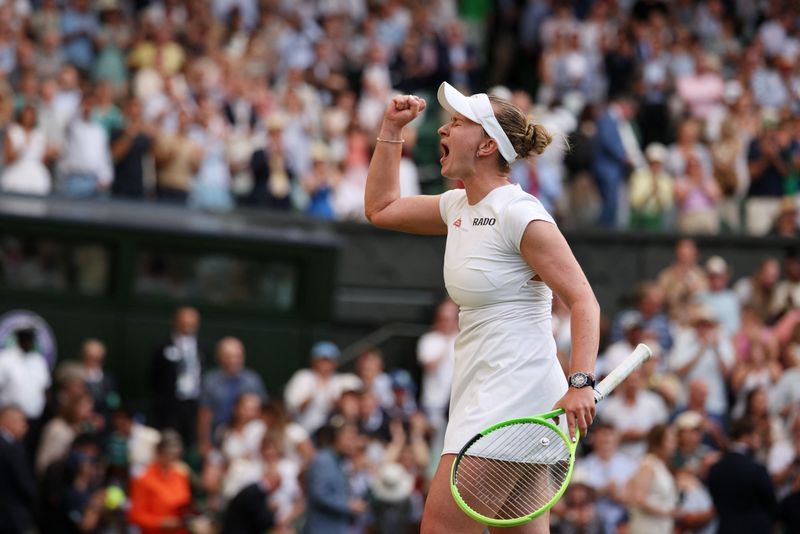
Barbora Krejcikova demonstrated the hallmarks of championship pedigree on Wednesday, clawing back from an opening-set loss to dispatch fifth seed Mirra Andreeva and secure her passage into the Wimbledon third round. Playing on the iconic Centre Court at the All England Club, the Czech former champion navigated a gruelling encounter that showcased both her experience and the considerable talents of her increasingly formidable Russian opponent, ultimately prevailing 4-6 7-5 6-4 in a match that demanded her full tactical arsenal.
The contest revealed contrasting trajectories in women's professional tennis. Krejcikova arrives at the Championships as a dual Grand Slam champion, having captured both the 2024 Wimbledon title and the French Open crown during her storied career. Andreeva, by contrast, represents the new generation of international tennis talent; at just nineteen years old, the Russian prodigy has already claimed her maiden Grand Slam title this season following a breakthrough performance at Roland Garros mere weeks prior. The generational collision between established excellence and youthful exuberance promised compelling drama, and the players delivered accordingly.
Krejcikova's early dominance suggested a straightforward passage through to the next stage. The Czech competitor established commanding momentum from the opening minutes, surging to a 3-0 advantage that hinted at a potential rout. However, the rhythm suddenly reversed as her level dipped markedly, allowing Andreeva to consolidate and then seize the initiative. The momentum swing proved decisive in the first set, with Andreeva capitalising on her opponent's lapse in concentration to claim the set 6-4 and establish herself as a genuine threat.
The significance of this opening-set victory extended beyond mere scoreline advantage. For the younger Andreeva, it represented tangible evidence that she possessed the mettle to compete against the circuit's established elite. For Krejcikova, it represented a stern examination of her current form and championship credentials. The complexity of women's tennis at elite levels demands not merely technical excellence but also mental fortitude—the capacity to recalibrate strategy, reset emotional equilibrium, and execute under pressure when initial advantages evaporate.
Krejcikova's championship experience proved instrumental in navigating this adversity. The second set became a demonstration of tactical refinement and renewed intensity. She reasserted control over the rally patterns, restricting Andreeva's offensive opportunities while progressively dismantling her opponent's rhythm. The contested second set went to a tie-break decision, with Krejcikova ultimately claiming the 7-5 verdict to square the match at one set each and force a decisive third set.
The decider proved where the accumulated knowledge of multiple Grand Slam victories became most apparent. Andreeva, despite her obvious talents and recent success in Paris, confronted the psychological pressure inherent in championship tennis. The frustration visibly accumulated as Krejcikova constructed a performance of controlled aggression, saving opportunities and capitalising on the moments when her opponent's composure frayed. Most dramatically, Andreeva faced no fewer than six match points in the final set—multiple opportunities where Krejcikova stood poised to seal victory—yet the teenager fought back each time, refusing capitulation despite mounting pressure.
Ultimately, however, the reserves of mental energy required to stave off so many championship moments proved insufficiently replenished. Krejcikova finally converted on her seventh match point, bringing closure to an encounter that demanded everything from both competitors. The victory marked only Krejcikova's second triumph in their five career meetings, underscoring how competitive this particular matchup has proven to be. For Malaysian and regional followers, this encounter illustrates the intensifying quality of women's professional tennis, where teenage prodigies now routinely challenge former champions on sport's grandest stages.
Following the match conclusion, Krejcikova's commentary reflected both respect for her opponent's extraordinary trajectory and satisfaction with her own ability to maintain composure when adversity struck. She acknowledged Andreeva's distinctive talents and the rarity of such precocious achievement in professional tennis, whilst expressing genuine pride in performing at Centre Court—widely regarded as tennis' most hallowed venue. Her remarks captured the gracious acknowledgment of a senior competitor recognising that the sport's future rests in increasingly capable hands.
The victory sets up a distinctly regional drama in the subsequent round, with Krejcikova facing Czech compatriot Nikola Bartunkova, ensuring that one Central European representative will definitely progress to the fourth round. Andreeva's departure leaves the American contingent and other seeded players competing for supremacy in the women's draw. Her showing here, despite the loss, suggests that the French Open breakthrough was no aberration but rather the emergence of a player capable of threatening multiple Grand Slam titles across her career. For tennis observers across Southeast Asia and beyond, the match underscored tennis' globalising trajectory and the democratisation of elite-level competition across nations and age groups.

