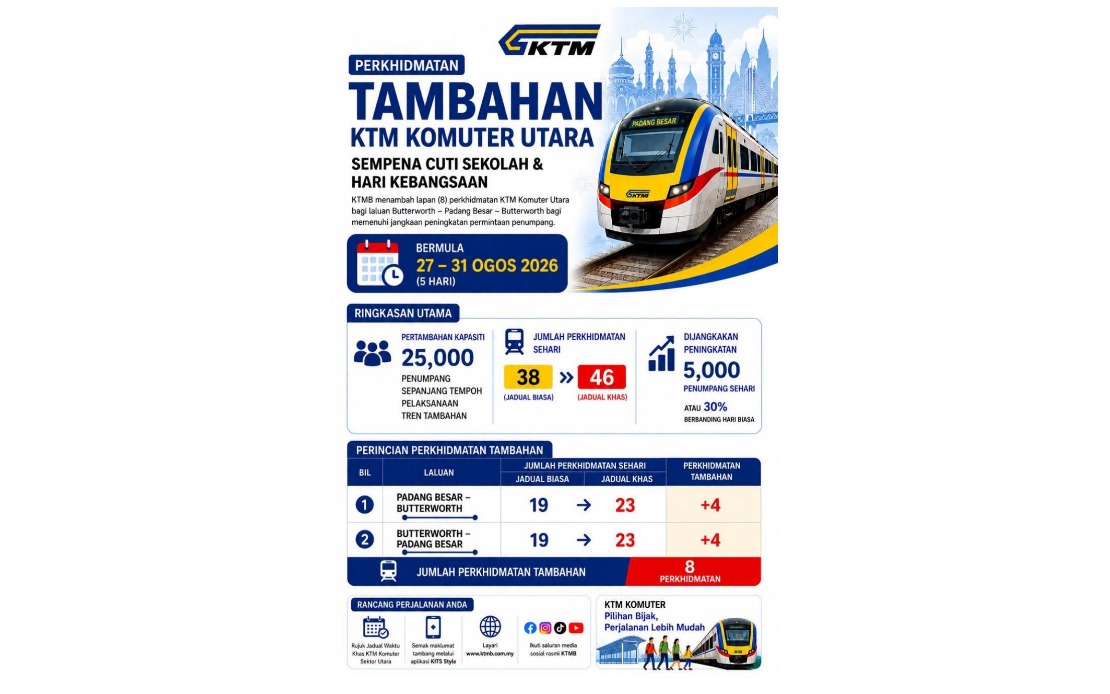
Keretapi Tanah Melayu Berhad (KTMB) is ramping up capacity on its northern commuter corridor in recognition of the twin holiday pressures bearing down on Malaysia's rail network this week. The state-owned operator announced on Thursday that it would introduce eight supplementary KTM Komuter Utara services serving the Butterworth and Padang Besar route, with these enhanced schedules running through Monday, August 31, to accommodate the confluence of school holidays and National Day festivities.
The railway company's decision reflects a calculated response to predictable travel patterns that emerge when Malaysians combine statutory holidays with school breaks. Rather than wait for congestion to build, KTMB has pre-emptively adjusted its timetable on the strategically important northern corridor connecting Penang, Kedah and Perlis. This proactive stance indicates the operator's growing focus on managing peak-period demand rather than simply reacting to overcrowding after the fact.
The infrastructure improvement translates into concrete numbers. KTMB's Northern Sector Special Timetable will elevate the total daily service count on the Butterworth-Padang Besar route from the standard 38 trains to 46 trains per day. This 21 per cent increase in capacity is distributed evenly between the two directions of travel, with four additional services added to each direction. Specifically, the Padang Besar-Butterworth leg rises from 19 to 23 daily services, whilst the return Butterworth-Padang Besar journey similarly increases to 23 services from its regular quota of 19.
The company's internal modelling suggests this expansion carries meaningful passenger implications. KTMB estimates a 30 per cent jump in commuter numbers compared with ordinary operating days, reflecting the pent-up demand that accompanies school breaks when family travel takes priority and work-commute patterns become irregular. The enhanced fleet deployment can theoretically absorb 5,000 additional passengers daily throughout the five-day implementation window, representing a total capacity boost of 25,000 passenger journeys across the entire holiday period.
This capacity injection assumes practical significance for residents and visitors across northern Malaysia's three states. For families planning trips to beach resorts in Penang, cultural sites in Kedah, or attractions in Perlis, the expanded timetable provides more flexible departure times and reduces the likelihood of boarding crowding. Business travellers and weekend visitors benefit similarly from the broader choice of schedules, potentially reducing journey planning complexity and improving the door-to-door travel experience.
The timing of KTMB's intervention carries broader strategic importance within Malaysia's public transport ecosystem. As the federal government continues pushing modal shift toward rail and away from private vehicle use—partly to reduce traffic congestion and carbon emissions—the operator's willingness to surge capacity during predictable peaks demonstrates a necessary operational discipline. Without such responsive scheduling, rail services risk failing to compete effectively with private cars and ride-hailing alternatives during holiday periods, potentially undermining longer-term modal shift objectives.
Yet the announcement also hints at underlying capacity constraints in Malaysia's commuter rail network. The fact that eight additional services represent a significant operational achievement rather than a routine timetable adjustment suggests the system operates near or at designed capacity during normal periods. This reality carries implications for future planning, signalling that substantial infrastructure investment may prove necessary if KTMB aims to accommodate continued growth in passenger demand without heroic scheduling manoeuvres during every school holiday.
The operator is attempting to ease journey planning through multiple information channels. Passengers can access the special timetable details via the KITS Style mobile application, KTMB's official website, and social media platforms, reflecting modern passenger communication expectations. This multi-channel approach acknowledges that Malaysian commuters increasingly expect digital accessibility alongside traditional station information displays. The emphasis on advance journey planning represents an implicit call for passenger cooperation—by booking and planning ahead, commuters can smooth demand distribution and improve overall system efficiency.
For Malaysia's tourism and hospitality sectors, the announcement may carry welcome economic signals. School holiday periods typically drive regional tourism flows, and improved rail connectivity reduces travel friction for families considering excursions to Penang's Georgetown heritage zone, Langkawi's island attractions, or Perlis's quieter diversions. Better rail services can shift holiday spending patterns toward destinations served by the Butterworth-Padang Besar corridor, benefiting accommodation providers and local businesses in these regions.
The initiative ultimately reflects KTMB's operational maturity in recognising that modern public transport cannot operate identically every day of the year. Strategic timetable flexibility during predictable peak periods represents responsible infrastructure stewardship. However, the announcement also underscores Malaysia's ongoing need for comprehensive rail network expansion, suggesting that without significant capital investment, commuter rail services may struggle to accommodate both rising baseline demand and seasonal surges in future years.

