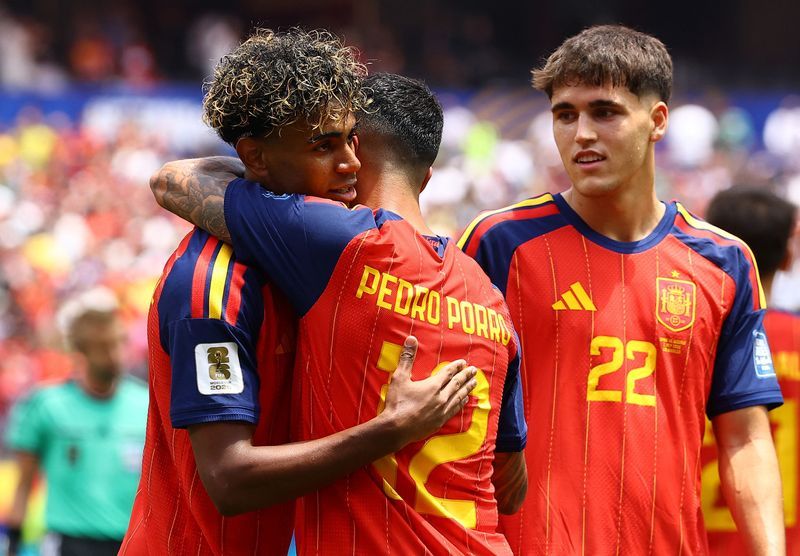
Spain's commanding 3-0 demolition of Austria demonstrated why their 18-year-old right winger Lamine Yamal has become indispensable to their World Cup ambitions. The Barcelona prodigy's growing influence on the competition has shifted the European champions from uncertain performers into a side rediscovering the cohesive attacking football that earned them continental glory in 2024.
Yamal's journey through this tournament reflects Spain's own trajectory. He arrived bearing a troublesome hamstring complaint that forced manager Luis de la Fuente to employ him sparingly in the opening fixture against Cape Verde, a tepid goalless encounter that exposed troubling gaps in the side's rhythm and cutting edge. Without their teenage catalyst operating at peak condition, Spain looked laboured and uninspiring—a stark contrast to the fluid, aggressive approach that defined their European Championship campaign.
As Yamal's fitness improved and he accumulated meaningful playing time, Spain's performances underwent a corresponding metamorphosis. The familiar architecture of their midfield control persisted, yet now it incorporated a volatile new ingredient: a teenage winger capable of making structured, possession-based football appear spontaneous and dangerous. Opposing defences understood precisely where Yamal would appear on the flank, yet tactical knowledge proved insufficient to neutralise his threat. This paradox—a player everyone anticipates but few can effectively stop—reveals the gap between his technical excellence and his footballing intelligence.
Yamal's centrality to Spain's success becomes clearer when examining their recent trajectory. Since bursting from Barcelona's celebrated La Masia academy at just sixteen, he has demonstrated an exceptional capacity to blend positional discipline with individual creativity. During Germany's European Championship, he anchored Spain's invincible campaign, which culminated in a record tournament scoring tally. His presence in North America initially faltered due to fitness complications and injuries to other key players like winger Nico Williams, whose explosive pace on the opposite flank formed crucial balance in De la Fuente's setup.
Against Cape Verde, with Gavi and Ferran Torres deployed wide, Spain appeared blunt and creatively constipated. The introduction of playmaker Alex Baena alongside Yamal's maturation within the competition, however, recalibrated their attacking geometry. Baena's positioning on the left flank created a second aggressive avenue, constantly stretching Austria's defensive shape and forcing constant positional adjustments. Meanwhile, Yamal functioned as a gravitational force, drawing defenders into his orbit with magnetic consistency.
Spain's tactical approach against Austria prioritised isolating their teenage sensation in wide duels, a strategy that frequently proved profitable. Yet their most aesthetically compelling and dangerous phases emerged when Yamal drifted centrally, compressed the pitch, and allowed midfield orchestrators Rodri and Pedri to orchestrate possession with the measured tempo characteristic of Spanish football. This interplay between Yamal's individual initiative and collective responsibility created attacking sequences of genuine menace, suggesting the various mechanical components are beginning to function in synchronisation once more.
While clear refinements remain necessary—particularly sustaining midfield dominance across extended passages and eliminating the defensive vulnerabilities that occasionally emerge between the lines—this performance indicated meaningful progression. Full backs Marc Cucurella and Pedro Porro delivered commanding displays in defensive width, Rodri exhibited pronounced improvement following halftime adjustments, and substitute Mikel Oyarzabal demonstrated decisive finishing when opportunities materialised.
Perhaps most revealing was Yamal's selection as player of the match despite neither scoring nor directly assisting. This distinction highlights Spain's strategic evolution. Where conventional tournament contenders depend upon exceptional attacking individuals generating consistent goalscoring output, Spain operated comfortably against Austria with Yamal exerting influence through subtler mechanisms—absorbing defensive pressure, destabilising Austria's structural organisation, and creating the spatial conditions allowing teammates to function effectively.
Spain's defensive architecture proved equally impressive. Austria received zero shots on target throughout the encounter, marking the first instance since Germany's 2014 World Cup final victory over Argentina that a knockout opponent failed to record a single shooting attempt. This defensive solidity extends beyond the current tournament; Spain have maintained their World Cup clean sheet since losing to Japan in 2022, currently riding a 34-match unbeaten streak that underscores their championship pedigree.
For Malaysian and Southeast Asian football observers, Yamal's emergence represents a fascinating inflection point in European tournament football. Rather than abandoning their philosophical foundations centred on collective coordination and patient progression, Spain have adapted their template to accommodate individual brilliance that enhances rather than supplants their fundamental approach. This capacity for tactical evolution—maintaining identity while embracing contemporary demands—offers compelling lessons about sustaining excellence in competitive football. As Yamal continues his tournament development, so too does Spain's championship trajectory, the teenager now central to everything his nation attempts.

