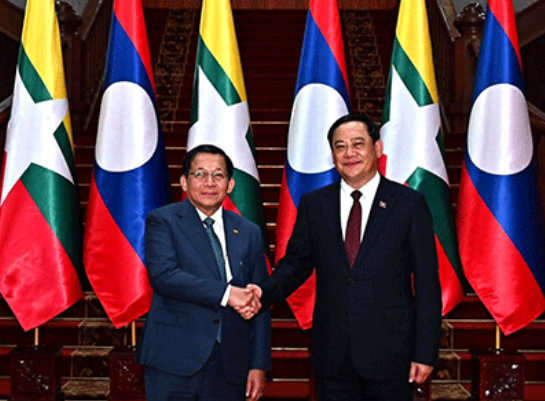
Myanmar's President Min Aung Hlaing wrapped up an official visit to Laos from July 3-5, during which both nations committed to broadening their partnership across political, economic and security domains. Accompanied by his wife and senior delegation members, the Myanmar leader was received with full state honours by Lao President Thongloun Sisoulith, underscoring the ceremonial significance attached to the engagement. The three-day tour served as a commemoration of seven decades of formal diplomatic relations, providing an opportunity for both governments to recalibrate their approach to bilateral cooperation in a period of regional transition.
The formal discussions between President Thongloun and President Min Aung Hlaing centred on reviewing the trajectory of their bilateral relationship and charting new directions for collaboration. Both leaders characterised their ties as rooted in traditional friendship and good-neighbourly principles, language that reflects the historical bonds forged during the Cold War era when both nations faced similar geopolitical pressures. Their conversation ranged beyond bilateral matters to encompass regional developments and international concerns, demonstrating that the relationship operates at multiple levels and serves broader strategic purposes within Southeast Asia.
Laos' leadership took the occasion to congratulate Myanmar on its recent electoral process and the formation of a new government, a gesture that holds particular weight given Myanmar's complex political circumstances in recent years. By publicly endorsing President Min Aung Hlaing's administration, the Lao government positioned itself as a stabilising influence while reinforcing its role as a constructive partner within the region. The Lao president expressed confidence that Myanmar would advance under its new leadership, a statement that underscores how smaller nations in Southeast Asia often validate each other's governance transitions through diplomatic recognition.
Defence and security cooperation emerged as a cornerstone of the renewed partnership framework. Both nations agreed to enhance border security mechanisms and establish stronger information-sharing protocols, recognising that their shared frontier requires coordinated management to address transnational challenges ranging from drug trafficking to irregular migration. This dimension of the relationship carries particular significance for Myanmar, which faces complex security challenges along multiple borders, making cooperation with a stable neighbour valuable for its own strategic interests.
Trade, investment and infrastructure development featured prominently in the bilateral agenda. The leaders welcomed ongoing progress in these sectors and encouraged their respective agencies to maintain close coordination to unlock further economic opportunities. For Malaysia and other ASEAN members observing these developments, the Laos-Myanmar economic partnership offers insights into how smaller nations leverage bilateral frameworks to diversify their engagement beyond major regional powers. Energy cooperation, including hydropower initiatives, represents another avenue through which the two countries seek mutual benefit, reflecting broader Southeast Asian trends toward regional energy integration.
Parliamentary engagement received explicit attention during the visit, with Myanmar's President meeting Laos' National Assembly President Xaysomphone Phomvihane. This legislative-level dialogue highlighted that both governments view their partnership as requiring implementation mechanisms beyond executive-level agreements. The National Assembly President committed to providing legislative oversight of bilateral agreements, signalling that Laos intends to ensure that cooperation memorandums translate into tangible benefits for its citizens rather than remaining symbolic gestures.
Tourist cooperation and cultural exchange gained formal recognition through a memorandum of understanding between the two nations' culture and tourism ministries. Additionally, the two capitals—Vientiane and Naypyidaw—established official friendship city relations, a framework that facilitates municipal-level collaboration and people-to-people connections. These initiatives move beyond conventional state-to-state diplomacy to build grassroots linkages that can sustain relationships during periods when political priorities shift.
A particularly poignant moment came when President Min Aung Hlaing laid a wreath at Vientiane's Unknown Soldier Monument, honouring Lao revolutionary forces. This gesture carries symbolic weight, acknowledging shared historical struggles and the sacrifices made during both nations' nation-building periods. Such ceremonial acts matter in Southeast Asian diplomacy, where historical grievances and revolutionary credentials inform how nations relate to one another.
The timing of this visit warrants consideration within Myanmar's broader diplomatic positioning. Xaysomphone noted that Laos was the first ASEAN member state visited by President Min Aung Hlaing for official engagements since assuming office, a distinction that suggests Myanmar is carefully calibrating its regional outreach. This strategic sequencing underscores Myanmar's interest in strengthening ties with immediate neighbours before pursuing broader regional engagement, a pattern that reflects both practical and political considerations.
For Malaysian observers, the Laos-Myanmar partnership illuminates how smaller ASEAN states navigate relationships with neighbours facing internal challenges or international scrutiny. The Lao approach—maintaining diplomatic warmth while advancing practical cooperation—offers a model of engaged pragmatism. Neither nation sought to isolate the other or impose conditions; instead, both emphasised mutual benefit and non-interference, principles that underscore ASEAN's foundational norms.
The involvement of cross-border cooperation frameworks, including the Mekong-Lancang Cooperation mechanism, reflects how bilateral relationships increasingly nest within regional and sub-regional structures. This layering of engagement channels provides redundancy and flexibility, ensuring that cooperation continues even when specific bilateral initiatives face obstacles. For regional stability, such multi-tiered partnerships distribute relationships across numerous contact points rather than concentrating them in single government-to-government channels.
The handover of snake antivenom serum to Laos' Ministry of Health, while appearing tangential, exemplifies how bilateral cooperation extends into public health domains. These technical collaborations often receive less diplomatic attention than defence or trade agreements, yet they address practical challenges affecting ordinary citizens and build constituencies for sustained partnership.
As Myanmar navigates an uncertain international environment and Laos seeks to deepen its economic integration with regional partners, the reinforced bilateral relationship serves both nations' strategic interests. For Southeast Asia more broadly, the strengthened Laos-Myanmar partnership demonstrates that despite external pressures and internal transitions, the region's nations continue investing in mutual cooperation and institutional development that will shape regional dynamics for years ahead.

