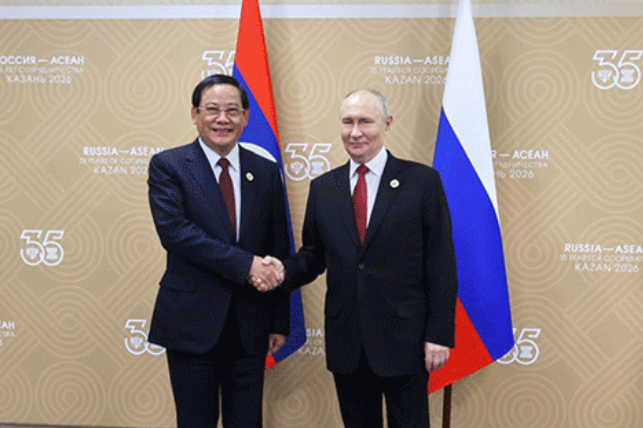
Laos and Russia have moved to deepen their longstanding partnership through a series of high-level meetings that underscore the countries' shared interests and aligned positions on regional and global affairs. Prime Minister Sonexay Siphandone and Russian President Vladimir Putin met during the Russia-Association of Southeast Asian Nations Summit in Kazan, where both leaders expressed confidence in the trajectory of bilateral relations and outlined ambitious plans for expanded cooperation. The encounter marked the culmination of Prime Minister Sonexay's inaugural official visit to Russia since his assumption of office, a visit undertaken at the invitation of Russian Prime Minister Mikhail Mishustin from June 14 to 17.
The centerpiece of the diplomatic engagement proved to be the signing of an intergovernmental agreement on cooperation in the peaceful use of nuclear energy, which President Putin characterised as a watershed moment in bilateral relations. The accord establishes the foundational legal framework for the construction of a small nuclear power plant utilising Russian technology within Lao territory. This development carries significant implications for Laos's energy security and long-term development strategy, positioning nuclear power as a potential component of the nation's diversified energy portfolio alongside its existing hydroelectric resources. For Russia, the agreement reinforces its technological and economic footprint in Southeast Asia at a time when Western nations have sought to limit Moscow's regional influence.
President Putin articulated Russia's valuation of the Laos relationship, emphasising the enduring basis of friendship, mutual respect, and reciprocal consideration of interests that has characterised ties between the two nations. This rhetorical positioning reflects a broader Russian strategy to cultivate and maintain partnerships across the Global South, particularly in regions where Moscow perceives opportunities to counterbalance Western diplomatic influence. The Russian president's explicit gratitude for Laos's diplomatic support within multilateral forums, including the United Nations, suggests that Moscow views Laos as a reliable partner capable of amplifying Russian positions on contested global issues.
The diplomatic calendar played a supporting role in the renewed affirmations of partnership. Putin recognised President Thongloun Sisoulith's attendance at Russia's Victory Day celebrations in May and acknowledged the participation of a Lao military contingent in the previous year's parade commemorating the eightieth anniversary of Soviet victory in World War II. These ceremonial engagements carry symbolic weight within Russian political culture and serve as tangible expressions of solidarity that extend beyond purely transactional state relations. For Laos, such participation in Russian commemorative events reinforces the nation's historical alignment with the Soviet Union and maintains cultural and diplomatic linkages that remain valued within Vientiane's foreign policy framework.
The bilateral agenda encompasses a remarkably broad spectrum of sectors, reflecting the ambition to construct a comprehensive partnership architecture. Energy cooperation forms the headline item, yet the scope extends into industrial development, agricultural collaboration, mining ventures, digital economy initiatives, banking relations, transport infrastructure, tourism promotion, and educational exchange. This multisectoral approach indicates that both nations envision their partnership as encompassing not merely security or political alignment but also tangible economic benefits and people-to-people connections. The breadth of proposed cooperation also suggests mutual recognition that deepening ties across numerous domains creates resilience and durability in the relationship.
Educational cooperation occupies a meaningful position within the partnership framework, with Prime Minister Sonexay explicitly acknowledging Russia's provision of annual scholarships and training opportunities for Lao nationals, including government officials. This emphasis on human resource development reflects a recognition that capacity building represents a long-term investment in institutional relationships. The ongoing construction of the Laos-Russia Friendship School in Vientiane, undertaken through inter-agency cooperation between both governments, embodies this commitment to deepening societal connections beyond the realm of formal diplomacy. Upon completion, the institution will serve as a physical manifestation of bilateral partnership and a conduit for cultural exchange.
Prime Minister Sonexay's address to a Laos-Russia business forum underscored the economic dimensions of the partnership renewal. Trade and investment constitute the practical mechanisms through which bilateral relations translate into tangible benefits for both societies. The forum provided a platform for private sector engagement, signalling that governmental affirmation of partnership principles must translate into commercial opportunities that incentivise sustained cooperation. For Laos, accessing Russian markets and technology transfer remains economically consequential, whilst for Russian enterprises, Laos represents a foothold within Southeast Asia's expanding consumer base and a source of natural resources.
The presentation of two elephants to the Kazan Zoo constituted a distinctive diplomatic gesture, marking simultaneously the sixty-fifth anniversary of bilateral relations and Russia's national day on June 12. This symbolic offering, presided over by Prime Minister Sonexay himself, employed cultural iconography to reinforce narratives of friendship and shared celebration. Such ceremonial dimensions of diplomacy, whilst superficially ornamental, carry genuine communicative value within international relations by projecting warmth and establishing memorable anchors for public perception of bilateral ties.
For Southeast Asia more broadly, the deepening Laos-Russia partnership reflects the region's broader strategic diversification and reluctance to align exclusively with any single external power. Laos's positioning as a bridge between China and other external actors, combined with its historical orientation toward Russia, illustrates how smaller Southeast Asian nations navigate great power competition by cultivating multiple partnerships. The nuclear energy agreement particularly signals Laos's pragmatic approach to energy security and its openness to technological cooperation from diverse sources. This dynamic mirrors broader regional patterns wherein countries such as Vietnam and Thailand similarly maintain substantive relationships with Russia even as they balance engagement with Western and Chinese partners.
The timing of these diplomatic engagements within the broader Russia-ASEAN framework carries additional significance. By hosting the summit and conducting high-level bilateral meetings, Russia demonstrates commitment to sustained engagement with Southeast Asia despite geopolitical tensions elsewhere. The Russian emphasis on 2026 marking thirty-five years of Russia-ASEAN relations suggests Moscow's intention to consolidate and expand institutional relationships at both bilateral and regional levels. For Malaysia and other ASEAN members observing from the sidelines, the Laos-Russia interaction illustrates how individual members of the regional bloc navigate relationships with major powers whilst maintaining nominal ASEAN solidarity and non-alignment principles.
The convergence of views on regional and global issues, as noted by both Putin and Prime Minister Sonexay, reflects alignment on issues ranging from Western-led sanctions regimes to perspectives on international law and sovereignty. Laos's strategic location along the Thailand-Vietnam border, combined with its historical ties to both Russia and the Soviet Union, positions it as a consistent supporter of Russian positions within international forums. This consistency provides Moscow with reliable diplomatic backing that proves valuable in contexts where voting patterns or diplomatic statements carry material consequences for Russian strategic interests.