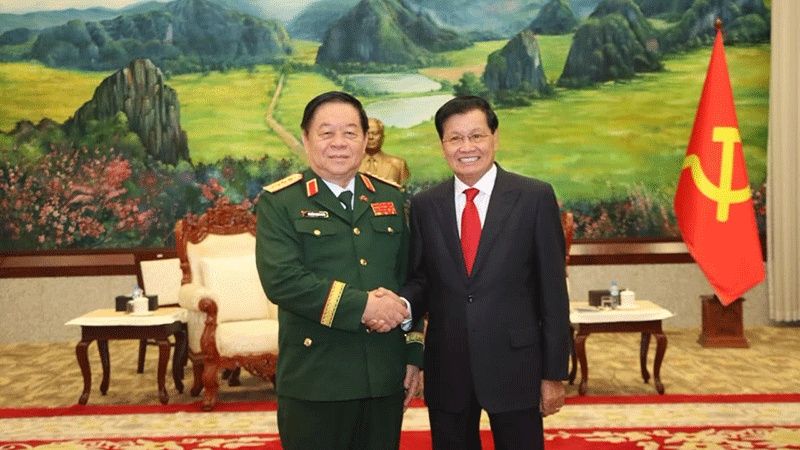
The leadership of Laos has expressed satisfaction with the progress made in defence discussions between the two countries' militaries, signalling a continued deepening of ties that have long defined the relationship between Vientiane and Hanoi. During an official visit that took place early August, Chairman of the General Department of Politics of the Vietnam People's Army General Nguyen Trong Nghia held a series of high-level meetings with Lao officials, culminating in a courtesy call with President Thongloun Sisoulith, who also holds the position of Secretary General of the Lao People's Revolutionary Party Central Committee.
President Thongloun characterised the visit as a meaningful step forward in consolidating the historical bonds between the two nations. He emphasised that the discussions represented another milestone in the trajectory of deepening friendship, special solidarity, and comprehensive cooperation that spans not only government structures but also their respective military institutions and broader populations. The president's warm reception of the Vietnamese delegation underscored the ceremonial importance accorded to such high-level defence engagements within the region's diplomatic framework.
The substantive discussions between military leadership produced what officials from both sides described as fruitful outcomes. The talks between the General Departments of Politics of the Lao People's Army and the Vietnam People's Army focused on identifying practical avenues for expanding cooperation while reinforcing existing institutional links. These conversations held particular significance given that defence cooperation stands as a pillar supporting the wider bilateral relationship between Laos and Vietnam, a comprehensive strategic partnership that extends into multiple domains including economic, cultural, and political spheres.
General Nghia's three-day visit, spanning August 5 to 7, formed part of a deliberate effort to strengthen the defence architecture connecting the two nations. The Vietnamese general also held separate meetings with other senior Lao defence officials, including Deputy Prime Minister and Minister of National Defence General Khamlieng Outhakaisone, and Lieutenant General Vongsone Inpanphim, who serves as Deputy Minister of National Defence and Director General of the General Department of Politics of the Lao People's Army. These multiple-level engagements reflected the institutional nature of the relationship and the breadth of issues under consideration.
Among the specific areas identified for enhanced cooperation were political education within military structures, exchanges between armed forces personnel, management of the shared border, and professional training programmes for military personnel. The emphasis on political education suggests that both countries view ideological alignment and historical consciousness as integral to maintaining their strategic partnership. By committing to educate younger generations about the foundations and enduring significance of Lao-Vietnamese friendship, the two nations appear intent on ensuring continuity of their bonds across generational transitions within their respective political and military establishments.
Border management cooperation carried particular practical importance in the agenda, reflecting geographical realities and the logistical challenges of maintaining territorial security along their shared frontier. Enhanced coordination in this domain would facilitate smoother cross-border military operations and intelligence sharing, while also addressing any transnational security concerns that might arise. Military personnel exchanges and training initiatives would enable knowledge transfer and strengthen interpersonal relationships among officers and personnel, thereby deepening institutional ties beyond formal diplomatic channels.
Vietnam's commitment to preserving and promoting the special relationship found explicit articulation through General Nghia's remarks to President Thongloun. The Vietnamese military official reiterated his nation's dedication to advancing the great friendship and special solidarity characterising the relationship, pledging continued effort to strengthen cooperation across party, state, and societal levels. This reaffirmation proved particularly significant given the geopolitical complexities of Southeast Asia, where major power competition and shifting alignments have prompted smaller nations to clarify their strategic priorities and key partnerships.
The timing and substance of these defence talks occur within a broader regional context where Laos occupies a strategically important position, serving as a buffer state between larger powers and connecting Southeast Asia to China. Vietnam's sustained engagement with Laos through high-level military visits demonstrates Hanoi's determination to maintain influence and close coordination with its western neighbour, ensuring that their shared interests remain aligned amid evolving regional dynamics. The emphasis placed on the special and comprehensive nature of their partnership suggests an intention to distinguish this relationship from Vietnam's other bilateral arrangements in the region.
For Malaysia and other ASEAN nations, the reinforcement of Laos-Vietnam defence cooperation carries broader implications for regional stability and the architecture of security arrangements in mainland Southeast Asia. The visit exemplifies how smaller nations within the bloc maintain bilateral relationships that complement rather than compete with regional mechanisms like the Association of Southeast Asian Nations. The focus on institutional capacity-building and personnel development indicates a long-term strategic vision rather than responses to immediate security challenges, suggesting stability in the relationship despite occasional regional tensions.
The discussions also revealed an intent to normalise and deepen defence relations through structured frameworks rather than ad-hoc arrangements. By establishing clear protocols for political education exchange, military training, and border cooperation, Laos and Vietnam are essentially formalising the mechanisms through which their defence partnership operates. This institutionalisation could serve as a model for how smaller neighbouring states manage their security relationships while preserving autonomy and protecting national interests.
General Nghia's visit concluded what appears as a routine but significant element of Laos-Vietnam bilateral relations, one that persists regardless of broader geopolitical fluctuations. The consistent high-level attention devoted to defence cooperation, combined with the ceremonial aspects of presidential receptions and multiple departmental meetings, underscores how central military coordination remains to the special relationship between these two nations. As Southeast Asia navigates periods of strategic uncertainty, the stable foundation of Lao-Vietnamese defence ties offers both countries reassurance about their fundamental security interests and shared trajectory within the region.

