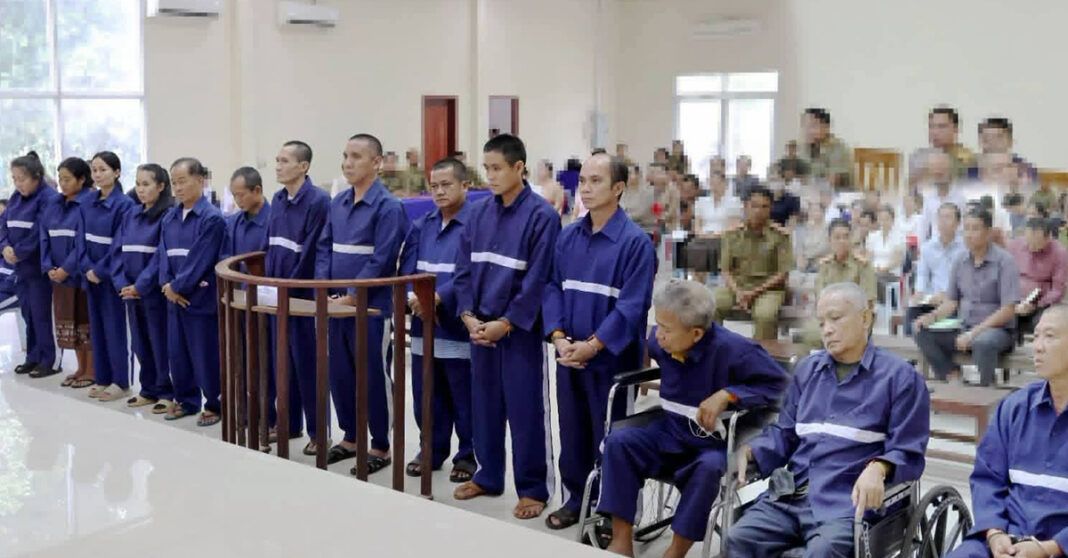
The Attapeu Provincial People's Court delivered one of the province's most significant corruption verdicts in recent memory on July 30, sentencing 15 state officials for large-scale embezzlement and financial malfeasance. The comprehensive judicial action reflects an escalating pattern across Laos of using severe penalties, including life imprisonment, to address systemic corruption at senior administrative levels. Ten of the defendants received life sentences, marking an unusually harsh application of judicial consequences in a case involving provincial-level officials rather than national leadership.
According to Lattana Simavath, head of the court office, the corrupt activities unfolded systematically between 2021 and 2024, orchestrated primarily by Sulixay "Mou" Suliyalay, a 37-year-old former deputy section head in the provincial office's research department. The investigation uncovered a sophisticated operation in which participants moved substantial sums through multiple currency denominations—approximately LAK 103.5 billion, USD 2.36 million, and VND 1.5 billion—with deliberate efforts to obscure the money trail by converting funds between Vietnamese dong, Lao kip, and Thai baht. The complexity of the scheme and the diversity of currencies involved suggest a level of planning and coordination among multiple conspirators.
The court calculated the actual confirmed loss to the state at LAK 51.9 billion (USD 2.4 million), USD 2.316 million, and THB 60,000, establishing the baseline figure for asset recovery proceedings. The disparity between the total amount moved through the scheme and the verified state loss indicates that investigators were able to trace portions of the stolen funds or that certain amounts involved were eventually recovered or accounted for. This distinction carries significance for understanding how thoroughly authorities penetrated the conspiracy and located stolen assets.
Nine individuals joined Sulixay in receiving life sentences, including several former departmental heads whose seniority underscores the breach of public trust at institutional levels. These included Sulichanh Phonkeo, the 55-year-old former Chief of Provincial Office; Sounnakhone Keoviengkham, 59, who previously headed the Planning and Investment Department; Khamphery Somthavone, 60, a retired finance department chief; and Thounxay Mekdavong, 60, a retired deputy finance chief. Additional life sentences went to Somsack Mountivong, a 45-year-old former provincial official; Inpong Silavikone, 38, formerly a technical officer; Manisone Phetvilay, 34, a former finance technical officer; Nipaphone Phothilath, 34, a volunteer staff member; and Phouthidavanh Kaysonesena, 36, an official in the finance department.
The remaining five defendants received differentiated sentences reflecting their varying degrees of culpability and roles within the conspiracy. Outthali Singthammavong, 43, head of the provincial office's administration section, drew a 20-year sentence, while Simmali Khamman, 44, another provincial official, received 18 years and six months. Keophouthone Vilathum, 47, a former finance department official, was sentenced to 16 years and six months. The judiciary's calibration of these intermediate sentences suggests prosecutors presented evidence of differential participation levels and responsibility among the co-conspirators.
Two individuals received substantially lighter penalties reflecting either lesser involvement or cooperation with investigators. Souksavanh Bounphan, 55, the former deputy head of the provincial finance department, received five years imprisonment, while Phonpiloun Xaysombath, 49, former deputy head of the accounting and audit department, received two years and six months, with credit for seven months and 11 days already served. The particularly lenient sentence for Xaysombath may indicate her provision of testimony or evidence crucial to the prosecution's case, a common practice in complex financial crime investigations.
A sixteenth defendant, Soukmay Soutbounlon, escaped conviction through his death during legal proceedings, though civil liability remains attached to his seized assets. This outcome, while preventing criminal sanctions, preserves the state's ability to recover damages through asset forfeiture mechanisms—an important consideration given the total financial exposure involved.
The Attapeu verdict does not stand in isolation but instead represents part of a broader intensification of anti-corruption enforcement across Laos during 2024. Just weeks earlier in July, the Vientiane Capital People's Court concluded proceedings in four major corruption cases spanning 17 defendants with connections to prominent state institutions including the State Inspection Authority, the Bank of the Lao PDR, the Agricultural Promotion Bank, the Ministry of Foreign Affairs, and Electricity of Laos. This parallel wave of prosecutions demonstrates coordinated judicial action against systemic corruption across multiple sectors and geographic regions.
The Vientiane verdicts resulted in combined restitution orders exceeding USD 27 million, with the single largest judgment—over USD 24.8 million—stemming from a hydropower corruption case involving former Electricity of Laos executives and a Thai businessman. That case alone highlights how corruption in energy infrastructure projects can generate extraordinary financial losses to the state and illustrates the transnational dimension of some Lao corruption schemes. The life sentences imposed on multiple defendants in these capital-region cases mirror the severity applied in Attapeu, suggesting a unified judicial approach across provincial and national courts.
These consecutive waves of verdicts signal a deliberate strategic shift by the Lao judicial system toward prosecuting and severely punishing high-level administrative corruption. The application of life imprisonment—traditionally reserved for the most serious violent crimes in many jurisdictions—to financial offences represents an unusual and notably harsh policy choice that reflects profound institutional concern about the scope and damage caused by official misconduct. For Southeast Asia and the broader region, Laos's approach offers both a cautionary example of how thoroughly embedded corruption can become within state institutions and evidence of potential political will to address it through judicial mechanisms.
The implications extend beyond Laos. Regional observers monitoring governance standards and anti-corruption efforts will assess whether these prosecutions and sentences represent sustained institutional commitment or a temporary enforcement surge. The recovery of actual stolen assets—separate from the symbolic force of imprisoning officials—remains crucial for evaluating whether the judiciary's harsh verdicts translate into genuine financial restitution to the state. For Malaysian observers, the Lao experience underscores persistent vulnerabilities in Southeast Asian financial systems to abuse by entrenched officials and the challenges of detecting complex schemes involving multiple currencies and cross-border transfers.

