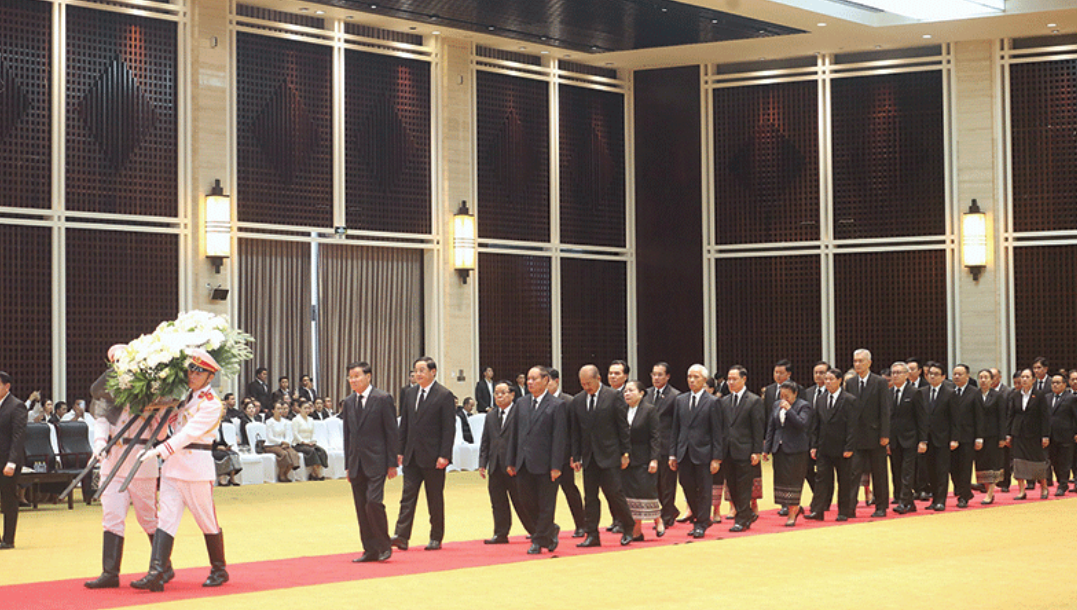
Laos is observing an extended period of national mourning after the death of National Assembly President Xaysomphone Phomvihane, with the country's top political leadership converging on Vientiane's National Convention Hall to pay their final respects. The solemn tribute ceremony on Sunday, August 9, drew Party Secretary General and President Thongloun Sisoulith alongside members of the Politburo, government ministers, National Assembly deputies, and representatives from a cross-section of Lao society to honour a figure whose nearly five-decade career shaped the nation's legislative and political development.
Xaysomphone, born December 12, 1956, occupied a position of considerable significance within Laos's power structure as both a Politburo member of the Lao People's Revolutionary Party Central Committee and President of the National Assembly. His prominence derived partly from his family lineage—he was one of six sons of former President Kaysone Phomvihane, whose legacy remains foundational to modern Laos. This family connection positioned him at the nexus of the country's political establishment, and his death represents a generational shift within the ruling elite.
The ceremonial proceedings at the National Convention Hall reflected the hierarchical nature of Lao governance, with delegations from state institutions presenting wreaths in carefully sequenced order. The Party Central Committee delegation, led by President Thongloun himself, proceeded first, underscoring the primacy of the Communist Party in Lao political life. Subsequent tributes from the National Assembly's Standing Committee, the Government led by Prime Minister Dr Sonexay Siphandone, and various family delegations demonstrated the institutional and personal networks through which power circulates in Vientiane. The visible participation of senior figures including Deputy Prime Minister Santiphab Phomvihane—himself Xaysomphone's brother—highlighted the intertwining of family relationships with state office that characterises Lao governance.
The involvement of Vietnamese delegations, including a senior representative from the Communist Party of Vietnam's Politburo and Chairman of Vietnam's National Assembly Tran Thanh Man, underscores the centrality of Sino-Vietnamese coordination within regional communist structures. Additional delegations from Vietnam's Ministry of Public Security and Ministry of National Defence attending the ceremony demonstrate how deeply integrated Laos and Vietnam remain on security and political matters. Vietnam's parallel declaration of two days of national mourning on August 10-11 reveals the symbolic importance regional powers attach to developments within Laos's political leadership.
Xaysomphone's legislative career encompassed decades of institutional building during a period when Laos transitioned from rigid central planning toward limited market reforms while maintaining single-party communist rule. His tenure at the National Assembly's helm involved navigating complex questions of economic policy, national development priorities, and the Party's relationship with society during a transformative period for Southeast Asia. The tributes emphasised his contributions to "national defence, development and the country's political and socio-economic affairs," language that reflects both the Party's official narrative and the genuine challenges of governing a lower-middle-income nation bordered by larger regional powers.
The extended mourning period—five days across August 8-12—provides unusual transparency into elite political processes. The wreath-laying ceremony open until August 11 creates space for foreign diplomats, provincial officials, business representatives, and ordinary citizens to participate in the national ritual of succession transition. This accessibility contrasts with the opaque decision-making processes through which actual power transfers occur within Lao governance structures, suggesting an attempt to balance inclusivity with controlled institutional choreography.
The planned cremation ceremony on August 12 at the That Luang esplanade, Vientiane's most sacred Buddhist site, carrying "full honours" status carries particular symbolic weight in Lao political culture. The selection of this location and the formal rituals surrounding his final farewell represent not merely personal or familial commemoration but state-sanctioned consecration of his political legacy. In Buddhist-majority Laos, such ceremonies blend communist state symbolism with deeply rooted religious and cultural traditions, creating hybrid legitimacy frameworks.
Xaysomphone's death occurs at a delicate juncture for Lao regional positioning. With Vietnam and China both exercising considerable influence over Lao affairs—through investment, security arrangements, and political guidance—his passing potentially reshuffles internal power balances. The prominence of Vietnamese attendance at his funeral suggests Beijing and Hanoi will likely exercise influence over succession questions, particularly regarding who assumes the National Assembly presidency. For Malaysia and other ASEAN members, such developments carry implications for regional multilateralism, as Laos's political stability affects ASEAN's coherence.
The enumeration of family delegations in official accounts—the Phomvihane family, Siphandone family, and Phommathat family—reveals networks of kinship and obligation that structure elite politics in ways formal institutional descriptions obscure. These family clusters frequently rotate senior positions among their members, creating dynastical patterns within nominally collective communist governance. Understanding Lao politics requires recognising such informal structures alongside official titles and party rhetoric.
For the Lao business community's visible participation in funeral proceedings and the ongoing national mourning, there exists implicit reassurance that political succession will occur smoothly and without threatening established economic arrangements. The Party's careful orchestration of tributes, the presence of both domestic and international figures, and the extended ceremonial calendar all suggest coordinated elite consensus around orderly transition rather than factional competition. Whether such surface unity masks underlying disputes remains unclear from available reporting.
The death removes from circulation a senior figure whose formative experiences encompassed French colonial Laos, the Indochina Wars, and the entire span of communist rule since 1975. Such generational transitions carry particular weight in revolutionary states where early cadres carry symbolic weight beyond their current administrative roles. Xaysomphone's passing marks another step in the gradual replacement of independence-era revolutionaries with bureaucratic managers born into the communist system.
The regional dimension of Lao succession politics deserves particular attention from Southeast Asian observers. The balance between Lao nationalist aspirations, Vietnamese strategic interests, and Chinese economic influence continues shaping how the country's leadership rotates and what policies they pursue. Xaysomphone's successor will face inherited challenges of economic underperformance, foreign debt, and the perpetual tension between maintaining Party control and accommodating market pressures—questions that have preoccupied Lao policymakers for decades and remain unresolved.

