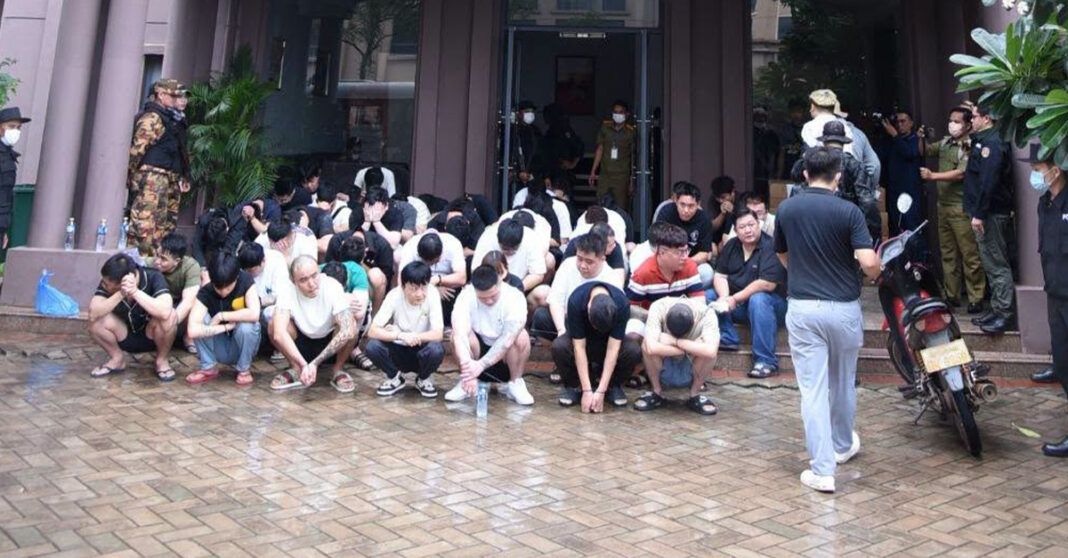
Vientiane police have dismantled a major telecommunications fraud and online gambling operation, detaining 261 suspects of seven different nationalities during an 8 August raid on a facility located within the Thatluang Lake Special Economic Zone. The operation represents a significant escalation in Laos's ongoing campaign against organised crime networks that have increasingly exploited the country's porous borders and relatively lenient regulatory environment to conduct scams targeting victims across Southeast Asia and beyond. The sheer scale and international composition of those arrested underscores the complexity of transnational fraud operations now entrenched in the region.
Chinese nationals constituted the largest proportion among those detained, accounting for 153 of the 261 suspects. Vietnamese nationals represented the second-largest contingent at 61 individuals, while Thai citizens numbered 36. The remaining detainees comprised five Taiwanese, two Malaysian, two South Korean and two Myanmar nationals. The preponderance of Chinese and Vietnamese operatives suggests coordinated networks with established supply chains for recruitment, logistics and technical expertise—a pattern consistent with emerging intelligence about how these schemes function across multiple Southeast Asian jurisdictions.
Police seized substantial quantities of equipment during the raid, indicating an industrial-scale operation. Nearly 500 desktop computers and laptops were confiscated, alongside 2,355 mobile phones, all catalogued as evidence for ongoing investigations. Such equipment inventories typically support call centres designed to impersonate financial institutions, government agencies or e-commerce platforms, a common tactic in large-scale romance, investment and credential-harvesting scams. The volume of seized devices suggests the operation was simultaneously targeting victims across multiple countries and time zones.
Authorities have identified the building as belonging to Lao Thatluang Investment Development Co., Ltd., raising questions about corporate accountability and regulatory oversight within special economic zones. Lao police have indicated they are pursuing leads to identify and prosecute the network's senior leadership and supporting infrastructure. Such investigations often reveal complex layers of complicity involving local facilitators, financial handlers, safe house operators and document forgers—elements without which large foreign criminal enterprises struggle to sustain operations in any country.
The Thatluang Lake raid forms part of an accelerating crackdown by Laotian authorities on scam networks operating throughout the country. In mid-July, police had conducted another major operation targeting the ST Vegas complex in Dongphosy village, Hatsayfong district, also in Vientiane. That operation, carried out on 18 July, ensnared 589 suspected scammers, predominantly Thai nationals but also including Lao, Vietnamese and Cambodian suspects. The back-to-back large-scale raids suggest either a deliberate intensification of enforcement efforts or the government's acknowledgement that the scale of criminal activity had reached intolerable levels.
The regional dimension became apparent through subsequent deportations. On 10 August, authorities transported 41 Thai suspects to Thai counterparts via the 1st Lao-Thai Friendship Bridge, extending cooperation that had already seen 32 Thai nationals handed over through the same crossing two days earlier on 6 August. These coordinated transfers brought the cumulative number of Thai nationals deported to at least 73 individuals, indicating reciprocal law enforcement coordination between Vientiane and Bangkok despite occasional diplomatic tensions. Such handovers, while encouraging from a regional security perspective, also highlight the ease with which foreign nationals have historically moved across the porous Mekong border.
For Malaysian readers, the inclusion of two Malaysian nationals among the 261 detained carries particular significance. Malaysia has in recent years become both a source and transit hub for scam operations, with Malaysian citizens appearing in detention lists across the region with increasing frequency. The presence of Malaysian operatives in Laotian networks suggests integrated regional criminal ecosystems where expertise, capital and personnel flow seamlessly across borders. This development underscores the need for Malaysian authorities to strengthen coordination with Laotian counterparts and enhance border security protocols.
The involvement of Taiwanese and South Korean nationals indicates these networks recruit operatives from developed Asian economies where language skills, technical proficiency and legitimate travel documentation facilitate their overseas deployment. This pattern reflects how sophisticated transnational crime organisations strategically diversify their workforce across nationalities to complicate investigation and prosecution. A single operation therefore becomes a tapestry of multiple national legal jurisdictions, each with different extradition treaties, evidentiary standards and sentencing frameworks.
The Lao government's pivot toward sustained enforcement action may reflect mounting international pressure and deteriorating reputational consequences. Southeast Asian nations, particularly Thailand and Vietnam, have suffered enormous aggregate losses to scam networks operating from Lao territory. Regional neighbours have begun implementing targeted sanctions and travel restrictions. For Laos, which depends substantially on tourism and foreign investment inflows, the persistence of such criminal enterprises represents both an immediate security concern and a longer-term economic vulnerability that threatens development objectives.
These operations highlight systemic vulnerabilities that transcend individual raids. Special economic zones in developing economies often operate under regulatory regimes lighter than national law, creating permissive environments for illicit enterprises. Weak corporate registry systems, limited financial intelligence capacity and inadequate coordination between civilian and security authorities all facilitate criminal consolidation. The Thatluang Lake SEZ raid, therefore, points toward urgent questions about governance structures within such zones and the necessity for strengthened compliance frameworks.
The path forward likely requires sustained regional cooperation mechanisms that move beyond ad-hoc deportations toward intelligence sharing, joint task forces and harmonised legal standards. Malaysia, as a significant economy within ASEAN with sophisticated law enforcement institutions, has a vested interest in championing such frameworks. The presence of Malaysian operatives in Laotian networks suggests that the scam ecosystem treats Southeast Asia as a unified operational theatre, and national police services must adapt their strategic thinking accordingly.
As investigations deepen and additional arrests materialise, patterns of financing, recruitment and victim targeting should yield valuable intelligence for regional authorities. The detained individuals represent a cross-section of criminal enterprise ranging from technical specialists to customer-facing operatives, offering law enforcement opportunities to map organisational hierarchies and identify command structures. Such mapping becomes increasingly crucial as transnational crime networks continue evolving their methods and expanding geographic footprints across Southeast Asia.

