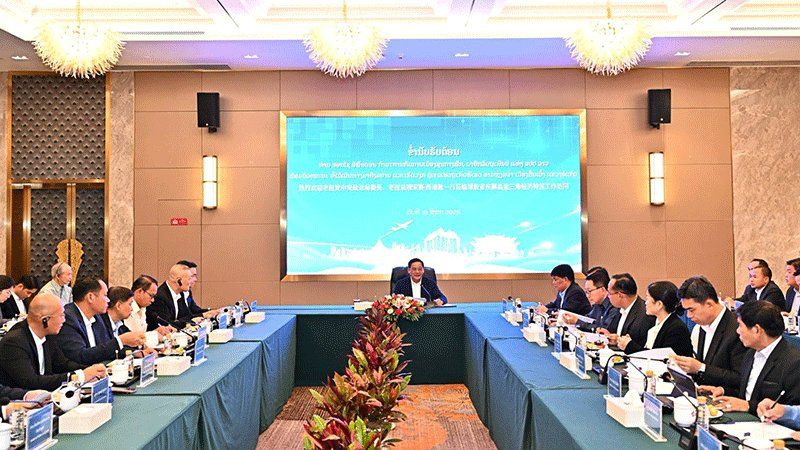
Laos is signalling a significant shift in its approach to managing the Golden Triangle Special Economic Zone, with Prime Minister Sonexay Siphandone demanding tighter oversight and more disciplined development practices during an inspection visit this month. The high-level intervention underscores growing frustration with what officials characterise as sluggish implementation across the sprawling zone, which straddles three nations at one of Southeast Asia's most strategically important crossroads.
During his August 18 visit to the 10,000-hectare zone in Bokeo province's Tonpheung district, Dr Sonexay outlined a comprehensive reform agenda targeting operational deficiencies that have persisted across the zone's 19-year history. While the zone has attracted approximately US$10 billion in investments since its 2007 establishment, a troubling statistic has emerged: investors have completed only around 60 per cent of the activities stipulated in their original contracts. This significant gap between commitment and delivery represents a critical failure point that the government now appears determined to remedy through enhanced regulatory intervention.
The Golden Triangle SEZ occupies a uniquely privileged position in Lao economic strategy, offering investors streamlined access to the labour and consumer bases of Myanmar, Thailand, and China simultaneously. Its banks along the Mekong River in the tri-border zone place it at the heart of regional trade flows and cross-border economic integration. Yet this geographic advantage alone has proven insufficient to drive the level of productive activity that government planners envisioned. The zone currently hosts over 10,000 registered workers, while managing flows of more than 10,000 additional investors, business operators, residents, and tourists—a complex operational challenge that existing management structures appear inadequate to handle effectively.
The Prime Minister's intervention reflects recognition that merely creating regulatory frameworks and offering incentives cannot guarantee sustained economic development without rigorous enforcement and oversight. Dr Sonexay specifically instructed authorities to strengthen the zone's one-stop-service system, improve investor support infrastructure, and enhance coordination among the various government agencies tasked with zone administration. More than 400 government officials from multiple sectors are already stationed there, yet their effectiveness in driving implementation remains questionable. The creation of additional bureaucratic capacity appears less important to the Prime Minister than reforming how existing authority is exercised.
A striking demand emerging from the inspection relates to financial governance. Dr Sonexay mandated that all transactions involving trade, investment, wage payments, services, and other commercial operations must flow through the Lao banking system rather than through informal or alternative channels. This requirement addresses a persistent challenge facing developing economies seeking to monitor and regulate economic activity within special zones, where parallel financial systems can flourish. By funnelling all transactions through formal banking channels, authorities gain visibility into capital flows, employment relationships, and the actual scale of economic activity occurring within the zone—essential data for policy-makers attempting to assess whether the zone is delivering genuine benefits to the Lao economy.
Border management has emerged as another priority area requiring immediate attention. The Prime Minister called for stricter regulation of entry and exit procedures at the zone, reflecting concerns about security, labour trafficking, and irregular population movements. The geographic proximity to Myanmar and Thailand creates both opportunity and vulnerability. Enhanced crossing protocols should help distinguish between legitimate business travellers and workers, investors, and other entrants moving through the zone. Greater coordination with neighbouring nations on recognising documentation, managing worker flows, and establishing mutual transparency mechanisms represents an implicit acknowledgment that the zone's transnational character demands regional cooperation rather than unilateral Lao approaches.
The emphasis on sectoral development priorities signals that the government views the zone's future differently from recent practice. Rather than welcoming investment across all sectors equally, Dr Sonexay identified tourism, manufacturing, processing, transportation, education, and public health as priority areas capable of generating sustainable and diversified economic growth. This selective approach suggests that previous investment patterns—including real estate speculation, which typically generates fewer employment opportunities and less technology transfer—may have disappointed government expectations. Redirecting the investment climate toward sectors offering stronger multiplier effects and employment generation reflects pragmatic assessment of what actually builds broad-based prosperity.
The demand for improved concession agreements that align more tightly with existing legislation hints at potential governance gaps that have permitted suboptimal outcomes. Contracts apparently negotiated with insufficient attention to enforceability or sufficiently vague performance metrics have allowed investors to claim contractual compliance while delivering minimal economic activity. Revising these foundational documents to establish clearer expectations and measurable deliverables addresses a fundamental structural problem that cannot be resolved through improved administration alone.
For Malaysian readers and businesses watching developments in the greater Mekong region, the Golden Triangle SEZ's trajectory carries important implications. As Laos tightens governance of its premier special economic zone, foreign investors—including those from Malaysia—should anticipate more rigorous enforcement of contractual obligations, heightened scrutiny of banking transactions, and pressure to deliver activities aligned with government priorities rather than merely maintaining nominal investment positions. The zone remains attractive given its tri-border location and Laos's investment incentives, but the business environment is entering a more demanding phase.
The Prime Minister's intervention also suggests that the Lao government is becoming more sophisticated in distinguishing between the appearance of development—measured in investment announcements and registered entities—and actual economic transformation. This distinction matters profoundly for Southeast Asia's development trajectory. Special economic zones function most effectively when they combine genuine fiscal incentives with rigorous enforcement and clear sectoral direction. Laos appears to be learning this lesson after nearly two decades of experience, implementing the kind of disciplined zone governance that has driven success in more developed neighbour nations. Whether the promised reforms translate into measurable improvements in zone performance will become apparent within months as the government tightens administrative controls.

