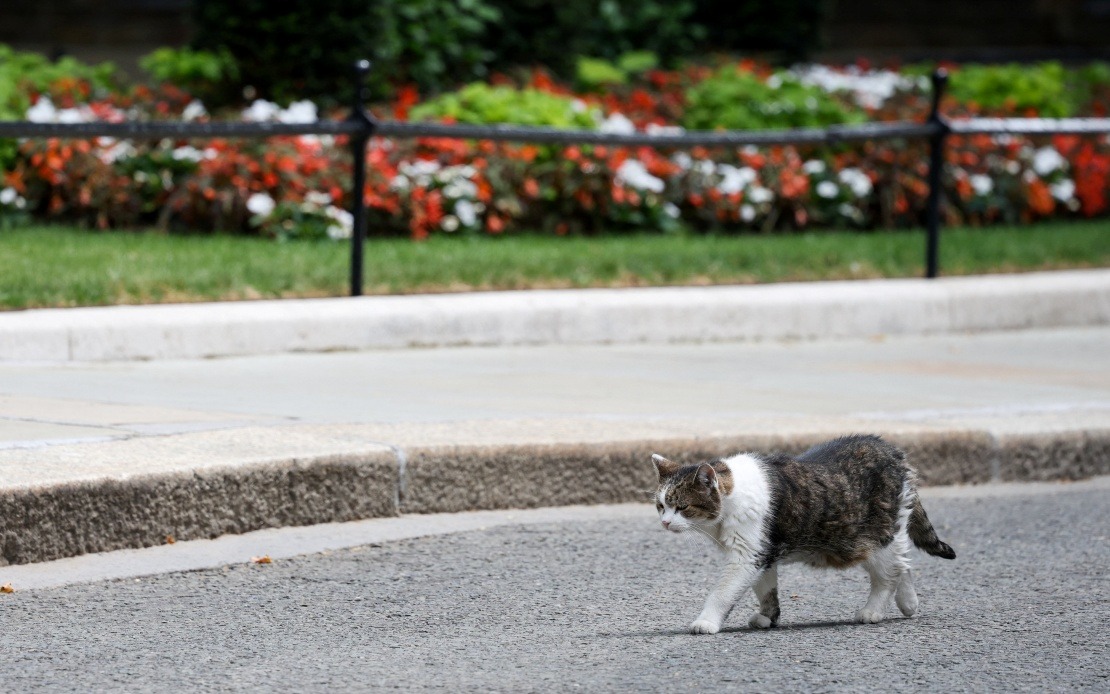
Britain's most famous feline resident has achieved a remarkable feat of institutional longevity that many politicians can only envy. Larry, the tabby cat of 10 Downing Street, has now served through six successive British prime ministers, a distinction that underscores both his enduring tenure and the rapid turnover that has characterised British political leadership in recent years. On Tuesday, July 21, as Britain's newly appointed Prime Minister Andy Burnham convened his first Cabinet meeting following his assumption of office, Larry was observed wandering the grounds outside the official residence—a scene that captures the symbolic continuity the cat represents amid the perpetual churn of Westminster politics.
The image of Larry roaming outside Downing Street while ministers assembled within carries particular resonance given the accelerating pace of change at the highest levels of British governance. In the span roughly equivalent to Larry's residence at the iconic address, the nation has cycled through six prime ministers, a frequency that would have been unthinkable in earlier eras of British political stability. Each departure of a sitting prime minister has marked a transition in No. 10's occupants, yet Larry has remained a constant fixture, indifferent to the electoral winds and political crises that have reshaped the British political landscape. His presence across such transitions highlights the gaps between transient political leadership and institutional permanence.
For Malaysian and Southeast Asian observers, the spectacle of Larry's longevity offers an instructive lens through which to examine leadership stability and institutional continuity. While Malaysia has experienced its own transitions in prime ministerial leadership, often marked by considerable political upheaval, the British experience demonstrates how even established Westminster democracies face significant challenges in maintaining consistent governance. The rapid succession of prime ministers in the United Kingdom reflects deeper fractures within the Conservative Party during recent years, internal disputes over policy direction, and mounting public dissatisfaction that has destabilised political tenure at the highest levels.
Larry's appointment to 10 Downing Street in 2011 initially served a practical purpose: to address a rodent infestation affecting the building's historic grandeur and administrative functions. What began as a utilitarian measure, however, has evolved into something far more significant within British political culture and popular consciousness. The cat has acquired almost symbolic status as a guardian of the institution itself, transcending his original mousing mandate to become an emblem of continuity and steady presence through tumultuous political upheaval. His tenure has become a subject of genuine public interest and affection, with media coverage and social media engagement surrounding Larry's activities at Downing Street reflecting a broader public appetite for symbols of stability.
The succession of prime ministers that Larry has witnessed encompasses a diverse range of political figures and governing philosophies. From David Cameron's initial coalition government through Boris Johnson's tumultuous premiership marked by scandal and internal rebellion, to Liz Truss's historically brief tenure lasting mere weeks, Larry has observed transformations in political direction and personnel that have frequently shocked both Westminster insiders and the international community. Each transition has brought new faces, new policy agendas, and new personnel to the Cabinet meeting rooms where Larry occasionally appears. Yet the cat's essential role and territorial claims at Downing Street have remained unaltered by these human-level upheavals.
Andy Burnham's accession to the office of Prime Minister represents another chapter in this extraordinary feline record. Burnham's appointment signals a shift in British political direction, marking a transition from previous administrations and the commencement of a new governmental agenda. As Burnham settled into the routines of prime ministerial office and chaired his inaugural Cabinet gathering, Larry's appearance outside the residence served as a subtle reminder that institutional memory and symbolic continuity transcend the particular individuals who occupy executive positions. The cat's indifference to the change in political leadership subtly underscores the distinction between the office and the officeholder—a distinction that remains central to functional Westminster governance.
From a comparative perspective, Larry's tenure illuminates the different trajectories that institutional continuity can follow across democracies. The British system, with its emphasis on parliamentary sovereignty and the primacy of the House of Commons, creates mechanisms through which prime ministers can be replaced relatively swiftly when they lose the confidence of their party colleagues. This flexibility, while permitting course correction and responsive governance, also generates the instability that Larry's steady presence has come to exemplify by contrast. Malaysian political observers might reflect on how their own constitutional frameworks balance stability with adaptive leadership, and whether the rapid cycling through prime ministers observed in Britain reflects vulnerabilities inherent in certain democratic structures or rather the particular political circumstances of recent British history.
Larry's continued residence at 10 Downing Street under Burnham suggests no imminent retirement for the now-aging feline. While his exact age has occasionally been subject to speculation among media observers, Larry has shown no signs of relinquishing his claim to the premises that have served as his home for more than a decade. Should he continue in his role, he stands poised to establish even more remarkable longevity records, potentially witnessing seven, eight, or more prime ministerial transitions. Such a prospect captures public imagination partly because it embodies a kind of stability and permanence that feels increasingly rare within the turbulent dynamics of contemporary democratic governance.
The affection that British public opinion has extended toward Larry reflects deeper currents within contemporary political culture. At a moment when trust in political institutions has declined substantially across Western democracies, and when the reputational capital of political leaders has frequently been squandered through scandal or poor governance, Larry's unwavering presence and essentially apolitical nature have endeared him to broad segments of the population. He makes no speeches, issues no policy statements, and courts no controversies—yet his mere continued existence at Downing Street provides reassurance that something stable and constant persists amid the flux of political change. In this sense, Larry transcends his origins as a mouse-catching pragmatist to become a symbol of institutional resilience and democratic continuity, however humble the form that symbol may take.

