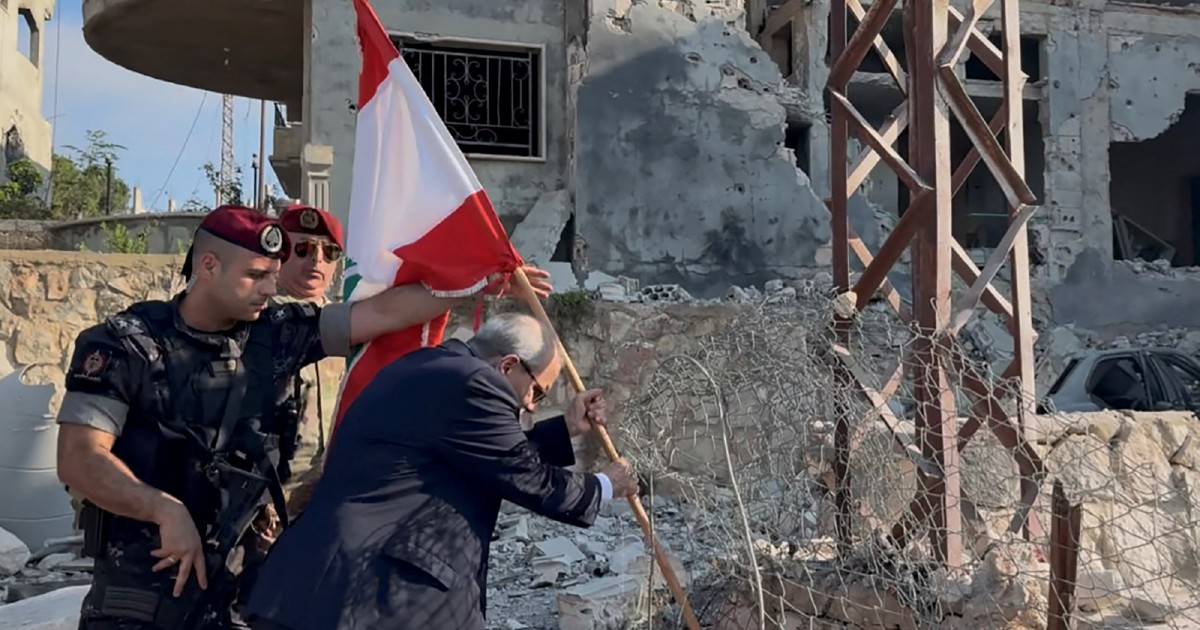
Lebanese Prime Minister Nawaf Salam has reiterated his government's determination to achieve what he describes as a "complete Israeli withdrawal" from territories under Israeli control, a statement made during a visit to Zawtar al-Gharbiyah, a village in southern Lebanon where national armed forces have recently established a military presence. The pronouncement underscores Beirut's negotiating posture as ceasefire discussions continue to shape the contours of Lebanon's security environment following months of intense cross-border conflict.
The timing of Salam's remarks is significant. His visit to the village where Lebanese army units have deployed reflects an attempt by the Beirut government to demonstrate tangible progress on security commitments. The repositioning of state military forces into areas previously contested or disputed represents a crucial symbolic and practical reassertion of Lebanese state sovereignty over its own territory. This deployment serves both as a confidence-building measure for international observers monitoring the ceasefire and as evidence to domestic constituencies that their government is actively working to recover lost ground.
For Malaysian readers and the broader Southeast Asian audience, Lebanon's territorial negotiations carry resonance beyond regional Middle Eastern politics. The conflict has exposed the fragility of small states navigating great-power competition and the importance of military deterrence. Malaysia, similarly situated in a region where larger powers exercise significant influence, can observe how smaller nations manage territorial disputes and maintain sovereignty through diplomatic channels. The Lebanese situation demonstrates that persistence in negotiations, even when asymmetries of power exist, remains essential to achieving political outcomes.
The concept of "complete withdrawal" carries different interpretations depending on the stakeholder. For Beirut, it presumably means the removal of all Israeli military personnel and assets from Lebanese sovereign territory, including border areas and zones that have been points of contention for decades. Historical disputes over maritime boundaries, the Shebaa Farms region, and various enclaves have long complicated Israeli-Lebanese relations. The current ceasefire framework appears to address these issues systematically, though the devil remains firmly in the details of implementation.
Salam's emphasis on securing full withdrawal reflects internal political calculations within Lebanon itself. Various constituencies, including parliamentary factions aligned with Hezbollah and other political movements, maintain strong views on what constitutes acceptable peace terms. By publicly committing to complete Israeli withdrawal, the Prime Minister signals to these domestic actors that the government has not compromised on fundamental sovereignty principles. This rhetorical positioning helps maintain the broad political consensus necessary to sustain a ceasefire agreement through its implementation phases.
The deployment of Lebanese army units into previously contested areas represents a practical implementation step. The presence of state military forces in Zawtar al-Gharbiyah and comparable locations serves multiple strategic purposes. It reasserts Lebanese government control over territory, displaces non-state armed actors from these areas, and provides international mediators with evidence that Beirut is fulfilling its obligations under the ceasefire accord. These deployments require significant coordination with international observers and verification mechanisms to ensure compliance from all parties.
Regional stability depends considerably on how these withdrawal negotiations proceed. For neighbouring countries including Syria, Jordan, and the broader Eastern Mediterranean region, a stable Lebanese-Israeli border reduces the risk of escalation and creates space for other regional initiatives. Maritime navigation, which affects trade flowing through the Eastern Mediterranean and connects to Southeast Asian supply chains through the Suez Canal, depends on relative stability in Lebanese waters. Prolonged territorial disputes could create security risks that complicate international commerce and shipping routes vital to Asian economies.
The international dimensions of Lebanon's territorial recovery cannot be overlooked. The United Nations, through its Interim Force in Lebanon (UNIFIL) and various diplomatic channels, monitors ceasefire implementation. The United States, France, and regional actors including Saudi Arabia and Iran all maintain stakes in how Lebanon's territorial and political settlement unfolds. For Malaysia and Southeast Asian nations, the lesson is that small states achieving security breakthroughs often depend on sustained international engagement and multilateral verification frameworks that can guarantee compliance.
Salam's statement also reflects the technical challenges inherent in implementing withdrawal agreements. Determining precise boundary lines, establishing timelines for phased withdrawals, managing buffer zones, and creating mechanisms for verifying troop movements all require meticulous coordination. The presence of the Lebanese army in villages like Zawtar al-Gharbiyah indicates that Beirut is attempting to sequence its state security forces into areas as Israeli forces depart, maintaining continuity of governmental control. This approach, if successful, prevents vacuums that could be filled by unstabilised non-state actors.
The ceasefire framework itself represents a significant diplomatic achievement after prolonged conflict. Lebanon's insistence on complete Israeli withdrawal forms a core component of what Beirut considers a successful outcome. However, successful implementation will require sustained political will from all parties, continued international pressure to honour commitments, and mechanisms to address the inevitable disputes that emerge during complex military withdrawals. For Southeast Asian observers, such processes demonstrate that even deeply rooted conflicts can move toward resolution when all parties accept the costs of continued confrontation outweigh potential benefits of negotiated settlement.
Looking forward, the test of Salam's commitment comes not in public statements but in sustained negotiations and implementation efforts. Lebanon faces enormous economic and humanitarian challenges that would worsen under renewed conflict. The government's ability to deliver on security commitments, coupled with international support for reconstruction and state-building, could create conditions for longer-term stability. Malaysia and regional neighbours watch these developments closely, understanding that successful conflict resolution in any part of Asia or the broader international system creates positive precedent for dispute management elsewhere.

