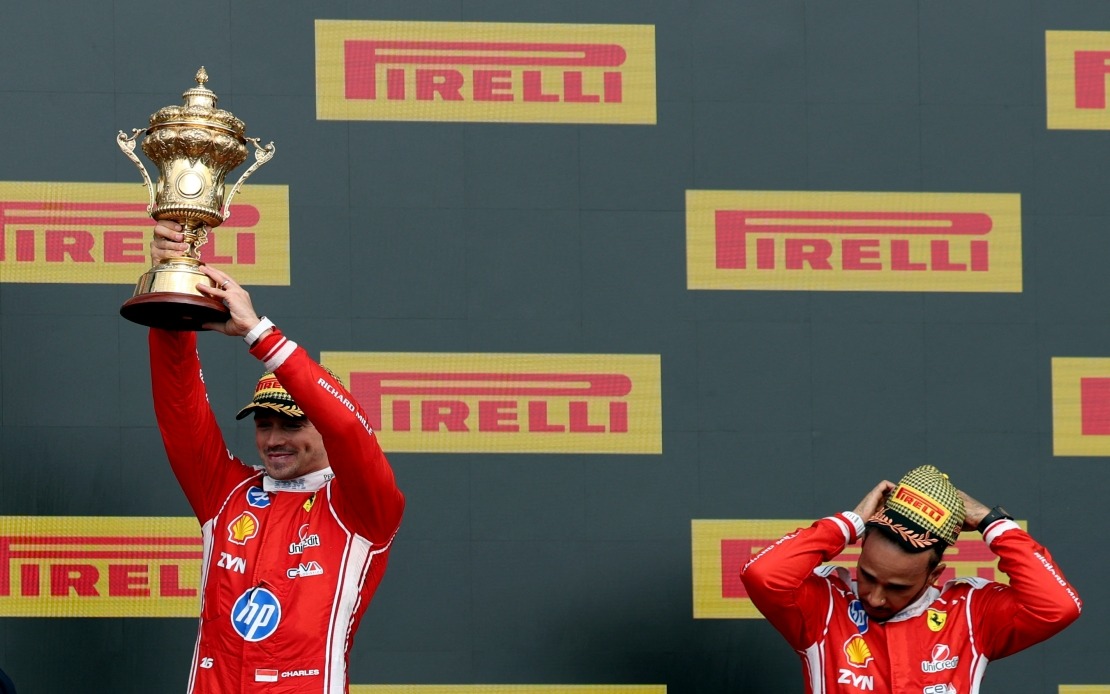
Charles Leclerc delivered a commanding performance to win the British Grand Prix at Silverstone on Sunday, capitalizing on a catastrophic mechanical failure that derailed championship leader Kimi Antonelli's bid to extend his commanding title advantage. The Ferrari driver's triumph marks a significant momentum shift in the 2024 season, coming just two rounds after Mercedes' Lewis Hamilton's victory in Spain and providing the Scuderia with fresh hope following a difficult spell. The race unfolded with dramatic turns that will reshape the championship battle heading into the summer break, with Antonelli's 66-point lead—built through five consecutive victories—now under serious threat.
Leclerc's victory was built on a spectacular start that immediately seized control of the race from pole-sitter Antonelli. The Ferrari driver executed a brilliant manoeuvre into the opening corner, simultaneously dispatching the Mercedes driver and establishing psychological dominance that would define much of the opening phase. Hamilton similarly profited from Antonelli's sluggish getaway, advancing to second position and briefly challenging for the lead before tire management concerns began to compromise his strategy. The sequence illustrated how the British Grand Prix can be decided in the opening moments, with Leclerc's superior launch control providing the foundation for what would become a hard-fought victory.
For much of the middle stages, Leclerc appeared to be cruising toward a commanding success, methodically extending his advantage over pursuing competitors while managing tire degradation with the precision expected of a championship-calibre driver. He built a buffer exceeding four seconds during the opening stint, controlling the pace and forcing the Mercedes team to react rather than dictate strategy. The pit-stop cycle initially favored Ferrari's approach, with Leclerc pitting on lap 25 while Mercedes kept Antonelli in the hunt by leaving the 19-year-old out for an additional ten laps. This gamble would have repercussions that neither team fully anticipated at the time.
Antonelli's strategy suddenly appeared vindicated as the younger driver emerged from his stop with considerably fresher soft tires and a manageable seven-second deficit. The Mercedes driver's raw pace advantage became evident almost immediately, with the superior straight-line speed of the silver arrows allowing him to mount a serious challenge just as fatigue began to compound Leclerc's difficulties. The championship leader began the crucial stages of the race with genuine momentum, cutting Leclerc's lead to under three seconds with eleven laps remaining and appearing poised to complete an unlikely recovery. The pendulum seemed to be swinging decidedly in Antonelli's favor as he hunted the Ferrari driver through the high-speed corners that define Silverstone's character.
The mechanical failure that shattered Antonelli's ambitions proved almost instantaneous and dramatically reversed the race's trajectory. Running aggressively over the curbing at Copse corner, Antonelli immediately radioed his team with a terse report that something had catastrophically broken. What commenced as suspected front-wing damage quickly evolved into a more sinister diagnosis: a broken front-left wheel shield had compromised the vehicle's structural integrity and aerodynamic balance. The damage forced an unscheduled second stop that decimated whatever remained of Antonelli's title bid, dropping him from contention and into a desperate battle simply to preserve championship points. Antonelli's subsequent struggles—running repeatedly beyond track limits as he fought an increasingly unwieldy machine—epitomized how swiftly fortune can desert a competitor in Formula One's unforgiving arena.
The race's conclusion added a layer of controversy that inflamed emotions at Silverstone and raised questions about decision-making under pressure. With four laps remaining, Max Verstappen's spin into the gravel at Stowe corner triggered a Safety Car that bunched the fractured field together, creating the tantalizing prospect of a climactic battle between fresh tires and experience. Ferrari made the tactical decision to pit the recovering Hamilton for soft rubber while Mercedes left Russell on track, a gamble predicated on the assumption that racing would resume properly. However, a software error in the FIA's communication systems broadcast an earlier message suggesting the race would restart normally, only for race control to reverse course and conclude the event behind the yellow flag. The race finished without the promised single-lap sprint to the finish, handing Russell second place ahead of Hamilton and robbing viewers of the sporting spectacle they anticipated.
Leclerc's emotional reaction to the victory provided insight into the psychological burden endured during Ferrari's recent struggles. The Monégasque driver spoke of particularly difficult weekends that had tested his confidence and his team's resolve, describing how recovering the precise feel in the car had required meticulous work and systematic problem-solving. His breakthrough moment, he indicated, arrived during the previous day's sprint qualifying session, when sudden clarity emerged from extensive data analysis and physical adjustments. The victory represented vindication not merely for one afternoon's driving but for collective organizational commitment to diagnosis and refinement during an extended rough patch. Such emotional candor from a championship-contending driver reflects the immense psychological investment required to compete at the sport's highest level.
Antonelli's assessment of his race revealed the cruel arbitrariness that sometimes determines Formula One outcomes. The Mercedes driver stressed that his contact with the curbing was neither exceptionally aggressive nor qualitatively different from his approach during previous laps, suggesting that mechanical failure rather than driving error had compromised his vehicle. His determination to continue despite persistent handling difficulties and repeated excursions beyond track limits demonstrated competitive spirit, yet also highlighted how severely structural damage undermines a driver's ability to manage a modern racing machine. The incident serves as a reminder that even championship leaders with overwhelming advantages remain vulnerable to the mechanical misfortune that has historically redistributed advantage in motorsport's fiercest arena.
The broader championship implications of Sunday's outcome cannot be overstated for understanding the season's trajectory. Antonelli's lead, while still substantial at approximately 66 points before Silverstone, faces erosion through patterns that increasingly favor Ferrari's resurgent form and Hamilton's continuing excellence within Mercedes' updated specification. The interval between championship leader and principal challengers compresses noticeably through such results, particularly when mechanical failures rather than pure driving performance determine races' conclusions. For Malaysian and Southeast Asian followers of Formula One, this shift portends competitive uncertainty that transforms every remaining round into a genuine contest, elevating the sport's narrative tension considerably. The summer break arrives with championship credentials now substantially redistributed from Antonelli's monopoly toward a more evenly balanced title race.
Ferrari's tactical and strategic evolution reflected throughout Silverstone competition underscores how the team has reorganized under pressure following their difficult period. The pit-wall communication, the vehicle setup refinements that Leclerc attributed to recent work, and the strategic gambles that ultimately favored the red cars collectively suggest an organization rising to meet contemporary challenges. Hamilton's continued speed within a vehicle that had previously struggled confirms Mercedes' own capacity to innovate and adapt, while Verstappen's relative invisibility during the closing laps hints at possible concerns with current Red Bull performance relative to earlier seasonal expectations. These shifting competitive balances will fascinate observers tracking technical development through the sport's mid-season phase and beyond.
The afternoon's events at Silverstone underscore why Formula One retains its grip on global sporting attention despite—or perhaps because of—its unpredictable nature. Championship leaders can encounter mechanical catastrophe, safety car deployments can transform outcomes dramatically, and established advantages can evaporate within laps rather than seasons. For drivers, teams, and supporters across the globe including Malaysia's growing motorsport enthusiast community, such outcomes remind us why commitment to excellence in preparation, strategy, and psychological resilience remains essential. Leclerc's victory, purchased with steady driving, strategic acumen, and ultimately good fortune when circumstances favored Ferrari, reflects the multifaceted excellence required to prevail in contemporary motor racing's supreme competition.

