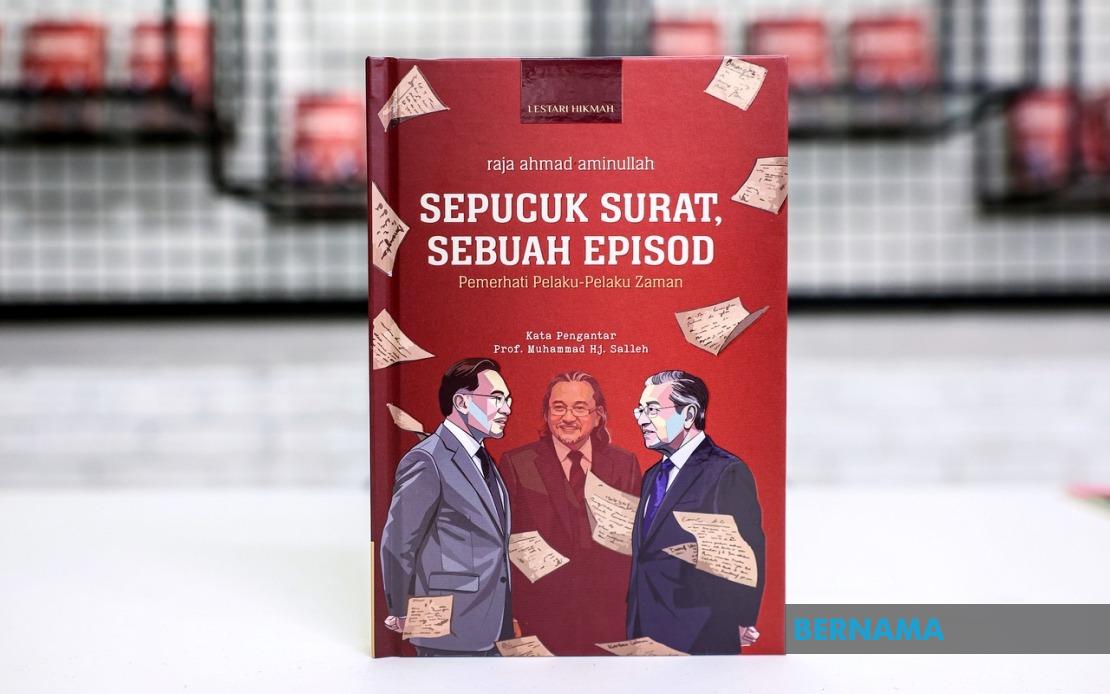
A new book launched in Kuala Lumpur this week offers something increasingly rare in Malaysia's literary landscape: a deeply personal archive of correspondence between a celebrated cultural observer and the country's most consequential figures. "Sepucuk Surat Sebuah Episod: Rakaman Pelaku-Pelaku Zaman," published by Lestari Hikmah and presented by the National Book Council of Malaysia, represents Raja Ahmad Aminullah's attempt to preserve not political rhetoric or grand narratives, but the intimate human exchanges that accompanied Malaysia's most turbulent and transformative decades.
Raja Ahmad Aminullah, widely known within cultural and intellectual circles as Pak Engku, has deliberately positioned this 169-page volume outside conventional political discourse. During the book launch, he emphasised that his primary concern lies with documenting the socio-cultural landscape of his era rather than advancing any particular political viewpoint or agenda. This distinction proves crucial for understanding the work's intended contribution to Malaysian letters and historical memory. Rather than seeking to vindicate or criticise political actors, Raja Ahmad frames his collection as a mirror reflecting broader societal patterns, community dynamics, and the interconnected nature of Malaysia's nation-building process across multiple domains beyond pure politics.
The correspondence captures exchanges spanning approximately 25 years, a period that encompasses some of Malaysia's most consequential political transitions and social transformations. By restricting himself to the role of observer and recorder, Raja Ahmad sidesteps the polarisation that typically surrounds books dealing with recent Malaysian political history. His approach invites readers to consider how prominent national figures thought, communicated, and related to one another in their private exchanges, removed from the public performance and strategic positioning that characterises formal political narratives.
When asked about the book's scope, Raja Ahmad deliberately avoided naming specific individuals as central subjects, despite the obvious historical interest in correspondence involving figures such as Tun Dr Mahathir Mohamad and Datuk Seri Anwar Ibrahim. Instead, he reframed the entire collection as a historical snapshot—a documentary record of a particular moment in time that allows readers to extract their own lessons and draw their own conclusions about the character, relationships, and values of the people who shaped Malaysia's institutional and cultural development. This methodological restraint reflects a mature understanding of how personal documents function as historical sources.
For Malaysian readers and regional observers alike, the book's value extends beyond mere curiosity about prominent figures. It addresses a significant gap in how Southeast Asia documents its recent past. While Malaysia has produced numerous political memoirs and official histories, fewer works examine the informal networks, personal relationships, and individual perspectives that operate beneath formal structures. Archives of personal correspondence provide crucial texture to historical understanding, revealing how decisions were contemplated, how relationships evolved, and what preoccupations occupied the minds of influential people during critical periods.
Raja Ahmad positioned the work as an instrument for future reflection rather than immediate judgment. By preserving these exchanges now, he creates a resource that younger generations and scholars can examine with greater historical distance and analytical clarity than their contemporaries might achieve. This approach respects the complexity of recent Malaysian history while recognising that understanding requires both sufficient time and sufficient primary material. Personal letters occupy a unique space in historical evidence, capturing spontaneity and candour that official records rarely contain.
The book's publication through commercial channels—available at RM30 for softcover and RM80 for hardcover editions through bookstores and online platforms—ensures it reaches beyond academic specialists to engaged general readers interested in Malaysia's recent past. This accessibility matters considerably in a media environment often dominated by political commentary and rapid-response analysis. A carefully curated collection of personal correspondence invites slower, more contemplative engagement with historical material.
From a Southeast Asian perspective, Raja Ahmad's work contributes to a broader regional conversation about how nations document their development and preserve their institutional memory. Malaysia's particular historical experience—marked by multiple communal groups, rapid modernisation, and significant political changes—creates particular challenges for historical documentation. Personal sources offer ways of understanding how individuals navigated these complexities at the ground level, beyond the abstractions of policy and ideology.
The National Book Council of Malaysia's role in launching the work signals institutional recognition that such documentation serves legitimate cultural and historical functions. By presenting the book through formal channels rather than as a private or underground publication, the council affirmed that Malaysia's institutional structures can accommodate reflection on recent political and social history when approached with sufficient intellectual maturity and without overt polemical intent.
Raja Ahmad's insistence that he himself remains "inconsequential" to the book's narrative invites readers to focus on the material and the broader historical forces at play rather than on the author's own ego or perspective. This rhetorical move, whether entirely sincere or strategically deployed, suggests an understanding that the most valuable historical documents subordinate the observer to the observed, allowing readers space to develop their own interpretations. In emphasising that readers should benefit from lessons the material contains, he encourages active engagement rather than passive reception of historical judgement.
For those researching Malaysian literature, social history, and the informal institutions that accompany formal political structures, this collection fills a documented gap. The work serves simultaneously as cultural document, historical record, and meditation on how societies preserve memory across generations. By presenting 25 years of correspondence without heavy editorial intervention or elaborate contextualisation, Raja Ahmad trusts his readers to understand the significance of what the letters reveal about character, relationships, and the human dimensions of nation-building.

